
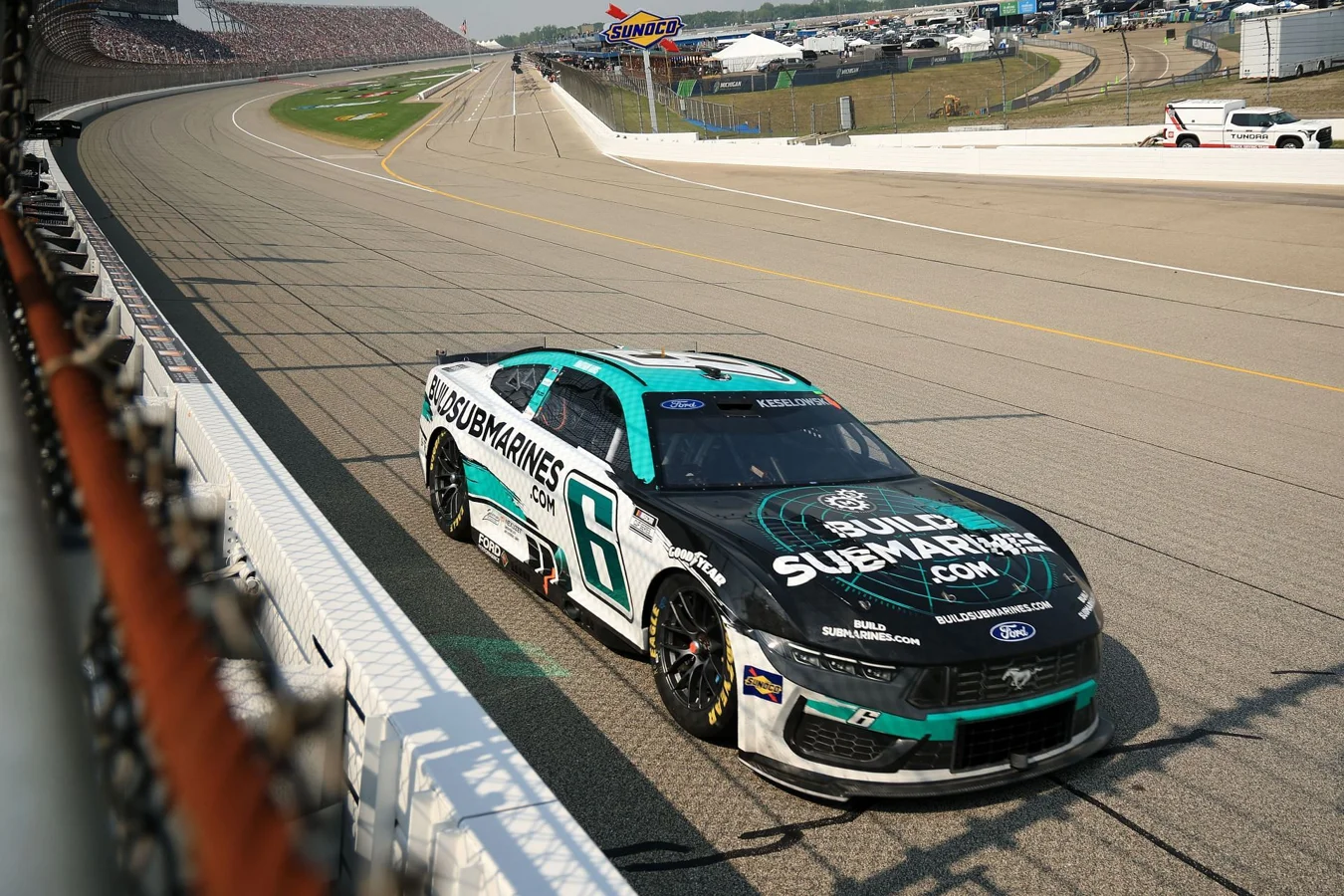
Brad Keselowski’s penalty for speeding on pit road during the FireKeepers Casino 400 at Michigan on June 7 fueled a heated debate over NASCAR’s pit road speed enforcement. The RFK Racing driver and co-owner questioned the accuracy of NASCAR’s timing loops, claiming a discrepancy between his team’s telemetry and the official measurements, igniting widespread discussion on fairness and technical precision in the sport.
Starting 27th, Keselowski had a strong showing, moving into the top 10 by race end despite setbacks caused by early pit strategies and the speeding penalty. The controversy intensified as Keselowski and fellow driver Todd Gilliland both received penalties in the same problematic section of pit road, raising questions about NASCAR’s system and potential bias at the Michigan track, historically a significant venue for Ford teams.
Discrepancies in Pit Road Speed Measurement Lead to Keselowski’s Penalty Debate
Keselowski openly expressed confusion regarding the speeding penalty, citing in-car telemetry data that showed his car traveling at 59.4 mph while NASCAR’s timing loops registered 60.9 mph, exceeding the 55 mph pit road limit plus a tolerance buffer. This 1.5 mph discrepancy caused frustration, particularly as Keselowski believed his car was one of the fastest on the track that day.
He said,
“Still not sure how we got speeding penalty from Sunday. Our incar telemetry shows 59.4mph where NASCAR’s system showed 60.9mph.”
This raised suspicions among fans and the NASCAR community alike, suggesting potential flaws in NASCAR’s timing methods or even targeted enforcement toward Ford teams at Michigan.
The penalty ultimately cost Keselowski stage position and track placement, dropping him to 24th before he managed to recover to a 10th-place finish. Meanwhile, teammate Chris Buescher secured a second-place finish, one of the few bright spots for RFK Racing in a season where Keselowski sits 32nd in points and has experienced multiple race DNFs.
Keselowski reflected on the situation with visible disappointment:
“We had a top-two or top-three car, I felt I was way slow, so getting called fast didn’t add up.”
Other drivers who were penalized concurrently also expressed disbelief, with Gilliland stating on social media,
“I got one right in front of you, by a lot… didn’t even think I was close.”
These comments fueled a theory among fans that NASCAR’s enforcement was inconsistent or biased.
Technical Analysis of NASCAR’s Pit Road Speed Enforcement Challenges
Landon Cassill, former NASCAR driver turned analyst, directly addressed the controversy, providing a detailed explanation that challenged Keselowski’s defense based on his team’s telemetry data. Cassill pointed out the difficult nature of accurately judging speed on pit road’s final section at Michigan, which contributed to Keselowski’s penalty.
Cassill outlined the specifics: NASCAR measures section 18 of pit road at 76 feet and calculates speed through timing loops embedded in the pavement. To comply with the 59.99 mph speed limit (which includes a 4.99 mph buffer above the 55 mph base limit), drivers must cover this segment in no less than 0.86364 seconds.
He noted, however, that the actual physical length of this section is 75.8 feet, slightly shorter than NASCAR’s measured distance. Because of this minor discrepancy, drivers timed at the speed limit could paradoxically incur speeding penalties—the system assumes the longer length, so the calculated speed is higher than actual, requiring drivers to reduce to about 59.84 mph to avoid penalties.
Addressing Keselowski’s claim about GPS telemetry, Cassill declared,
“Brad’s GPS data says something different, but the GPS data isn’t reliable to the level of accuracy needed.”
He highlighted additional nuances, noting sections 16 and 17 are slightly longer than NASCAR’s numbers, allowing drivers to exceed 61 mph without penalty in those parts. Cassill estimated Keselowski’s speed entering section 18 was approximately 60.5 mph, exceeding the limit by 0.65 mph and aligning with NASCAR’s official 60.97 mph reading.
On Twitter, Cassill explained:
The final section of pit road at Michigan is a tricky one, which likely led to Brad’s speeding penalty. I’ll explain:NASCAR measures section 18 at 76.00 feet. Because NASCAR calculates pit road speed by time between sections, drivers are allowed to travel through section 18 no… https://t.co/z0w1YhwT87
— landon cassill
Cassill’s thorough breakdown made a strong case that the timing system’s precision and calculations are accurate within the constraints of the physical layout, undermining the argument that Keselowski’s telemetry data alone could exonerate him.
Fan Reactions and Wider Penalty Controversy Impacting RFK Racing
Following the detailed analysis, public opinion split, with some praising Cassill’s explanation as a “masterclass in shutting down excuses,” while others remained skeptical of NASCAR’s pit road speed enforcement consistency. The fact that multiple drivers, including Gilliland, were penalized in the same section reinforced the idea that the system might catch drivers out due to pit road quirks rather than intentional bias.
The Michigan race saw a total of 22 pit road penalties, including those against prominent drivers Chase Elliott and Kyle Larson, intensifying the scrutiny on NASCAR’s regulations. Fans of RFK Racing became increasingly frustrated, especially considering previous penalties the team endured, such as heavy fines and point deductions in 2022 for technical infractions and recent playoff disqualifications.
Keselowski’s history with NASCAR’s regulatory landscape includes a noted willingness to challenge enforcement decisions and interpret rules aggressively. He has likened navigating NASCAR’s rulebook to dealing with “the IRS tax code” due to its complexity, indicating ongoing tensions between his team and NASCAR officials.
Despite the controversy, Cassill’s analysis refocused the narrative toward driver responsibility in managing pit road speed precisely, suggesting Keselowski’s team miscalculated rather than being unfairly targeted by NASCAR’s enforcement system.
RFK Racing’s Future Hinges on Potential Charter Expansion Amid Legal Uncertainty
Parallel to the Michigan penalty saga, RFK Racing is monitoring a crucial legal development involving charters in NASCAR. The U.S. Court of Appeals recently ruled to revoke charters from teams 23XI Racing and Front Row Motorsports (FRM), both of which had purchased charters originally held by Stewart-Haas Racing. If upheld, this decision mandates that these teams relinquish their charters, casting uncertainty on NASCAR’s charter landscape throughout the remainder of the 2025 season.
Industry insiders expect that NASCAR may put these charters up for sale, with estimated values around $45 million each. This would deal a significant financial hit to 23XI and FRM by stripping away the competitive and financial benefits associated with charter ownership. Keselowski, both a driver and co-owner, is paying close attention to these developments and remains interested in possibly acquiring one or more charters to expand his team‘s presence.
He shared his hopes for resolution:
I just wish the whole thing would find a peaceful resolution and the sport could kind of move on,
and added,
I think there’d be a long list of suitors…but you know RFK has a lease agreement currently with Rick Ware Racing…certainly we’re keeping our eyes open.
While RFK Racing remains focused on upcoming races like the Mexico City weekend, where none of their cars have yet qualified for the playoffs, the potential to secure additional charters represents a strategic opportunity for growth amid a turbulent competitive season.
Ultimately, the Brad Keselowski Michigan pit road penalty controversy underscores the delicate balance between enforcing safety regulations and maintaining trust among teams and drivers. Precise technical measurement issues at Michigan revealed inherent challenges in NASCAR’s timing systems, while intense scrutiny from former drivers and analysis keeps discussions alive around fairness, responsibility, and the future competitiveness of RFK Racing within the sport.
