
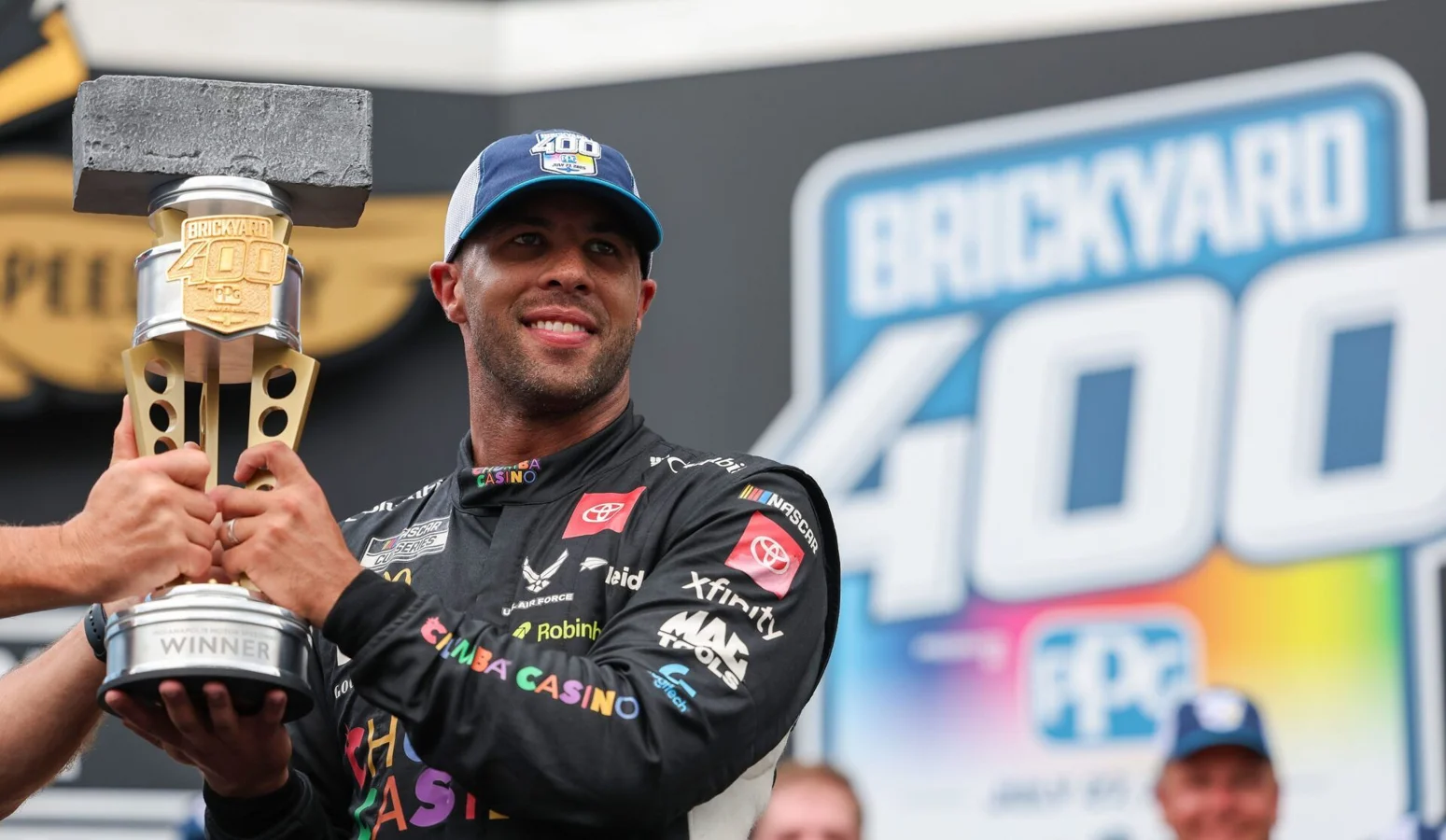
Bubba Wallace NASCAR driver identity came into sharp focus with his historic victory at the Indianapolis Motor Speedway’s Brickyard 400 in 2024, where he became the first Black driver to claim that title. Despite the media attention on his race, Wallace places primary importance on his role as a professional racecar driver, emphasizing his performance and dedication over identity labels.
Wallace’s Historic Achievements and Career Context
Bubba Wallace’s win at the Brickyard 400 marked a significant milestone, making him one of only two Black drivers, alongside Wendell Scott, to win a NASCAR national series race at the Cup Series level. Before Rajah Caruth’s Truck Series win at Las Vegas in 2024, the two were the sole Black drivers to hold this distinction. While many highlight these racial firsts, Wallace himself does not seek to define his career by them.
Instead, he confronts the spotlight with a focus on racing excellence over identity.
“You know, for me, I’ve always said from the beginning is I show up as a racecar driver first and let everything else settle in after that,”
Wallace told the media at Iowa Speedway. He reflected on his recent win with relief and pride, saying,
“So, for me crossing that start-finish line, the first thing I thought about, finally, no more ‘days since Bubba Wallace’s last win.’ No more being on the cutline last race going into Daytona. Like, we’re in the playoffs, you know, we’ve done it, we’ve won. After I’ve told myself so many times, or I’ve questioned myself, ‘Can I do this again?’ All that was gone in that moment.”
The Emphasis on Racing Over Identity
Wallace’s approach highlights how the narrative surrounding him often originates in the media rather than from his own statements. He embraces his biracial heritage but stresses that his foremost identity is that of a racer.
“I didn’t realize the African-American side until hours later, and it’s still incredible,”
Wallace said.
“I think what gets lost in translation, though. And a lot of people get offended and try to downplay it, and I get it. I am biracial, and I love both sides of who I am. So, at the end of the day, I am a racecar driver and enjoy where I’m at in life and who I am as a person.”
He addressed the media’s tendency to focus on his racial identity in headlines but clarified his own stance:
“That’s not, I never lead off with ‘I’m the Black driver.’ No disrespect to you guys [in the media], but a lot of the headlines you start off with that. That’s what I was saying. Like, yes guys, I know it’s out there every time I do something. Just embrace it, like you have to enjoy it. Of course, people flip it and say like, ‘All he cares about is being Black.’ And that’s not what I was saying. That’s neither here nor there. I love my Black side, love my white side. Love that I’m competitive, and I’m able to showcase that at the highest level in NASCAR.”
Wallace’s Place Within NASCAR and the Broader Sport
Within the NASCAR Cup Series, Wallace is one of 36 full-time drivers competing at the highest level of stock car racing in the United States. His Brickyard 400 victory is a landmark in the sport’s history and will remain a defining achievement in his career. Prior to this win, he had endured a 100-race drought, spanning nearly three years without a victory, which added significant emotional weight to the accomplishment.
His win not only ended that dry spell but also secured a spot in the NASCAR playoffs, underscoring his stature as a serious contender. For Wallace, the celebration prioritizes personal and professional satisfaction over external narratives.
“It had been 100 races, almost three calendar years, since his last win. So, that other stuff was secondary. Last Sunday, all that mattered was that he won,”
reflecting the intensity with which he views his racing career beyond identity labels.
Why Wallace’s Perspective Resonates with Fans and Media Alike
Bubba Wallace’s openness about his identity and competitive drive contributes to his popularity among fans and the media. He balances a raw and honest reflection about the pressures of being recognized not just as a skilled driver but as a symbol within a historically white-dominated sport. His perspective challenges simplistic narratives and invites a more nuanced understanding of his role.
By emphasizing racing first, Wallace encourages recognition based on merit and performance while acknowledging the significance of his identity. This duality speaks to the evolving conversation about diversity in motorsports and beyond, showing that athletes can be both representatives of broader social identities and individuals focused on excellence in their craft.
