
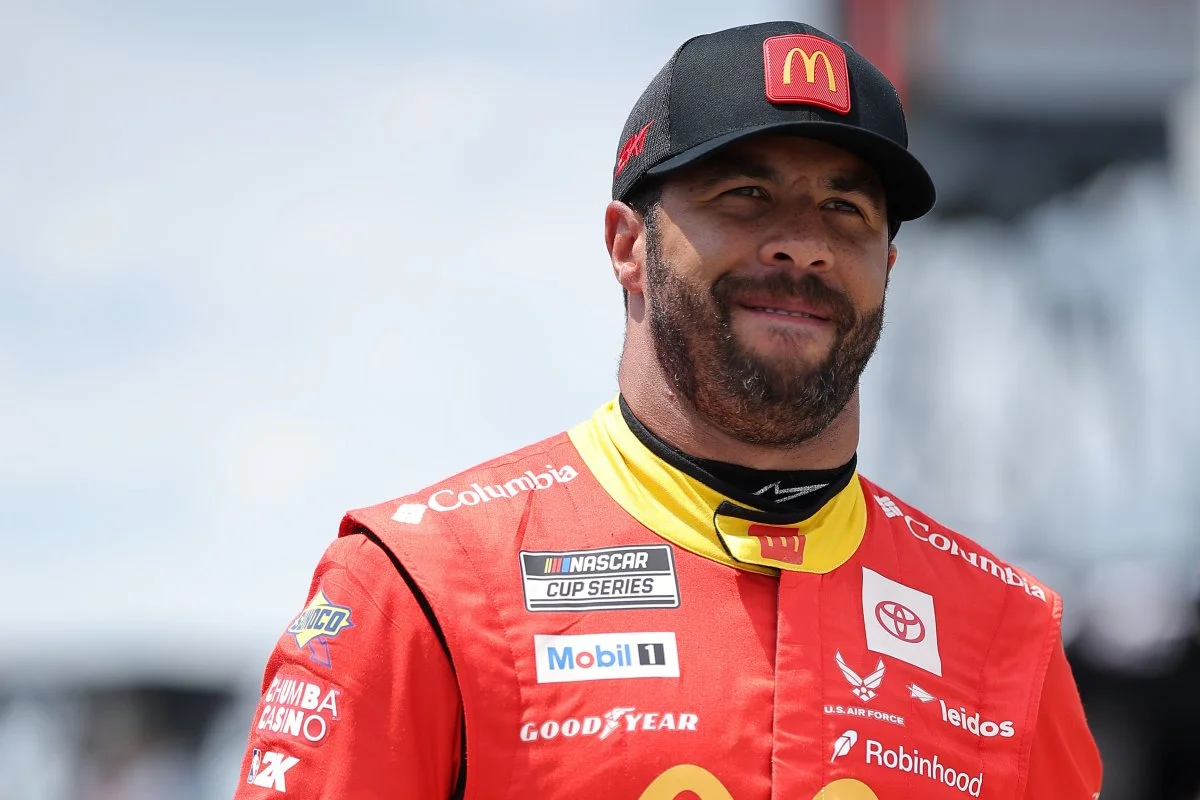
Bubba Wallace has expressed strong concerns regarding the safety and positioning of spotters at certain NASCAR road courses, highlighting visibility problems that jeopardize driver safety. Speaking after the recent race in Mexico City, Wallace criticized the current spotter setups as insufficient and called for immediate improvements to ensure proper communication and track awareness.
Unlike oval tracks where spotters benefit from clear and elevated vantage points, road courses present a unique challenge due to their multiple turns and limited sight lines. These conditions create blind spots requiring additional spotters to maintain safety, but many venues have yet to adopt these measures.
Wallace Criticizes Spotter Positions Following Mexico City Race
Wallace addressed these issues on June 27, emphasizing the dangers posed by poor spotter placements, particularly around turn one at the recent Mexico City event. He condemned the practice of positioning spotters behind obstructive objects, such as trees and banners, which severely limits their ability to monitor the track.
“Spotters into a turn one in Mexico, do you know where they were standing? You can’t see anything. So if we want to talk about safety and all this stuff, either say we’re not racing with spotters or get them in a position and make sure the area is safe for them to operate in to give us the safety and the protocols that we need.”[5:52 onwards]
—Bubba Wallace
“Sticking them behind trees or behind banners or whatever is at this point where we’re at in the year is completely unacceptable,” he added.
—Bubba Wallace
Wallace’s comments underscore the gap between safety expectations and the reality at complex road courses, where spotters’ limited visibility directly affects a driver’s ability to respond to on-track incidents.
Racing Performance and Upcoming Challenges
At the Echopark Speedway, Wallace qualified 24th for the Quaker State 400, marking a start to the NASCAR In-Season Challenge. His teammate Tyler Reddick qualified just ahead, and Wallace will be competing against Trackhouse Racing’s Daniel Suarez, who secured the 31st starting position. The crucial 260-lap race is scheduled to air on TNT Sports at 7 PM ET.
Previous Visibility Issues Highlighted by Spotter Freddie Kraft
Concerns over spotter visibility at road courses have been ongoing. Earlier in June 2024, Freddie Kraft, Wallace’s spotter, publicly admitted shortcomings during the Enjoy Illinois 300 at Gateway. On the ‘Door Bumper Clear’ podcast, Kraft explained the difficulty spotting cars in certain turns where his view was blocked or limited.
“In turn one is you lose kind of sight of your car…..and you can’t see the runs coming because they’re driving straight away from you. And you can’t see who’s got momentum and you can’t see who’s kind of getting ready to peak out,” he said. [15:28 onwards]
—Freddie Kraft
This lack of visibility complicated communication between Kraft and Wallace but fortunately did not result in a crash. Wallace finished 21st after starting eighth, emphasizing how critical clear spotter views are to race performance and safety.
Kraft has also highlighted other venues with similar challenges, such as North Wilkesboro Speedway, where parked cars and infield obstructions create blind spots. NASCAR will face comparable difficulties at the upcoming Chicago street course and Sonoma Raceway. Teams are expected to deploy multiple spotters at these events to cope with limited sight lines and improve track coverage.
Implications for NASCAR Spotter Protocols and Driver Safety
Wallace’s demands bring attention to a vital yet often overlooked aspect of race safety: the spotter’s role and their ability to maintain clear views of critical track areas. As NASCAR continues to expand its use of road courses and street circuits, solving spotter visibility problems is paramount to protecting drivers and ensuring the integrity of race communications.
Addressing these concerns may lead NASCAR to revise spotter protocols, incorporating better positioning or additional spotter personnel to cover blind sections. Failure to improve these safety measures could increase risks for drivers during complex races, especially in tight turns where rapid decisions depend heavily on spotter input.
