
Since joining Williams for the 2025 F1 season, Carlos Sainz has experienced a series of inconsistent performances that have raised concerns about his adaptation to the new team. His start to the season was unexpectedly poor, but he briefly regained form before once again encountering difficulties on track. These ups and downs have prompted closer scrutiny of his results and race data to understand the factors behind his challenges.
While many expected Sainz to add stability and consistently maximize the car’s potential, the reality has reflected a more uneven trajectory. After a tough beginning, he managed to deliver points finishes regularly for a while, suggesting progress. However, setbacks such as a disappointing race in Barcelona, a mediocre outing in Canada, and a mechanical failure before the start of the Austrian Grand Prix have interrupted his momentum.
Comparing Sainz and Albon’s Head-to-Head at Williams
Analyzing the competitive dynamics within Williams this season reveals that Alex Albon has held a decisive edge over Sainz. After multiple qualifying sessions and races, the points tally underscores this gap: Albon has accumulated 42 points compared to Sainz’s 13. This significant difference suggests deeper performance issues beyond mere luck or circumstance.
Williams’ FW47 car itself is a major limiting factor, favoring circuits with heavy braking zones, tight corners, and long straights while struggling on tracks with fast, flowing corners. For example, Williams scored well at Miami and Imola, where these conditions exist, but failed to score points at Barcelona and Bahrain, which demand superior handling in high-speed bends. Both Sainz and Albon retired in Austria due to mechanical troubles, highlighting reliability struggles that have affected the entire team.
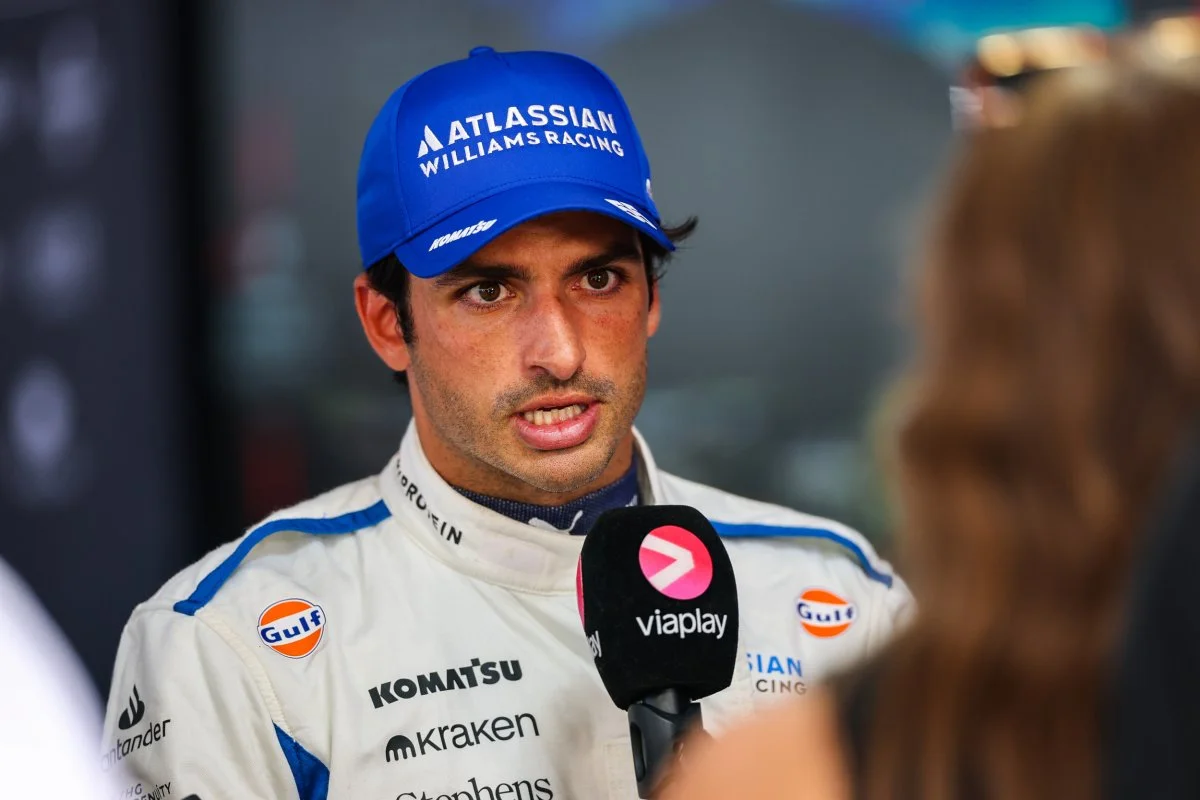
Early data from free practice sessions at Silverstone indicates that point-scoring opportunities this weekend look slim for Williams and Sainz, reflecting ongoing challenges for the driver-car combination.
Where Sainz is Losing Ground to Albon on Track
Telemetry analysis especially exposes where Sainz falls behind his teammate. The most pronounced time losses occur in high-speed corners such as Copse and the fast sector from Turn 10 through Turn 13 at Silverstone. At Copse corner, Sainz’s apex speed is noticeably slower, partly because he brakes slightly at the apex while Albon maintains full throttle through the same section.
This disparity contributes approximately three-tenths of a second lost in these segments. Additional mistakes at Turn 4 and the final chicane (Turns 16 and 17) add to the time difference, resulting in Sainz lagging around 0.319 seconds behind Albon in overall lap times. Such areas where technique and confidence are critical reveal that Sainz is still adapting to the FW47’s handling limits.
Albon’s greater familiarity with this type of car clearly benefits him on circuits that do not perfectly match Williams’ strengths. Sainz’s telemetry also showed an incident where he lost control exiting a fast corner in FP2, nearly colliding with Lewis Hamilton, which further underscores the adjustment challenges he faces.
Race Pace and Tactical Insights from Practice Sessions
Although qualifying data paints a challenging picture, Sainz’s race pace offers a slightly more positive outlook. In FP2, he completed a long stint on soft tires, running alongside other competitors like Hadjar and Hamilton. While fuel loads and specific team strategies make direct comparisons difficult, Sainz’s lap times were competitive relative to Hadjar’s Racing Bulls car and reasonable compared to Albon’s times on medium tires.
Nonetheless, these results should be interpreted cautiously, as varying fuel levels and unknown race strategies limit the conclusions that can be drawn. Moreover, soft tire usage might not significantly influence Sunday’s race, barring unforeseen events such as a safety car deployment.
Overall, it remains clear that Sainz’s full adjustment to the Williams car is an ongoing process, even this far into the season—a surprising yet crucial aspect for his performance going forward.
Team Dynamics and Future Prospects for Williams and Sainz
The difficulties faced by Sainz are not isolated; Williams as a team has been struggling organizationally and competitively, with both Sainz and Albon retiring from three races each so far this year, hampering their championship aspirations. Despite the challenges, there is undeniable progress compared to last season’s results, suggesting that endurance and further development may yield better outcomes.
As is evident from Lewis Hamilton’s experience adjusting to new cars with different traits, settling into a fresh team and vehicle can require considerable time and patience. For Carlos Sainz and Williams, the current phase seems to be one of cautious rebuilding and adaptation to unlock more consistent performances and capitalize on the FW47’s strengths where possible.
“On race pace, things look slightly better for Sainz.” —Anonymous
Our Reader’s Queries
Q. Why does Carlos Sainz have 55?
A. Over the years, the number 55 has become closely linked with the Spanish racer, important to who he is both on and off the track. Sainz selected this number because of a smart personal link: Carlo5 5ainz.
