
Lewis Hamilton has faced a difficult start to his career at Ferrari during the 2025 Formula 1 season, struggling to adapt to the unique characteristics of the team‘s new car while his teammate Charles Leclerc continues to outperform him. After a highly anticipated move from Mercedes, the seven-time world champion managed a pole position and victory in the China sprint, but he has yet to finish higher than fifth in a Grand Prix. Meanwhile, Leclerc has steadily extracted maximum performance from the SF-25, highlighting a clear gap between the two drivers.
Technical experts Mark Hughes and Giorgio Piola offered an in-depth analysis of the reasons behind Hamilton’s challenges and Leclerc’s success, revealing how the two drivers approach the car’s behavior differently. According to their report on F1.com, Hamilton’s major difficulty lies in dealing with the car’s braking dynamics and corner entry, where Ferrari’s 2025 design demands a distinct technique that Leclerc seems to have mastered.
Leclerc, who has adapted his driving style effectively, benefits from Ferrari’s distinctive power unit and its underperforming SF-25 chassis by maximizing engine braking. This approach allows him to handle the car’s tendencies more efficiently, particularly when negotiating sharp corners where the car’s behavior feels “pointy” and more challenging to control. The Monegasque driver emphasized how adjusting to these changes was crucial in securing Ferrari’s first podium of the season in Saudi Arabia.
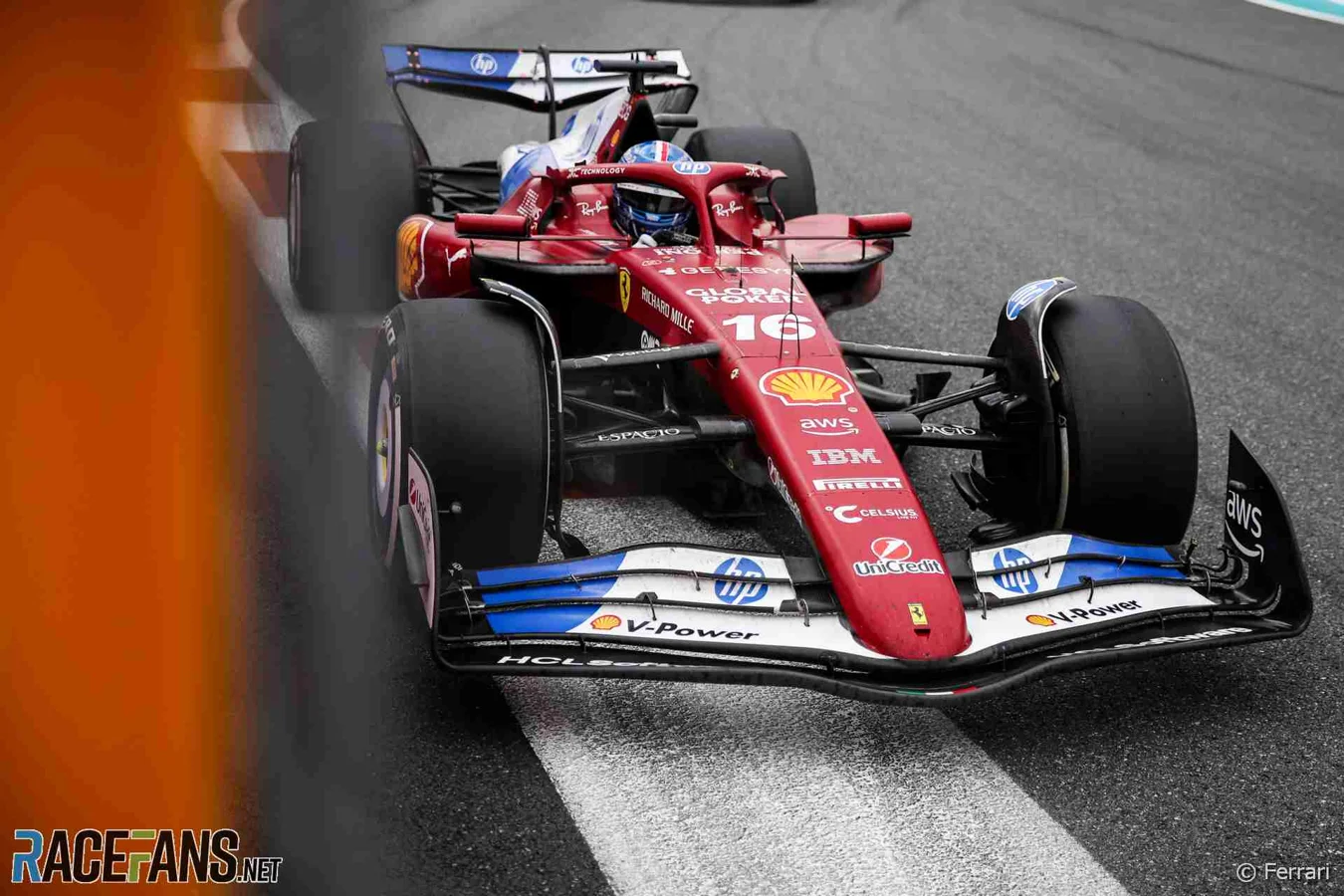
Leclerc explained in Jeddah. “And that’s quite tricky to drive, especially when you are on the limit in qualifying. But it’s something that I like, that I’ve always liked in my career.
Hughes and Piola’s technical breakdown notes that Leclerc effectively uses engine braking to provide additional deceleration on the rear wheels through the axle. This mechanism helps him rotate the car earlier into corners by overlapping braking and cornering phases, creating a mild ‘handbrake’ effect that improves his cornering speed and stability.
The report contrasts this with Hamilton’s experience, who is accustomed to the Mercedes power unit’s much lighter engine braking. Hamilton’s difficulty in anticipating and managing this increased rear-wheel braking has undermined his confidence, affecting how much speed he can carry into turns and consequently his overall lap times.
An illustrative example comes from their qualifying laps at the Jeddah Turn 13 hairpin. Hamilton brakes slightly later but remains on the brakes 12 metres longer than Leclerc, costing him precious time. Leclerc downshifts to fifth gear earlier and achieves higher mid-corner speeds, registering 168 kilometers per hour compared to Hamilton’s 155. The Monegasque’s earlier rotation allows him to apply throttle sooner and more aggressively, gaining an additional advantage worth 0.053 seconds in that corner alone.
The cumulative effect of these differences means Hamilton lost 0.168 seconds just through this section of track, highlighting the significance of familiarity and confidence with the car’s behavior. Hamilton’s struggles to find that rhythm under Ferrari’s unique setup remain evident, despite his high-level skills and past successes.
Ferrari is actively developing improvements to the SF-25, with particular focus on the rear suspension to enhance drivability and performance. These upgrades, however, are unlikely to be introduced until later in the season, meaning Hamilton must continue his adaptation process with the current machinery in the meantime.
As the season progresses, the ongoing battle between Leclerc and Hamilton offers a vivid illustration of how technical nuances and driving style compatibility can shape success in Formula 1. Leclerc’s ability to adapt quickly and leverage Ferrari’s distinctive power unit dynamics reinforces his status as a leading force in the team, while Hamilton’s learning curve with the SF-25 represents a significant challenge for one of the sport’s greatest champions.
The outcome of this internal rivalry could have wide-reaching implications for Ferrari’s ambitions in 2025, as the team seeks to maximize points and achieve consistent podium finishes. How Hamilton evolves his technique and copes with the car’s demands will be closely watched by fans and analysts alike, as the familiar question of experience versus adaptation continues to unfold on the world’s most demanding racing stages.
