
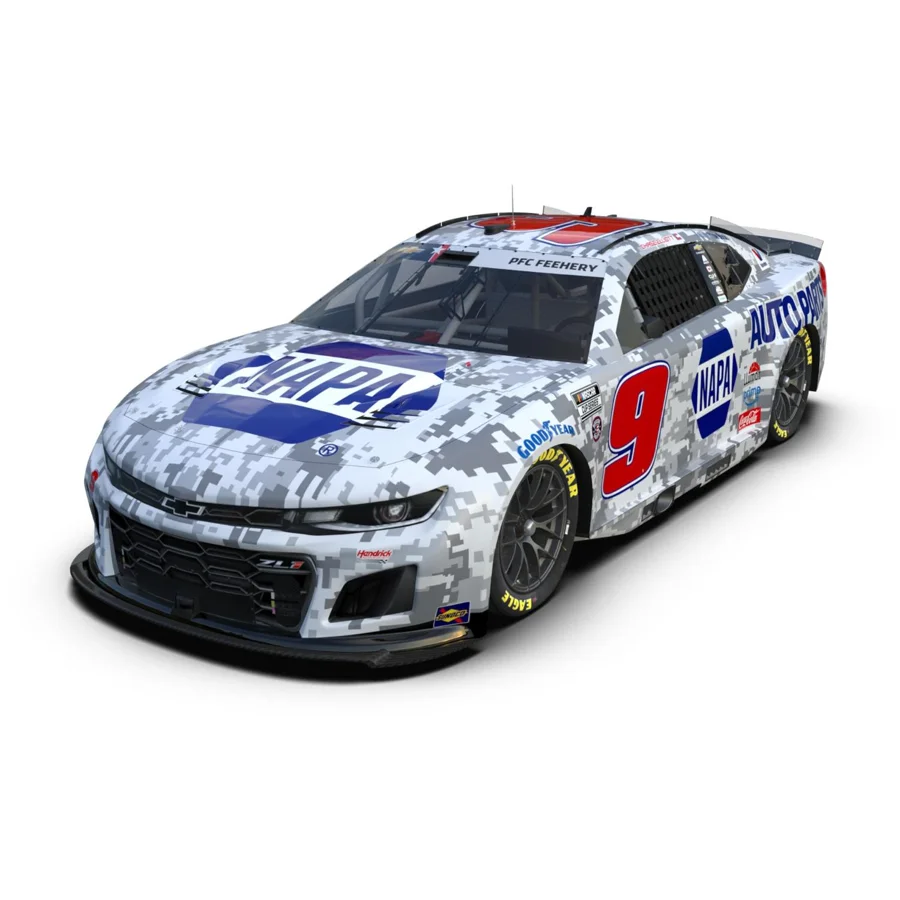
Chase Elliott, widely recognized as one of NASCAR’s top drivers and a seven-time winner of the sport’s most popular driver title, is experiencing a significant shift in his merchandise sales rankings for the 2025 season. NASCAR’s recently released data reveals that Elliott has dropped to third place in merchandise sales, with his teammate Kyle Larson advancing to second place. This unexpected change signals a potential decline in Elliott’s dominance within the sport’s commercial appeal.
The official rankings list NASCAR itself at number one for overall merchandise sales, while Elliott, who led last year, has been overtaken by Larson. Elliott’s slide in popularity contrasts sharply with Larson’s rising profile, which has grown steadily in recent years.
Kyle Larson’s Growing Popularity and Recent Achievements
Kyle Larson, 32, has gained increasing recognition in NASCAR and beyond, drawing comparisons to top figures in other motorsports such as F1’s Max Verstappen. His two forays into the prestigious Indy 500 have further increased his visibility among fans and media. Meanwhile, Elliott has not produced comparable buzz or high-profile moments recently, which may explain the shift in merchandise sales.
Following Elliott and Larson in the sales rankings are well-known drivers Kyle Busch in fourth place and Ross Chastain in fifth. The list also features Joey Logano, the Earnhardts, and Denny Hamlin, among others. According to Sports Business Journal, NASCAR merchandise sales during this year’s Coca Cola 600 event reached levels not seen since 2010, suggesting a resurgence in the sport’s overall popularity.
Social Media Presence Shows Elliott’s Continued Online Strength
Despite the merchandise sales setback, Chase Elliott maintains a strong lead over Kyle Larson in terms of social media followers, which remains a crucial measure of public influence. Athlon Sports compiled a ranking of the top 10 NASCAR drivers based on their combined followers across Instagram, X, Facebook, and YouTube. Elliott commands a substantial total of 1,947,300 followers, placing him second behind Kyle Busch, who leads with 2,126,600 followers.
In comparison, Kyle Larson has a smaller cumulative social media audience totaling 1,378,800, ranking him fourth behind John Hunter Nemechek. Denny Hamlin’s following is close to Larson’s but not surpassing him. This data emphasizes that Larson’s merchandise sales growth is not yet matched by an equivalent increase in social media presence.
“In December, I produced my first list of the most popular NASCAR Cup Series drivers on social media. Now, six months later and halfway through the 2025 regular season, it’s time for an update. pic.twitter.com/uylFn6v3TI” —Kyle Dalton, Sportswriter
One limitation of the social media data is that it counts followers across platforms without eliminating duplicates, meaning some fans likely contribute to multiple counts. Nevertheless, these figures offer a useful perspective on the drivers’ reach and influence online, which remains increasingly important in modern sports marketing and sponsorship.
Implications for Sponsorship and NASCAR’s Competitive Landscape
In NASCAR, a large fanbase directly impacts a driver’s ability to attract sponsorship opportunities, which are vital to both personal earnings and team budgets. Chase Elliott’s status as the sport’s most marketable driver has been challenged by Larson’s merchandise sales surge, raising questions about future dynamics within Hendrick Motorsports and the broader field.
While Elliott’s social media dominance provides some cushion, Larson’s commercial momentum may signal a shift in fan engagement and sponsor interest as the 2025 season progresses. The strong overall merchandise sales this year also point to a renewed enthusiasm in NASCAR’s fanbase, potentially enhancing competition among drivers for market visibility.
As the season unfolds, monitoring the interaction between merchandise sales, media presence, and on-track performance will be key to understanding which drivers will define NASCAR’s next chapter.
