
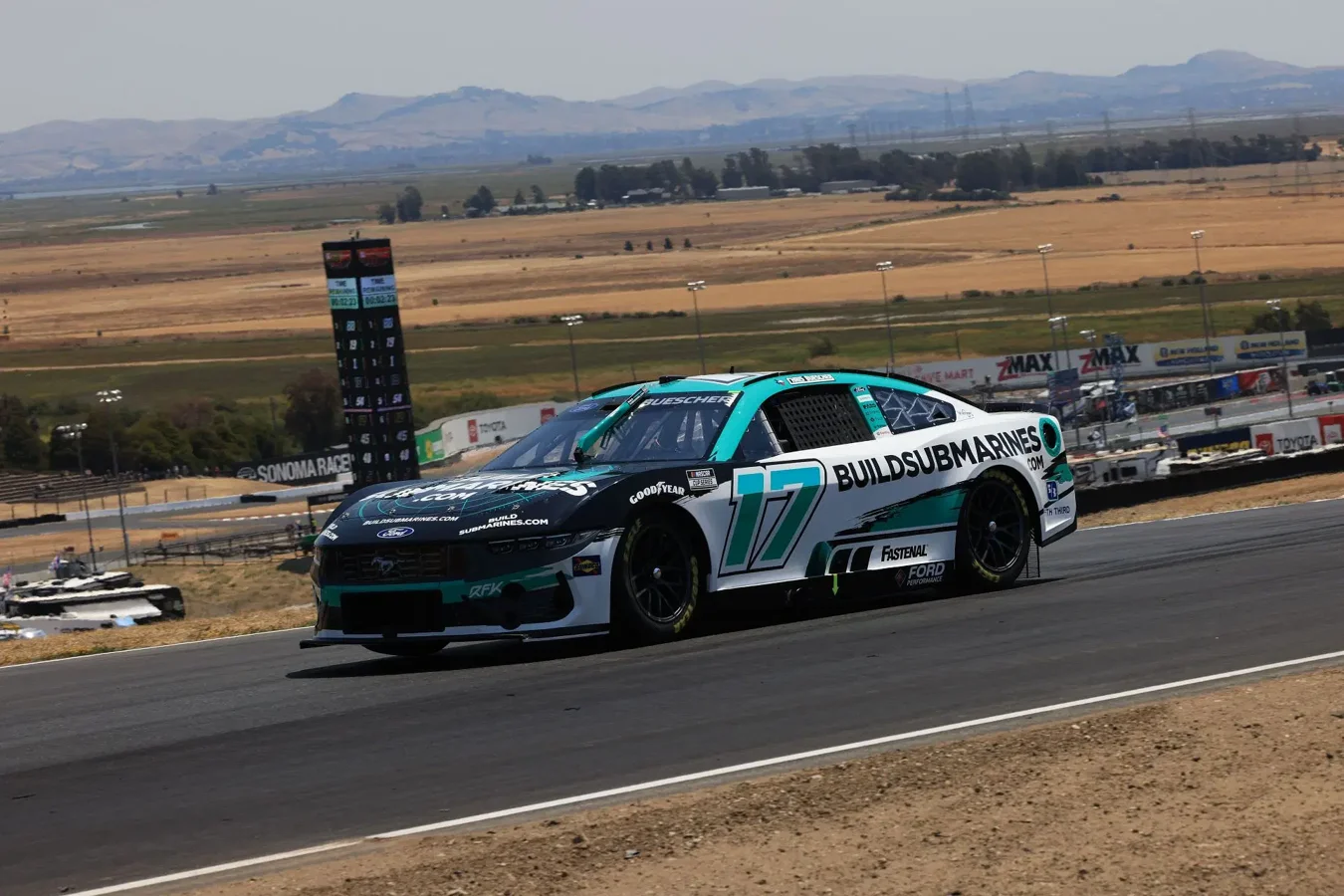
NASCAR is currently deep into a stretch featuring three road course events among the last five races, with two more still scheduled before the season finale. While the increase in road course races has drawn significant attention, Sonoma Raceway in California presents a distinct set of challenges for drivers. Chris Buescher recently explained how this historic track’s demanding layout tests even veteran competitors, highlighting the unique difficulties they face during the Sonoma Raceway challenges.
The Unique Difficulty of Sonoma’s Elevation Changes and Blind Corners
Although recent races, such as the Xfinity battle between Shane van Gisbergen and Connor Zilisch, offered thrilling moments, Buescher noted that the introduction of the Next Gen car changes the dynamics substantially. He stated,
No amount of simulator time could prep you for Sonoma. To come off a course last week where I feel like we had about 8ft of elevation change throughout the entire thing, to a place that we have over 150 here, or something, 160. It’s huge, right?
Buescher emphasized that simulators cannot fully replicate the visceral experience of Sonoma’s vast elevation swings and its blind corners. Drivers must learn firsthand how these characteristics impact throttle control and positioning. He further explained,
It’s ’cause it’s a rolling hill and you have no clue what’s on the other side. It’s a trust factor. It takes laps to know where you’re at and where you’re pointed. And yeah, it’s a challenging race.
Buescher’s Perspective on Racing Strategy with the Next Gen Car
Despite Sonoma’s formidable difficulty, Buescher embraces its complexity and distinctiveness. He praised the track for its character, contrasting it with more conventional circuits that feature predictable 90-degree turns. Instead, Sonoma features flowing rhythm sections that demand precise control and adaptation.
He also described how the approach to curbing has evolved with the Next Gen car. Drivers, including Buescher himself, tend to be less aggressive hitting the curbs now compared to previous Cup drivers. He observed that older cars permitted more aggressive curb riding, whereas today’s approach is more conservative, yet Sonoma’s layout maintains enough subtlety and rhythm to create an engaging driving challenge.
Reflecting on Road Courses and Safety in the Current Season
Buescher also addressed safety, acknowledging the impact of incidents like Cody Ware’s recent severe crash at Chicago. He expressed relief that Ware was unharmed following the hard collision with the tire barrier.
“That impact was massive” –@Chris_Buescher glad that Cody Ware is OK after the hard head-on crash in the tires at Chicago.
He also talks about the number of road courses on the schedule and his strengths at Sonoma. #NASCAR pic.twitter.com/S9RcP9YL2n
— Frontstretch (@Frontstretch) July 12, 2025
With more road courses included in the NASCAR schedule, Buescher’s experience and strengths at Sonoma position him well for the continuing challenges ahead, underscoring the importance of adapting to evolving car dynamics and track features to maintain competitiveness.
