
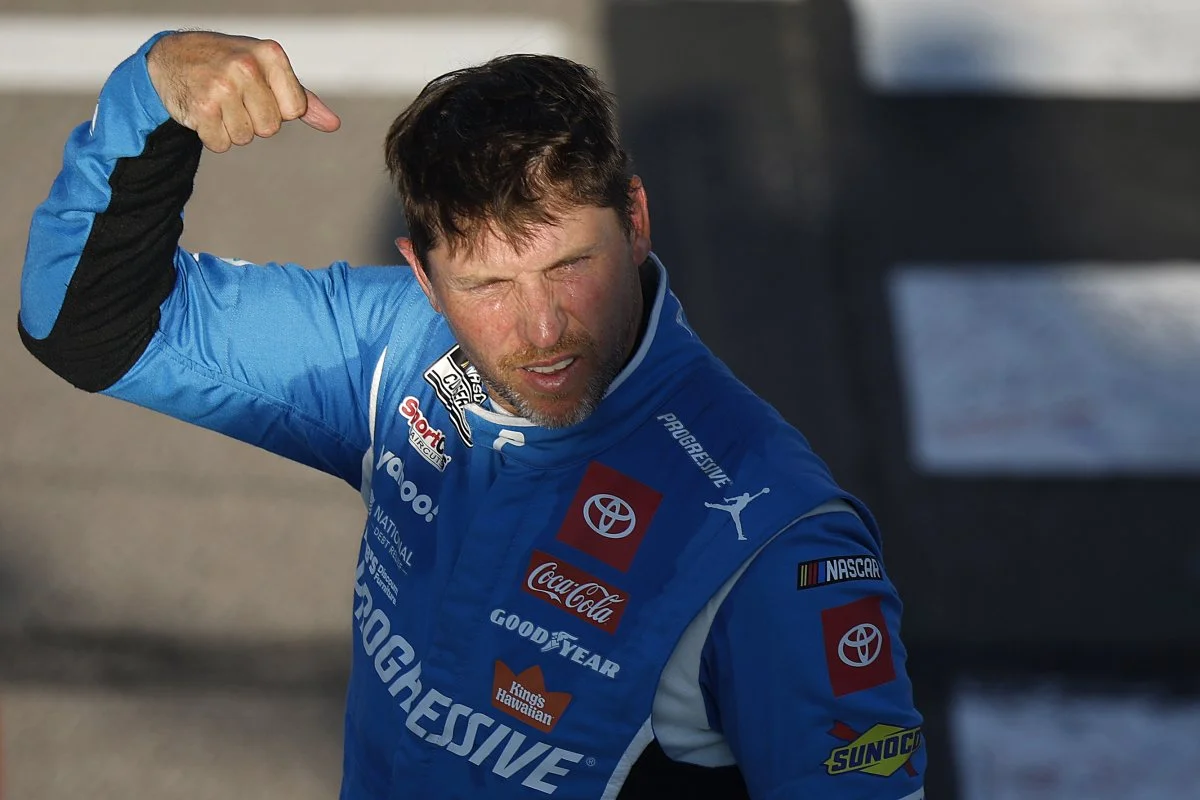
On September 7, Denny Hamlin secured his 59th career victory in the NASCAR Cup Series, marking his 713th start over 21 years. This win also represented Toyota’s 200th milestone triumph. Alongside the achievement, Hamlin introduced a new post-race interview catchphrase:
“Get on the bandwagon, or get run over by it.”
Hamlin currently holds a contract extension with Joe Gibbs Racing that commits him through the 2026 and 2027 seasons. After his recent win at Gateway, he confirmed in a post-race press conference that he intends to retire following the completion of this deal, indicating that these next two years will likely represent the final chapter of his racing career.
When you’re talking about having the countdown 70 to go, that’s kind of assuming the next two-year deal will be your last, right?
HAMLIN: Yes. That’s correct.
—Joseph Srigley, NASCAR Reporter
Projecting Hamlin’s Remaining Race Opportunities
Based on the current schedule, Hamlin has approximately 80 remaining Cup Series starts: eight races left in 2025 and then full 36-race schedules in both 2026 and 2027, assuming NASCAR‘s calendar remains unchanged. His challenge now is estimating how many additional wins he might accumulate before retiring.
Statistically, Hamlin boasts an 8.2% win rate over his Cup career. Applying this percentage to 80 races suggests roughly seven more wins, which would bring his total to 67 victories. Achieving this number would place Hamlin ninth on NASCAR’s all-time wins leaderboard, surpassing Kyle Busch who currently has 63 wins, assuming Busch does not significantly increase his tally in the next two years. However, surpassing Dale Earnhardt’s historic 76 wins appears unlikely.
Factoring Course Types and Race Variables into Win Projections
Hamlin has openly acknowledged that road and street courses are not his strengths, which influences realistic win projections. Among the upcoming races, one road course remains this year (Charlotte Motor Speedway ROVAL), with five in 2026 and an assumed five in 2027. Removing these road races reduces Hamlin’s viable winning opportunities to 69. When accounting for the unpredictability of superspeedways, the number likely further declines to approximately 63 races where Hamlin could contend for victories.
While Hamlin has proven capable of winning at challenging tracks such as the Daytona 500 and supremely wild races at Talladega and Atlanta, these remain high-variance events and hard to count on consistently.
Hamlin’s Perspective on Performance and Retirement Outlook
Hamlin understands the importance of exiting on his own terms rather than facing decline due to age or diminished competitiveness. At 45 years old and heading into his 46th season, he has commented candidly on the subject.
There’s just got to be a means to an end,
I’m just not going to leave the sport on my deathbed … just leaking oil, just running in the back of the pack … I have way too much pride for that. I’m way too cocky for that.
—Denny Hamlin, Driver
This outlook suggests Hamlin will aim to maintain a high level of performance while carefully managing his career’s final stages.
Analyzing Potential Win Scenarios for Hamlin’s Remaining Career
Several possibilities exist for Hamlin’s win totals over his final 80 starts, ranging from none to top-tier performances:
1) No Additional Wins: It is conceivable, though unlikely, Hamlin could finish his career without further victories. NASCAR history includes celebrated drivers like Darrell Waltrip, Richard Petty, Rusty Wallace, Jimmie Johnson, and Kevin Harvick, who all endured long winless periods before retiring.
2) One or Two More Wins: Hamlin could cap his career with limited victories, perhaps even clinching a championship at Phoenix Raceway, creating a memorable exit. Winning another race late in his career, such as at Martinsville Speedway, and then announcing retirement could be a satisfying conclusion.
3) Approximately 65 Wins: Considering Hamlin’s win totals over recent seasons—six, seven, two, two, three, three, and five (so far) since his only winless year in 2018—adding around three wins per season for his final two years is reasonable, pushing his total to 65.
4) Between 65 and 69 Wins: This win range represents an optimistic but feasible scenario, assuming Hamlin capitalizes consistently on favorable opportunities across his remaining races. Such an outcome would require near-perfect execution and performance.
5) 70 or More Wins: Surpassing 70 losses would place Hamlin in rare company. This would require victories in nearly every race where he has the strongest car, plus a few unexpected wins, including success on superspeedways or tracks like Richmond Raceway and Pocono Raceway, where he has historically performed well. Given the elimination of some races at venues like Dover Motor Speedway, where he previously excelled, this target is extremely ambitious.
Where Hamlin’s Journey Likely Ends
Given the data and Hamlin’s current form, the most plausible range for his final win tally is between 65 and 69. Achieving 60 wins before reaching this stage seems both a critical and achievable milestone, potentially realized soon at Bristol Motor Speedway. Hamlin has enjoyed strong performances there recently, recording two wins, a fourth-place, and a second-place finish in his last four visits, making it an ideal venue to mark such a milestone.
Regardless of final totals, Hamlin’s career trajectory, marked by 59 wins and consistent competitiveness, ensures a spot as a first-ballot Hall of Famer. His forthcoming seasons promise to be watched closely by fans and rivals alike, as he strives to meet or potentially exceed his Denny Hamlin career win target before stepping away from racing.
