
Denny Hamlin made headlines for two reasons during the Dover NASCAR weekend in July 2025: not only did he secure his 58th career Cup Series win at the Monster Mile, but he also stepped into the broadcast booth for the NASCAR Xfinity Series race on CW. This marked a rare and insightful moment where Hamlin revealed his perspective on the sport, shifting from competitor to commentator. His NASCAR broadcasting experience revealed unexpected challenges despite his well-known racing acumen.
Given Hamlin’s reputation for sharp racing intelligence and straightforwardness, his decision to join the commentary team raised questions about how easily a current driver could adapt to this different role. Many former Cup stars, including Jeff Gordon, Clint Bowyer, and Jamie McMurray, have made smooth transitions to broadcasting, but Hamlin’s experience proved to be more complicated and demanding than initially anticipated.
Inside Hamlin’s Broadcasting Experience at Dover
On his podcast, Actions Detrimental, Hamlin candidly discussed what it was like to juggle on-air commentary with his responsibilities as a driver during the Dover weekend. Despite assumptions that being in the broadcast booth might provide a tactical advantage, Hamlin was clear in dismissing this notion.
I got asked post-race if it was an advantage to be up there,
he said.
In the bus, it’s like I don’t—I’m not distracted with all the other stuff. And so I would say it’s not an advantage at all to go up there and do the booth,
emphasizing that the booth setting didn’t offer more insightful access to race dynamics.
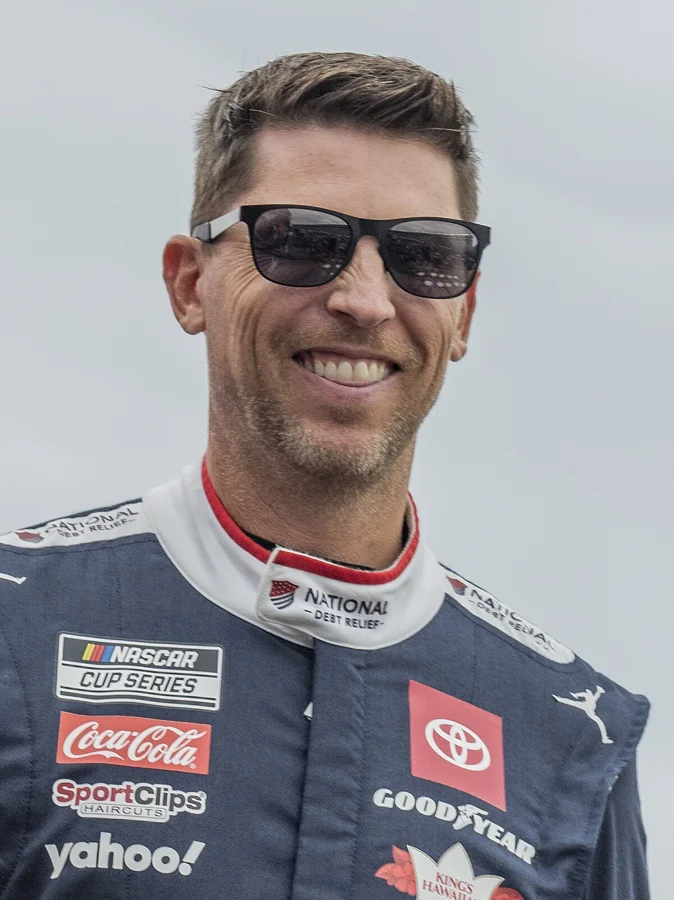
The environment of the broadcast booth was hectic and distracting, with Hamlin noting the difficulty in focusing on the race itself amid producers’ instructions, camera changes, and other off-track distractions.
Truthfully, I’d see a hell of a lot more sitting in my motorhome,
he admitted, highlighting how the behind-the-scenes activity took away from real-time observation. Yet, he praised the professionalism and ease brought by veteran commentators Adam Alexander and Jamie Little.
Adam makes it so freaking easy…
Despite having a bird’s-eye view of the race, Hamlin found the role limiting in terms of delivering deep analysis. He explained that the format required commentators to react instantly to what was on screen rather than elaborating on complex technical points.
You’re trying to concentrate on, ‘Okay, what do the people see? Let’s talk about what the people are seeing,’
Hamlin said.
You want to be talking about what the camera is showing, and so, even though you’ve got something good you want to say, you’ve got to throw it out the window and go with what’s on the screen.
This real-time constraint clashed with Hamlin’s natural inclination for detailed, technical breakdowns.
The live broadcast pace made it tough for Hamlin to convey the nuanced insights he is known for as a driver.
Um, so I just I feel like my role in the booth would be talking about what the drivers need to be looking for, how they need to be setting up passes, things like that,
he reflected.
You know, being a little more technical in that aspect. I think that’s kind of my lane.
However, the fast tempo of live production often overwhelmed this approach.
Still, Hamlin found value in working alongside skilled on-air talent.
They’ve got great on-air talent that makes things extremely easy,
he said, also describing the smooth nonverbal communication between himself and Jamie Little during broadcasts.
We would kind of give hand signals of like, you know, when you want to say something… so the other person knows to wrap up.
When asked whether he would take on broadcasting duties again despite the challenges, Hamlin responded affirmatively.
Yeah, I would do it again. I would.
This experience gave him a fresh perspective on the sport beyond the driver’s seat and opened the door to future opportunities in the media realm.
Hamlin’s Ongoing Pursuit of Success on and off the Track
At 44 years old, Denny Hamlin remains a formidable figure in NASCAR, showing no signs of slowing down. With 58 Cup Series victories, he is closing in on the elite milestone of 60 wins, a club that includes legends like Kevin Harvick. Hamlin’s determination to reach this rare achievement, alongside his sharp racing intellect, keeps him competitive each weekend. Although a championship title has eluded him so far, his consistency, racecraft, and longevity have cemented his legacy as one of NASCAR’s top drivers.
Beyond racing, Hamlin is expanding his influence through 23XI Racing, the team he co-owns with NBA legend Michael Jordan. Since its launch in 2021, the organization has rapidly become a major contender, earning victories and attracting top-tier talent. Balancing full-time driving with team ownership places Hamlin among the most powerful figures in modern NASCAR, blending performance excellence with strategic leadership.
Hamlin’s career trajectory reflects evolution rather than mere endurance. As he continues to compete at the highest levels on track, he is simultaneously cultivating his impact off it, positioning himself as a lasting presence in the sport. Rather than fading into the background, Hamlin is broadening his role—whether in the race car or the broadcast booth, he is actively shaping NASCAR’s competitive and cultural future.
Our Reader’s Queries
Q. How did Denny Hamlin get so rich?
A. Denny Hamlin started racing full-time in the Cup Series in 2006 with Joe Gibbs Racing. Since then, he’s achieved an impressive career. He’s won 51 Cup Series races, including three Daytona 500s in 2016, 2019, and 2020, and has made a lot of money doing it.
Q. How is Denny Hamlin so rich?
A. Denny Hamlin has a net worth of $65 million, largely thanks to over $100 million from his NASCAR contracts and race winnings. He also earns millions from sponsorships with companies like FedEx, Jordan Brand, and Toyota. Additionally, he part-owns 23XI Racing, a team now worth more than $100 million.
