
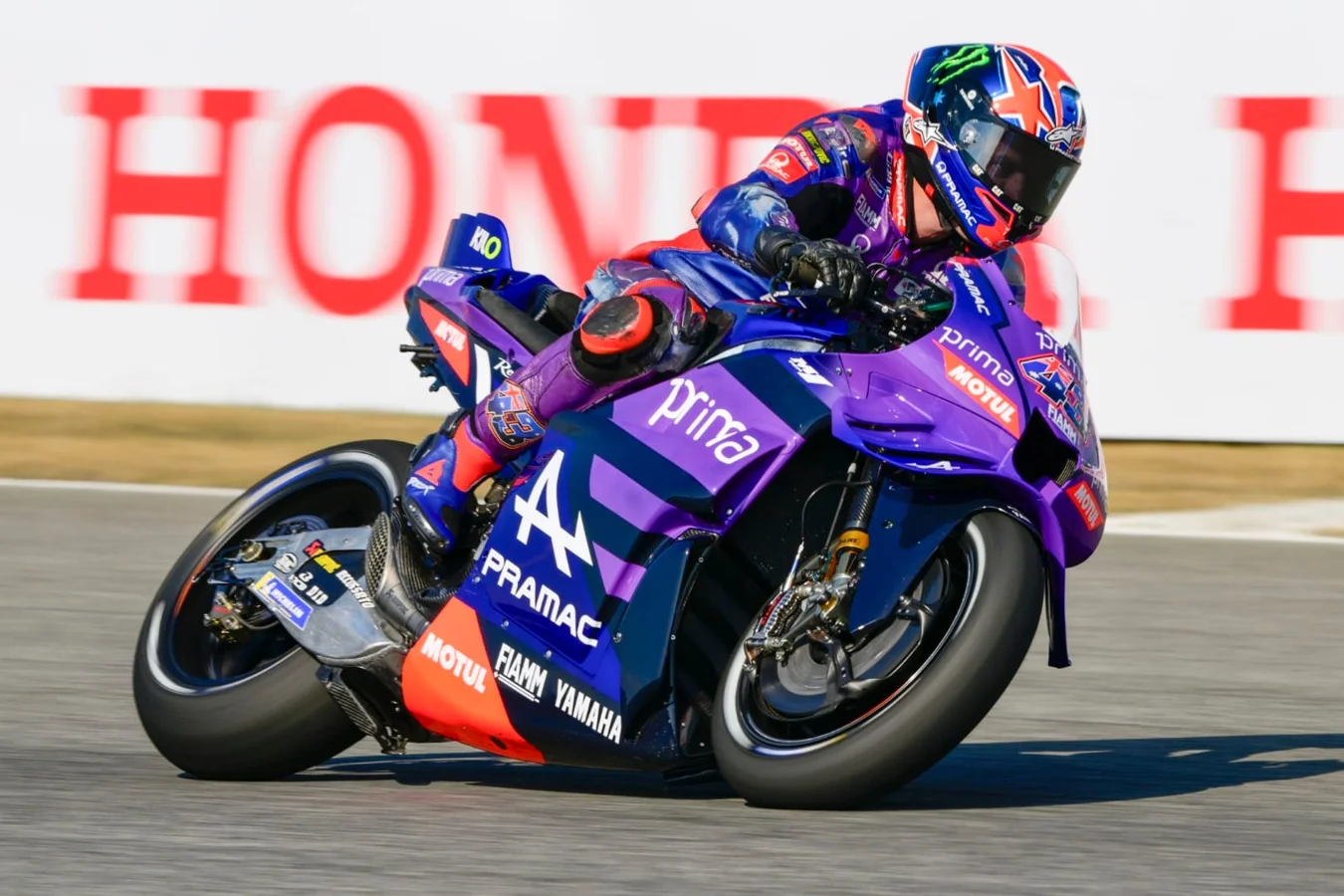
Jack Miller has secured an unexpected extension to his MotoGP career with Yamaha into the 2026 season, marking his 12th year in the sport. Despite a 2025 campaign that offered only sporadic glimpses of promise, Yamaha recognized Miller’s value, ultimately deciding to retain the 30-year-old Australian rider as it pushes toward significant developmental goals in its MotoGP program.
Performance and Contract Dynamics Behind Yamaha’s Decision
Miller’s continuation with Yamaha came despite limited leverage on his part and being the last rider signed for 2025 with a one-year contract. His contract contrasts with teammate Miguel Oliveira, whose deal was cut short after Yamaha exercised a break clause, driven principally by Miller out-qualifying Oliveira ten to one and out-scoring him 52 to 10 through the first 14 rounds. Though on-track results favored Miller, this decision extended beyond statistics, influenced by Yamaha’s strategic needs and rider availability.
Yamaha’s predicament also arose from missed opportunities to sign new talent. Had a promising Moto2 star accepted Yamaha’s offer, Miller’s future in premier-class racing might have been uncertain. Instead, Yamaha was compelled to rely on Miller’s experience amid a transitional period marked by the impending 2027 rule changes and technical evolution.
Why Yamaha Could Not Replace Miller in 2026
The absence of fresh talent willing to immediately step up played a crucial role in Yamaha’s decision to retain Miller. Diogo Moreira, a leading young star from Moto2 and Yamaha’s preferred rising talent, chose to join Honda under a forthcoming multi-year factory deal. Moreira’s skill set, demonstrated by multiple Moto2 victories and his status as the first Brazilian rider on the grid since 2007, made him highly sought after, but Yamaha lost out in the competition for his signature.
Moreira was slated to join a Yamaha-affiliated rookie line-up alongside Toprak Razgatlioglu at Pramac, but Honda’s longer-term commitment and strategic offer swayed the young Brazilian to their side. This left Yamaha without a clear successor to Miller, who, despite being nine years older, brings irreplaceable technical insight and MotoGP experience.
The Significance of Miller’s Experience with Multiple Manufacturers
Miller’s vast experience with V4 engine MotoGP bikes, having ridden for Honda, Ducati, and KTM before Yamaha, has made him an essential asset for Yamaha’s ongoing engine development projects. Yamaha is one of the few manufacturers persisting with an inline-four engine while simultaneously developing a new V4 engine to stay competitive as they prepare for the 2027 transition to 850cc machines with reduced aerodynamics and new tyre suppliers.
Test rider Augusto Fernandez will debut Yamaha’s V4 engine in competition at the San Marino Grand Prix in September, and Miller’s knowledge is critical in connecting these new developments with the current program. Among Yamaha’s 2026 riders, only Fabio Quartararo’s factory teammate, Alex Rins, has any experience on a V4, and his injury-shortened season limits Yamaha’s options.
I feel like I have a lot of information to give and a lot of input and can help with a project like that,
Miller said recently in Hungary, affirming his role in Yamaha’s technical progress.
The Larger Context: Yamaha’s Struggle in MotoGP’s Competitive Landscape
Since 2020, Yamaha and Honda have both faced difficulties maintaining their historical dominance in MotoGP, which was challenged by the rise of European manufacturers such as Ducati. Yamaha has endured a winless drought exceeding three years, with its flagship bike—the YZR-M1—remaining competitive on flowing tracks but lacking the power and consistency to battle effectively in close-race pack situations.
Fabio Quartararo, the 2021 world champion and Yamaha’s leading rider, has demonstrated pole-winning speed four times in 2025 but with mixed race results ranging from podium finishes to retirements. Quartararo has publicly expressed frustration with Yamaha’s current machinery, emphasizing his desire not just for a long-term project but for a bike ready to fight for wins from the first race of future seasons.
[the contract] wasn’t only for the money but also for the project, but for the future I don’t want a project but a bike that is ready, that I get on and that from the first race I can fight to win.
—Fabio Quartararo, Yamaha rider
Yamaha’s power unit developments, moving toward a V4 configuration, are an attempt to close the gap with Ducati, KTM, Aprilia, and Honda, all manufacturers who already use V4 engines. Miller’s ongoing role in feedback and development remains invaluable as Yamaha navigates this crucial phase.
Quartararo’s Support for Miller’s Role Within Yamaha
Quartararo has been a vocal advocate for keeping Miller within the Yamaha paddock, praising the Australian for uniquely possessing the V4 experience required to assist with Yamaha’s engine transition. Quartararo’s endorsement highlights Miller’s strategic importance beyond just race-day performances.
I don’t know what is [the decision] with Pramac, but I think it’s great to keep Jack, because he’s the one who has much more experience with the V4,
Quartararo said during the Hungarian Grand Prix weekend.
I never rode a V4. Alex [Rins] rode a Honda for half a year, Toprak [Razgatlioglu] never rode a MotoGP bike, so you have to keep one guy that has experience with a V4, I think.
—Fabio Quartararo, Yamaha rider
Navigating the Upcoming MotoGP Changes and Team Strategies
The 2027 regulation overhaul, introducing 850cc engines and significant technical changes including less aerodynamic assistance and a switch from Michelin to Pirelli tyres, precipitates an unprecedented reset for MotoGP teams. Yamaha’s need for a rider who understands both the current and upcoming generation of motorcycles explains why Miller remains valuable despite nearing the typical retirement phase.
Pramac, Yamaha’s satellite team, is poised to run an all-rookie line-up in 2026, focusing on riders like Toprak Razgatlioglu and potentially Diogo Moreira or Manu Gonzalez. These rookies will face a steep learning curve on circuits and machinery unfamiliar to them. In contrast, Miller offers Yamaha a seasoned and reliable figure who can help ease transitions and development.
Miller’s occasional struggles, such as tyre management, are outweighed by his deep technical knowledge, consistent adaptability, and ability to perform well in mixed weather conditions. His aggressive, fast-starting riding style remains a competitive weapon early in races and brings stability to Yamaha’s rider lineup.
The Commercial and Cultural Value of Miller in MotoGP
Beyond on-track contributions, Miller offers Yamaha and MotoGP essential commercial advantages, particularly under the new ownership by Liberty Media, which aims to broaden viewership globally through increased English-language appeal. As the sole rider hailing from Australia, Britain, or the United States, Miller connects with key English-speaking markets that typically have fewer representatives in the sport.
The majority of MotoGP’s current riders are Spanish or Italian, countries that host multiple Grand Prix rounds annually. Miller’s personality, outspoken nature, and authentic appeal provide Liberty Media with a relatable figure to promote MotoGP’s global reach, helping to engage larger audiences outside the traditional European and Latin American strongholds.
The reality is that English is the most widely-spoken second language in the world,
MotoGP reporter Simon Patterson explained on a Fox Sports podcast, highlighting the strategic importance of riders who can communicate effectively to an international audience.
It’s the language that, if you’re in Indonesia or Argentina, you speak English as a second language. It makes sense to force [the riders] into speaking in English across the board. To be fair to [MotoGP’s former majority owners] Dorna, I know they have been working on that… The minute they realised Pedro Acosta was the next big thing, he was basically ordered into Dorna-organised and paid-for English lessons that paid off.
Dorna realised five or six years ago that they really needed to do something to fix this, and we’re really only now starting to see the payoff for that. It’s going to take another five to six years to really change the structure of the grid.
—Simon Patterson, MotoGP reporter
Looking Ahead: Miller’s Role Through 2026 and Beyond
Miller’s career is likely to conclude shortly after the 2027 technical reset, but his role in Yamaha’s transitional phase is pivotal. His blend of technical expertise, racecraft, and unique rider profile provides Yamaha a bridge between current challenges and future opportunities. As Yamaha continues to develop new engine concepts and adapt to evolving regulations, Miller’s feedback and experience will remain invaluable.
In 2026, Miller represents not only continuity for Yamaha but also a measured response to the changing demands of MotoGP. His impact on Yamaha’s MotoGP program is expected to outlast his time on the bike, influencing development directions and team strategies for years to come.
