
Jimmie Johnson is actively considering an expansion of his NASCAR team in the upcoming 2026-27 seasons, exploring options that may include partnering with a new car manufacturer. Following a challenging 2024 campaign where his Legacy Motor Club cars fell short of top-25 finishes, Johnson’s team has shown marked improvement in 2025, fueling ambitions for further growth within NASCAR’s competitive landscape. The prospect of adding additional teams aligns with broader discussions in NASCAR about welcoming a fresh original equipment manufacturer (OEM) into the sport.
Since Toyota’s introduction in 2007 as the most recent OEM entry and Dodge’s exit in 2012, the sport has not seen a change in manufacturers. However, rumors point toward new developments involving Johnson’s team and other organizations preparing for a potential manufacturer shift, setting the stage for a significant transformation in NASCAR’s manufacturer lineup.
Johnson’s Ambitions for a Third NASCAR Team and OEM Opportunity
The seven-time NASCAR Cup Series champion has already navigated substantial changes since acquiring a stake in Petty GMS Racing in 2022, which was rebranded as Legacy Motor Club while transitioning its manufacturer allegiance from Chevrolet to Toyota. Despite a rocky start in 2024 with drivers Erik Jones and John Hunter Nemechek struggling to make an impact, recent performances in 2025 have signaled a resurgence, with both drivers posting competitive top-five speeds during the summer.
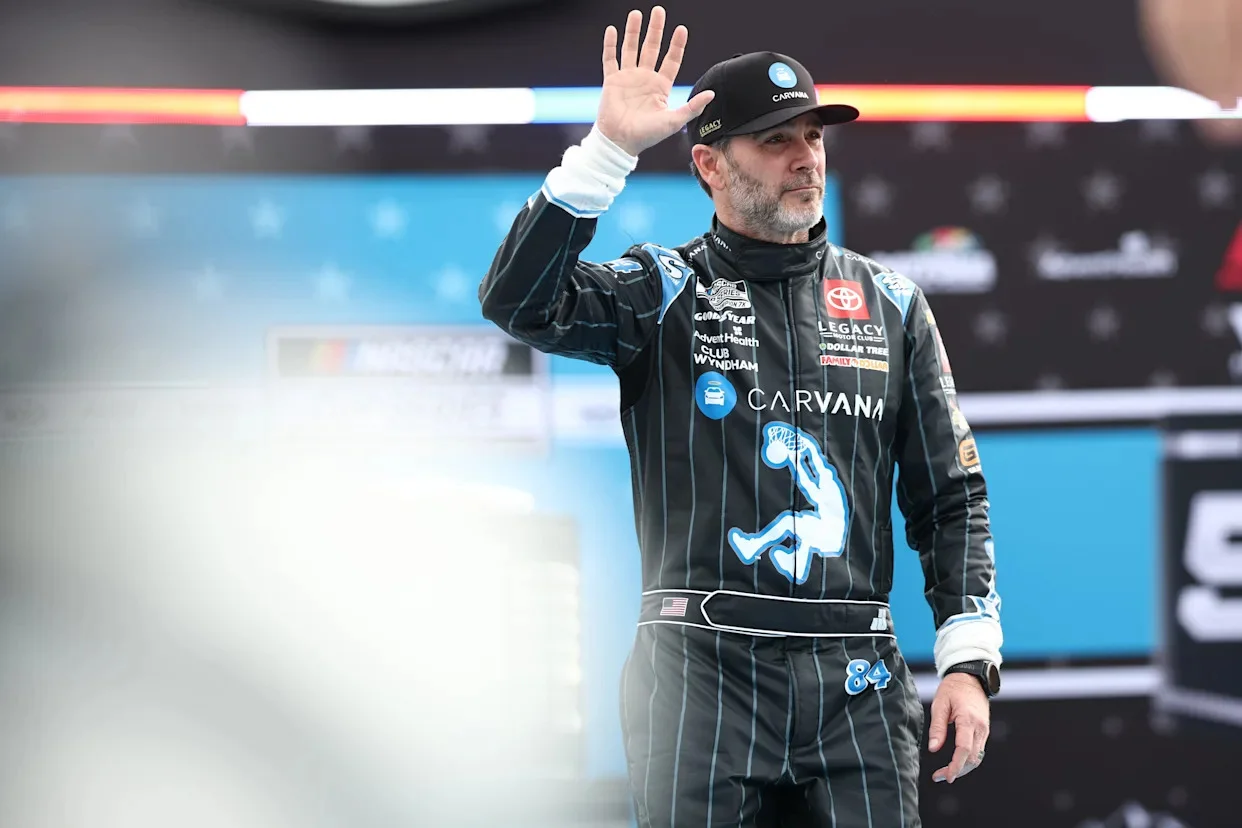
This upswing has inspired Johnson to pursue the addition of a third car to his team’s roster. While this effort included legal disputes involving Rick Ware Racing, with the latter recently selling its charters to new owner TJ Puchyr, Johnson remains committed to his expansion plans. On his podcast, he stated,
“It’s been a process, unfortunately, but I think we’ll have some form of outcome here soon. It’s our intentions and ambitions to put a third car on the grid in ’26, I’d say worst case scenario would be ’27.”
—Jimmie Johnson, NASCAR Team Owner
Expert analyst Eric Estepp has suggested this expansion ties closely with a potential manufacturer switch. He noted,
“LMC would never be the top Toyota team. So maybe a new manufacturer swap in the coming years makes sense having three charters proving that you have the infrastructure to embrace a new manufacturer is extremely important…Three charters is the sweet spot from a competitive standpoint, from a business standpoint, potentially from a new OEM standpoint.”
—Eric Estepp, NASCAR Expert
The acquisition of a third charter would position Legacy Motor Club strategically in terms of competition and organizational depth. Currently, possible drivers under consideration for this new seat include Jesse Love, Daniel Suárez, and Connor Zilisch, each bringing different strengths ideally suited to bolster the team’s prospects amid these structural changes.
Estepp explained the significance of three-charter ownership under NASCAR’s latest regulations:
“Under the new charter agreement, 3 is the max you’re allowed to own unless your name is Joe Gibbs or Rick Hendrick…3 charters seem to be the perfect balance in the Next-Gen era, strengthen numbers, ability to share data back and forth, while not spreading your organization too thin. Plus it could be attractive to a new manufacturer.”
—Eric Estepp, NASCAR Expert
Challenges Surrounding Increased Horsepower and Costs
Alongside his team’s expansion ambitions, Johnson has expressed caution regarding NASCAR’s recent proposals to raise the horsepower of Next-Gen cars from the current 670 horsepower to 750. While drivers and fans commonly favor more power for enhanced racing excitement, such a move would demand significant engineering overhauls to engines, cooling systems, and aerodynamics. These modifications risk undermining NASCAR’s Next-Gen program goal of cost parity among teams and manufacturers.
Any substantial horsepower increase would require alignment and approval from the involved OEMs—Chevrolet, Ford, and Toyota—who must agree on uniform body and component designs. Such coordination involves multiple submissions, approvals, and added expenses, complicating the introduction of any new manufacturer into the series.
Johnson elaborated on these challenges in early June, stating,
“Drivers always love more horsepower. Fans like it too. All of the cooling elements will need to be redesigned, which then would mean a new submission for all three OEMs and their bodies. That does not help the cost savings program that we’re all working on.”
—Jimmie Johnson, NASCAR Team Owner
He further explained the drivers’ motivation behind seeking more horsepower:
“I’m glad I’m not NASCAR. Fundamentally, what the drivers are asking for in the pro-horsepower conversation is around abusing tires. We want more passing. It’s harder than ever to pass. We’re at this point where it’s like softer tires that wear out, more horsepower that wears out the tires. So that’s really the driving force behind it.”
—Jimmie Johnson, NASCAR Team Owner
Legacy Motor Club’s Future Outlook and Industry Impact
Jimmie Johnson’s Legacy Motor Club is at a crucial crossroads involving both team expansion and strategic alignment with NASCAR’s evolving manufacturer landscape. The aim to field three cars strengthens the team’s competitive structure, providing a platform to attract potential new OEM partnerships and maximizing data sharing within the team without diluting resources.
However, the path forward presents challenges such as increased costs linked to the Next-Gen car’s development and the complexities of aligning three existing manufacturers around shared technical regulations. Johnson’s cautious yet ambitious approach reflects the balancing act between growth opportunities and the practical realities of motorsports economics and technology.
As NASCAR prepares for possible manufacturer changes and technology upgrades in 2026-27, Johnson’s efforts could signal a turning point for Legacy Motor Club and the sport. The decision to embrace a new OEM or stick with Toyota will influence competitive dynamics and potentially shape NASCAR’s manufacturer diversity for years to come.
Ultimately, whether Legacy Motor Club can leverage its expansion to thrive sustainably with a new manufacturer remains to be seen. The combination of technical challenges and strategic ambitions will determine the team’s success and may inspire similar moves across the NASCAR landscape.
