
After Max Verstappen’s triumph at the Italian Grand Prix in Monza, Red Bull’s newly appointed team principal, Laurent Mekies, downplayed his role in the success, claiming no personal contribution to the win. The victory marked Verstappen’s third of the season and the first since Christian Horner’s departure. Despite high praise from key figures like advisor Helmut Marko and Verstappen himself, Mekies insisted that his involvement was minimal amid the team’s collective effort.
Marko highlighted a new approach within Red Bull, where the team no longer relies solely on simulation data but integrates more practical input. Verstappen emphasized Mekies’ effective communication during the race weekend, noting his ability to ask pertinent questions that helped align drivers and engineers. Nevertheless, Mekies firmly stated:
The answer is a very easy one, the level of my contribution is zero.
This declaration sparked laughter among journalists present in Red Bull’s hospitality, but Mekies maintained his stance, clarifying the extensive team effort behind the scenes.
Behind Mekies’ Modesty: The Team’s Collective Achievement
Mekies elaborated on the scale of Red Bull’s workforce, explaining that 1,500 individuals contribute to improving the car’s performance by refining technical details and maximizing use of new components. He described himself as simply facilitating the conditions for these talents to excel, stating:
And I’m not joking either. It’s 1,500 people working on making the car faster, so these are the talents that make the car faster, that make the hundredths and the thousandths [of lap time], and that make the set of options with the new components available. So the short answer is that my contribution is zero.
Pressed about his role once more, Mekies reaffirmed that the credit rightfully belongs to the team and to Verstappen, who showed determination by sticking with a low-downforce car setup that differed even from Monza’s usual standards:
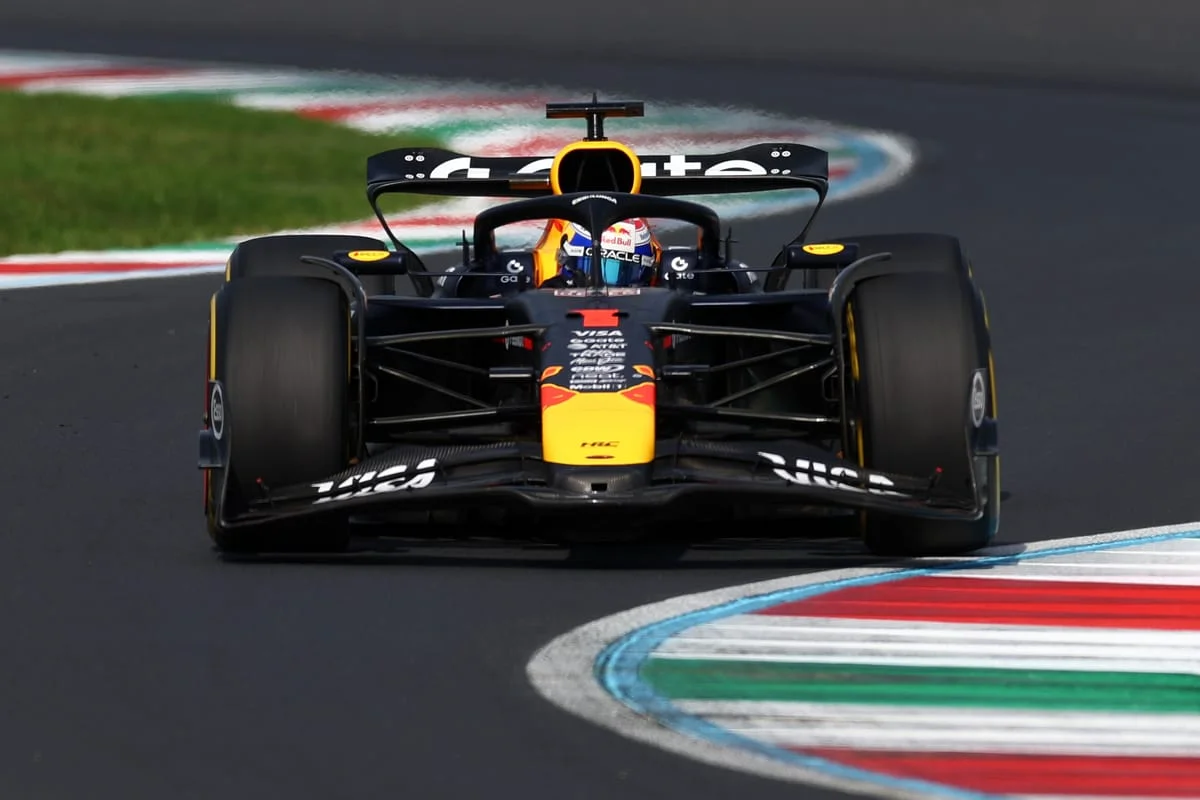
Our only role is to make sure that the talents that we have are put in the right conditions to express that talent at best. That’s the only thing we are doing, so that’s the extent of the contribution. That’s it, nothing more.
Assessing Mekies’ Actual Impact on Red Bull’s Performance
Although Mekies’ humility is clear, several factors suggest his influence was more meaningful than he lets on. The positive remarks from advisor Helmut Marko and Max Verstappen indicate that Mekies’ presence contributed to the team dynamic, even if the technical developments had been underway prior to his promotion. Red Bull’s low-downforce package for Monza this year was a significant improvement over last year’s approach, representing ongoing development that began before Mekies took charge.
Last year, Red Bull lacked a dedicated low-downforce rear wing suitable for Monza. This season, however, the team prepared this specialized wing, reflecting a focused effort to overcome previous shortcomings. Mekies noted that the mistakes made in 2024, especially regarding incorrect wing setups, were carefully analyzed to avoid repeating the same errors:
You do a lot of things only for Monza. You do wings only for Monza, you do set-up only for Monza, so last year was a very difficult point and the guys did an amazing job analysing last year and coming here with very specific solutions. It seems like they overshot the target – meaning the car was actually in a much better window compared to the other tracks,
These improvements were in progress before Mekies’ promotion, minimizing his direct influence on the car’s design and hardware upgrades. However, the division between car development and operational management is important to consider, as Verstappen made clear:
The car this year is simply what it is,
Verstappen explained that Mekies cannot alter the physical car but can influence race operations and strategic decisions, where subtle differences often determine outcomes. Mekies’ engineering background has been beneficial in this regard. Verstappen acknowledged Mekies asking “the right questions” to engineers, helping streamline decision-making and communication during race weekends.
Shifting Toward Greater Driver Involvement and Tactical Flexibility
Red Bull’s evolving philosophy under Mekies favors a blend of simulation insights and direct driver feedback, departing from a purely data-driven approach. Helmut Marko described this shift as balancing technical input with Max Verstappen’s real-world experience and the insights of racing engineers:
Now the idea is to take whatever the simulation shows us, but mix that with the experience that Max has and with the experience that our racing engineers have. They are not blindly taking what the simulation says.
This new mindset was evident at Monza, where Verstappen advocated for maintaining a low-downforce setup despite challenges in achieving optimal balance. Mekies explained how the team supported Verstappen’s insistence, adapting other setup elements rather than increasing wing levels:
Whilst it looked a lot more difficult to get the balance right with that lower downforce level, Max has been very strong and good at pushing us to keep it on the car and to find other solutions to give him the balance back. The guys have done an amazing job in managing that,
The successful collaboration between the driver, technical department, and Mekies underlines the importance of communication in optimizing performance. This trio operated effectively in Monza, contributing to the race win.
Red Bull’s Internal Dynamics and Mekies’ Leadership Style
Mekies’ modesty gains further context when considering internal changes within Red Bull following Christian Horner’s departure. Tensions had arisen between different factions, with some viewing Horner as monopolizing control over racing operations. Horner’s two decades of success were undeniable, but Mekies has adopted a contrasting leadership style focused on collective achievement rather than personal recognition.
This approach appeared particularly during the Monza celebrations, when technical director Pierre Wache was sent to the podium instead of Mekies. Wache, despite facing increased scrutiny for the car’s weaknesses earlier in the season, was visibly pleased to share in the moment, symbolizing a shared sense of ownership among the team.
This culture of inclusiveness and shared credit reflects a modern approach to team management in Formula 1, where people management is crucial. Similar leadership trends are seen at McLaren with Andrea Stella and at Williams with James Vowles, where team principals often emerge from engineering backgrounds and emphasize team cohesion over personal accolades.
Looking ahead, Red Bull faces significant challenges with their power unit development for the 2026 regulations. Mekies himself has admitted this remains “a Mount Everest to climb.” Nonetheless, the Monza victory represents an early sign that the team’s new philosophy and leadership style can yield important results, boosting morale and confidence during a transitional period.
Mekies’ Claim of ‘Zero Contribution’ Examined
While Mekies’ claim of having zero influence may sound humbling or even self-effacing, it is more accurate to view his role as that of an enabler and facilitator, who ensures the talented individuals and drivers at Red Bull work together efficiently. This leadership style, paired with a willingness to listen to driver feedback and balance technical input pragmatically, has had a measurable effect.
Though Mekies avoided taking direct credit when interviewed post-race, the combined praise from Verstappen, Marko, and insiders suggests that Mekies’ presence and management are important to Red Bull’s recent success. His understated approach may help maintain unity and focus within the squad, which could be critical as the team confronts more competitive seasons ahead.
