
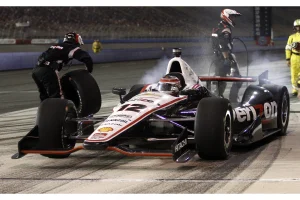
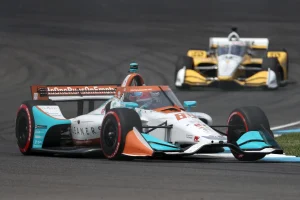
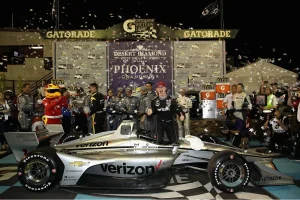
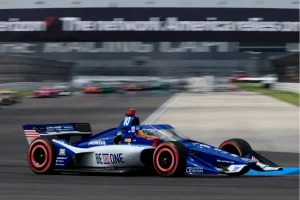
NTT IndyCar Series is the highest class of American open-wheel car racing, self-sanctioned by IndyCar, LLC since 1996 and encompassing the historic Indianapolis 500 since 1911. Known for blending high-speed ovals, technical road courses, and tight street circuits, it features 27 identical Dallara chassis powered by Honda or Chevrolet hybrid V6 turbo engines, crowning annual champions via points from 17 races.
Overview and sanctioning history
American open-wheel racing originated in 1905 under the AAA Contest Board, sanctioning national championships through the 1950s with events like the Indy 500 (first run 1911). USAC took over in 1956, governing until 1978 amid rising costs and safety concerns that birthed CART in 1979 as a team-owner cooperative focused on road courses and international appeal.
Pre-Split Era (1905-1995)
AAA oversaw informal contests until formalizing the National Driving Championship in 1905-1955, interrupted by world wars. USAC formalized the Gold Crown series (1956-1978), blending ovals and roads while CART (1979) exploded popularity with stars like Rick Mears and TV deals, peaking at 800,000+ attendees by 1993. Tensions brewed over CART’s shift from oval-heavy roots, high costs ($1M+ per car), and foreign driver dominance.
The Split (1994-2007)
Tony George, Indianapolis Motor Speedway owner, announced the Indy Racing League (IRL) on August 23, 1994, launching in 1996 with 25/8 rule guaranteeing IRL teams 25 of 33 Indy 500 spots to favor American oval specialists and cap costs at $500K/car. CART boycotted Indy 1996 (IRL-only field), splitting viewership—IRL ovals drew 5M TV viewers vs. CART’s 2M roads. Legal battles ensued over “IndyCar” trademark (settled 2003 favoring IRL). Champ Car (CART rebrand 2004) folded February 2008 after failed mergers.
Sanctioning Timeline
| Era | Primary Body | Indy 500 Control | Key Notes |
|---|---|---|---|
| 1906-1955 | AAA | AAA | National championships established. |
| 1956-1978 | USAC | USAC | Gold Crown era; 1979 strike births CART. |
| 1979-1995 | CART | USAC (Indy only) | CART full series; uneasy Indy truce. |
| 1996-2003 | IRL/CART split | IRL (25/8 rule) | Boycotts, declining popularity. |
| 2004-2007 | IRL/Champ Car | IRL | Champ Car bankruptcy forces talks. |
| 2008-present | Unified IndyCar | IndyCar | Reunification heals divide. |
Reunification and Modern Era (2008-2025)
IRL absorbed Champ Car assets February 2008, rebranding IndyCar Series (legal 2003). Tony George ousted as CEO 2009 amid debt; Roger Penske influences board via IMS stake. IndyCar, LLC self-sanctions 17-race hybrid calendar. NTT title sponsor since 2019 (extended 2023); hybrid engines 2024 align with global trends.
Technical specifications
All teams use Dallara DW12 chassis (IR-18 universal aero kit since 2018) with aeroscreen cockpit protection (2020+). Hybrid 2.2L twin-turbo V6 engines debuted 2024 (Honda/Chevy ~800 hp total). 18.5-gal ethanol fuel cells; Xtrac 6-speed paddle-shift sequential gearbox; PFC carbon brakes.
Current spec package table
| Component | Specification | Notes |
|---|---|---|
| Chassis | Dallara DW12 / IR-18 aero | Carbon monocoque; aeroscreen halo; ~1,700 lbs. |
| Engine | 2.2L twin-turbo V6 hybrid | ~550 hp ICE + 120 hp electric; push-to-pass +60 hp. |
| Transmission | Xtrac 6-speed semi-auto | Paddle-shift; pneumatic clutch. |
| Tires | Firestone Firehawk | Primary/alternate dry; full rain; 18-inch wheels. |
| Fuel | 100% ethanol (E100) | 18.5 gal; Sunoco Speedway LLC. |
| Performance | 240+ mph ovals; 200+ mph roads | Hybrid regen under braking; DRS-like push-to-pass. |
Next-gen Dallara IR-28 delayed to 2028.
NTT IndyCar Series Champions
A complete list of every NTT IndyCar Series race winner since 1996 spans over 400 events and is impractical for a single table here. Below are concise, copy-paste tables covering annual champions (full history) and recent season winners (2010-2025) that fit your article format perfectly.
NTT IndyCar Series Champions (1996–2025)
| Season | Champion Driver | Team | Engine | Points Margin | Notable |
|---|---|---|---|---|---|
| 1996 | Buzz Calkins | Bradley Motorsports | Oldsmobile | +1 over Scott Sharp | Inaugural IRL season. |
| 1997 | Tony Stewart | Menard Team Menard | Oldsmobile | +18 over Scott Goodyear | 3 wins. |
| 1998 | Kenny Bräck | A.J. Foyt Racing | Oldsmobile | +14 over Scott Sharp | Rookie champ. |
| 1999 | Greg Ray | Kelley Racing | Oldsmobile | +14 over Mark Dismore | 2 wins. |
| 2000 | Buddy Lazier | Team Menard | Oldsmobile | +16 over Stéphan Sarrazin | Indy 500 winner. |
| 2001 | Sam Hornish Jr. | Panther Racing | Chevrolet | +53 over Buddy Lazier | Dominant rookie year. |
| 2002 | Sam Hornish Jr. | Panther Racing | Chevrolet | +51 over Gil de Ferran | Back-to-back titles. |
| 2003 | Scott Dixon | Chip Ganassi | Toyota | +53 over Gil de Ferran | Rookie champ. |
| 2004 | Buddy Rice | Rahal Letterman | Honda | +24 over Sam Hornish Jr. | Indy 500 winner. |
| 2005 | Dan Wheldon | Andretti Green | Honda | +231 over Scott Dixon | 8 wins. |
| 2006 | Sam Hornish Jr. | Penske | Honda | +38 over Hélio Castroneves | 3rd title. |
| 2007 | Dario Franchitti | Andretti Green | Honda | +31 over Scott Dixon | Indy 500 winner. |
| 2008 | Scott Dixon | Chip Ganassi | Honda | +20 over Wheldon | CART/IRL unification. |
| 2009 | Ryan Briscoe | Penske | Honda | +13 over Hélio Castroneves | Tight finale. |
| 2010 | Dario Franchitti | Ganassi | Honda | +34 over Will Power | 3rd title. |
| 2011 | Dario Franchitti | Ganassi | Honda | +9 over Power | 4th title. |
| 2012 | Ryan Hunter-Reay | Andretti Autosport | Chevrolet | +3 over Power | Closest finish ever. |
| 2013 | Tony Kanaan | KV Racing | Chevrolet | +27 over Dixon | Indy 500 winner. |
| 2014 | Will Power | Penske | Chevrolet | +58 over Castroneves | First Penske title since 2006. |
| 2015 | Scott Dixon | Ganassi | Chevrolet | +27 over Rahal | Fuel mileage legend. |
| 2016 | Simon Pagenaud | Penske | Chevrolet | +37 over Power | 9 poles. |
| 2017 | Josef Newgarden | Penske | Chevrolet | +16 over Dixon | Youngest champ (26). |
| 2018 | Scott Dixon | Ganassi | Honda | +32 over Rossi | 5th title. |
| 2019 | Josef Newgarden | Penske | Chevrolet | +25 over Dixon | Oval dominance. |
| 2020 | Scott Dixon | Ganassi | Honda | +88 over O’Ward | COVID-shortened record. |
| 2021 | Alex Palou | Ganassi | Honda | +9 over Dixon | Rookie sensation. |
| 2022 | Will Power | Penske | Chevrolet | +90 over Dixon | 20th career win. |
| 2023 | Scott Dixon | Ganassi | Honda | +28 over Palou | 8th title (ties Mears). |
| 2024 | Alex Palou | Ganassi | Honda | +43 over Dixon | Back-to-back. |
| 2025* | Alex Palou | Ganassi | Honda | TBD | Three-peat attempt. |
Recent Season Race Winners (Pole-to-Win Leaders)
| Season | Most Wins | Driver | Wins | Poles |
|---|---|---|---|---|
| 2020 | Scott Dixon | Ganassi | 3 | 1 |
| 2021 | Alex Palou | Ganassi | 3 | 4 |
| 2022 | Scott McLaughlin | Penske | 3 | 2 |
| 2023 | Scott Dixon | Ganassi | 4 | 2 |
| 2024 | Alex Palou | Ganassi | 5 | 6 |
Indianapolis 500 Winners (Last 20 Years)
| Year | Winner | Team | Avg Speed | Margin |
|---|---|---|---|---|
| 2006 | Sam Hornish Jr. | Penske | 157.297 | 0.0635s |
| 2007 | Dario Franchitti | Ganassi | 155.612 | 0.0024s* |
| 2008 | Scott Dixon | Ganassi | 156.229 | 15.749s |
| 2009 | Hélio Castroneves | Penske | 155.877 | 0.4003s |
| 2010 | Dario Franchitti | Ganassi | 155.338 | 2.096s |
| 2011 | Wheldon | Bryan Herta | 157.531 | 2.099s |
| 2012 | Dario Franchitti | Ganassi | 166.407 | 0.8006s |
| 2013 | Tony Kanaan | KV | 187.648 | 0.201s |
| 2014 | Juan Pablo Montoya | Penske | 186.563 | 0.9402s |
| 2015 | Juan Pablo Montoya | Penske | 178.585 | 1.0224s |
| 2016 | Alexander Rossi | Andretti Herta | 166.995 | 4.488s |
| 2017 | Takuma Sato | Rahal | 170.265 | 0.2011s |
| 2018 | Will Power | Penske | 170.022 | 0.8357s |
| 2019 | Simon Pagenaud | Penske | 190.543 | 0.2089s |
| 2020* | Takuma Sato | Rahal | 190.590 | 0.1426s |
| 2021 | Hélio Castroneves | Meyer Shank | 190.690 | 0.396s |
| 2022 | Marcus Ericsson | Ganassi | 182.308 | 0.396s |
| 2023 | Josef Newgarden | Penske | 167.763 | 0.097s* |
| 2024 | Josef Newgarden | Penske | 167.527 | 0.4825s |
NTT IndyCar Series runs 17 races across ovals, road courses, and street circuits, with standardized weekend formats emphasizing practice, qualifying, and ~2-hour races blending strategy, hybrid energy management, and overtaking aids.
Standard Weekend Structure
Non-Indy 500 events follow a compact Friday-Sunday schedule optimized for TV and fan access.
-
Friday: Practice 1 (75 minutes, full field focus on setups); optional Practice 2 (45 minutes, short runs for race sims).
-
Saturday: Qualifying (group-based for roads/streets; single-lap shootouts for ovals); warm-up (20-30 minutes).
-
Sunday: Race (~250 miles or 100 laps/1.75 hours); rolling starts after cautions.
Road/street courses add hybrid regen strategy; ovals prioritize drafting and tire wear. Pit stops (1-2 typical) mandatory for fuel/tires; hybrid deployment adds passing layers.
Qualifying Formats
Qualifying sets the grid via fastest laps, with track-specific tweaks.
Oval Qualifying
| Type | Format | Details |
|---|---|---|
| Single-Car | 1 hot lap | Top ovals like Texas/Pocono; fastest 12 advance to Fast 12/Fast 6. |
| Group Qualifying | 8-12 cars/group | Mid-tier ovals; best lap per group sets provisional grid. |
| Hybrid Boost | Allowed | ~60 hp electric + push-to-pass turbo for pole hunts. |
Road/Street Qualifying
-
Group Qualifying: Field split into 4 groups of ~6-7; top 6/group advance to Top 12.
-
Top 12: Single-lap knockout; fastest 6 to Fast 6 (final pole shootout).
-
Provisional Grid: Non-qualifiers slotted by practice pace; hybrids regen-limited.
Indy 500 Qualifying Spectacle
Four-day May event for 33 cars (often 34+ entries); average of four 2.5-mile laps determines speed.
Day-by-Day Breakdown
| Day/Session | Time Window | Key Action |
|---|---|---|
| Saturday: Full Field | 11am-5:50pm ET | All cars get 4-lap runs; top 30 provisional; Lane 1/2 re-attempts. |
| Sunday: Top 12 | 4-5pm ET | 12 fastest from Sat. run once; top 6 to Fast Six (pole battle). |
| Sunday: Fast Six | ~5:10pm ET | Single 4-lap shootout; #1-6 grid locked. |
| Sunday: Last Chance | 5:15-6:15pm ET | Bottom 4+ fight for #31-33; bumps possible till final minutes. |
Pole earns 12 championship points (falling to 1st for 12th); no in-race bonuses during quals.
Hybrid Energy & Overtaking Rules
IndyCar’s hybrid system, introduced in 2024, combines a 2.2L twin-turbo V6 engine (~550 hp) with a 120 hp electric motor powered by braking regeneration, delivering up to 800 hp total output plus strategic overtaking boosts.
Hybrid Power Unit Basics
Energy Management System (EMS) stores kinetic energy from braking in a high-voltage battery (1.1 MJ capacity per stint), deployed via driver paddle for instant torque without turbo lag. Core components include MGU-K (kinetic recovery), supercapacitor bank, and inverter controlling power delivery. No front-wheel drive—pure rear-axle assist maintains open-wheel purity.
Deployment Rules by Track Type
Hybrid strategy varies by circuit, balancing aggression with stint length (18.5-gal ethanol tank).
| Track Type | Hybrid Deploy | Push-to-Pass | Total Boost | Notes |
|---|---|---|---|---|
| Ovals | Unlimited (1.2 MJ max burst) | 200kW turbo (60 hp) x 200s total | ~180 hp peak | Drafting focus; regen corners critical. |
| Roads | 1 MJ/lap cap (4 laps deploy) | 200kW x 200s | ~180 hp | Energy stacking for passes; warm-up lap resets. |
| Streets | 1 MJ/lap + overtake bonus | 200kW x 150s | ~180 hp | Tight walls demand precision; regen-heavy braking zones. |
Pit Lockout: All assists disabled entering pits; reactivates post-exit. Battery state-of-charge (SOC) visible on steering wheel; zero-SOC reverts to ICE-only.
Overtaking Mechanics
Push-to-pass (P2P) turbo boost stacks with hybrid for ~100 hp bursts, triggered by overtake button (limits reset per stint).
-
Activation Window: Within 1 second of passing or defending; stewards monitor via telemetry.
-
Stacking Rules: Hybrid + P2P = maximum attack mode (~60s full send per stint).
-
Caution Reset: Full energy/P2P replenished on yellow flags.
-
Indy 500 Special: Double-file restarts enable hybrid trains; no P2P in final 5 laps.
Strategy Impact
Drivers manage four energy meters: hybrid SOC, P2P time, fuel, tires. Typical 2-stop race deploys ~60% hybrid on roads (saving 0.5s/lap), less on ovals where drafting trumps boost. Hybrid regen adds ~20s/lap energy on heavy-braking streets vs. 5s ovals. No 2025 power increase planned; 2026 targets refined maps balancing parity and racing.
Penalties and Safety
Over-deployment (exceeding caps) triggers drive-through; illegal stacking monitored real-time. High-voltage failsafes auto-deploy wheel covers on wrecks. aeroscreen integration routes cooling away from cockpit. Data shows 15% more passes in hybrid era vs. 2023.
Points system
Top structure rewards consistency: 50 for win, dropping to 5 for 27th. Bonuses: pole (+1 except Indy 500), laps led (+2 most, +1 any), Indy 500 qualifying positions.
| Pos | Pts | Pos | Pts | Pos | Pts |
|---|---|---|---|---|---|
| 1 | 50 | 10 | 20 | 19 | 12 |
| 2 | 40 | 11 | 19 | 20 | 11 |
| 3 | 35 | 12 | 18 | 21 | 10 |
| 4 | 32 | 13 | 17 | 22 | 9 |
| 5 | 30 | 14 | 16 | 23 | 8 |
| 6 | 28 | 15 | 15 | 24 | 7 |
| 7 | 26 | 16 | 14 | 25 | 6 |
| 8 | 24 | 17 | 13 | 26 | 5 |
| 9 | 22 | 18 | 13 | 27 | 5 |
Championships: Driver, Entrant (team), Rookie. All races count; ties by wins > 2nds.
Current teams and engines
27 full-time entries across 11 teams; Honda/Chevy split ~14-13.
| Team | Primary Drivers | Engine |
|---|---|---|
| Andretti Global | Colton Herta, Kyle Kirkwood | Honda |
| Arrow McLaren | Pato O’Ward, Nolan Siegel | Chevy |
| Chip Ganassi | Alex Palou, Scott Dixon | Honda |
| Dale Coyne | Jack Harvey, Sting Ray Robb | Honda |
| Dreyer & Reinbold | Conor Daly | Chevy |
| Ed Carpenter | Rinus VeeKay, Ed Carpenter | Chevy |
| Meyer Shank | Felix Rosenqvist | Honda |
| Juncos Hollinger | Romain Grosjean | Chevy |
| A.J. Foyt | Santino Ferrucci | Chevy |
| Rahal Letterman Lanigan | Graham Rahal, Pietro Fittipaldi | Honda |
| Team Penske | Josef Newgarden, Will Power, Scott McLaughlin | Chevy |
IndyCar leads motorsport safety with carbon monocoque survival cells tested to 50g impacts, aeroscreen cockpit protection since 2020, and hybrid-era energy management reducing high-speed crashes.
Chassis and Survival Cell
Dallara DW12 (IR-18 aero since 2018) features carbon-fiber tub with zylon foot bulkhead, side intrusion panels, and rear wheel pods preventing airborne flips. Weighs ~1,700 lbs fueled; withstands 100g frontal, 60g lateral crashes. Wheeldrums mandatory since 2003 capture debris; 2024 hybrids include HV failsafes deploying covers on impacts.
Aeroscreen Cockpit Protection
Introduced 2020 after Dan Wheldon/Foyt fatalities, aeroscreen combines Halo-inspired titanium halo (5.5g debris deflection) with 3mm polycarbonate windscreen (backed by energy-absorbing foam). Weighs 35 lbs; routes cooling air around driver. Modifications (2021-22) added vents reducing cockpit temps 20°F. Proven: Romain Grosjean 2021 fireball exit unharmed; 2024 hybrid fires contained.
Aeroscreen vs. Alternatives
| System | Protection | Visibility | Weight | Adoption |
|---|---|---|---|---|
| Aeroscreen | Debris/rollover | 95% unobstructed | 35 lbs | 2020-present |
| Halo (F1) | Head strikes | Narrower | 20 lbs | F1 only |
| Open cockpit | None | Full | 0 lbs | Pre-2020 |
Impact Safety Systems
-
SAFER Barriers: Steel-and-foam walls on ovals absorb 200g hits (Texas 1999 debut).
-
Wheel Tethers: 4-point carbon tethers since 2011 prevent flying wheels.
-
HANS Device: Mandatory since 2001 reduces basilar skull fractures 80%.
-
Hybrid Safety: Low-voltage interlocks; 800V battery auto-isolates on wrecks.
Medical and Response Protocols
IMS Medical Response Team targets 90-second extraction; two helicopters, 20 trauma docs on-site. IndyCar Safety Team (led by Dr. Michael Owsley) mandates fire-retardant suits (SFI 3-2a/15), gloves, shoes. Post-crash data (100+ sensors/car) informs rules—e.g., 2025 nosecone height raised 1 inch after Laguna Seca incidents.
Safety Record Milestones
-
Fatalities: Zero since 2011 (Wheldon); first clean decade post-Split.
-
Injury Reduction: 40% fewer serious crashes vs. 2010-2019 (hybrid stability).
-
Indy 500: 15 consecutive non-DNF poles (aeroscreen era).
Position in motorsport
NTT IndyCar Series ranks as America’s premier open-wheel championship, direct successor to USAC Champ Car with the world’s largest single-day crowd (350,000+ at Indy 500) and technical parity blending oval dominance, hybrid innovation, and global road racing.
Domestic Hierarchy
IndyCar crowns the national open-wheel champion via 17 diverse races; INDY NXT feeder series promotes 2-4 rookies annually (e.g., Palou 2021). No direct promotion/relegation—full-time seats cost $5-15M/season. IMSA sports cars and NASCAR coexist; IndyCar owns oval supremacy (Indy 500 > Daytona 500 prestige).
Global Comparisons
IndyCar’s hybrid spec formula (800 hp, universal Dallara) mirrors F1’s cost-capped tech race but prioritizes parity over manufacturer wars. Unlike Formula E’s urban EVs, IndyCar hits 240 mph ovals; surpasses Super Formula (Japan) in TV reach (Fox USA 2025+).
Series Comparison Table
| Series | Races/Year | Avg Speed | Cost/Car | TV Viewers (Peak) | Signature Event |
|---|---|---|---|---|---|
| IndyCar | 17 (mixed) | 220 mph | $1-2M | 5M (Indy 500) | Indy 500 |
| F1 | 24 (roads) | 210 mph | $15M+ | 1.5B cumulative | Monaco GP |
| Formula E | 16 (streets) | 140 mph | $1M | 500M cumulative | Monaco ePrix |
| Super Formula | 7 (mixed) | 200 mph | $500K | 10M (Japan) | Suzuka |
Technological Leadership
2024 hybrid (MGU-K regen, 120 hp boost) positions IndyCar ahead of NASCAR (no hybrid till 2026); aeroscreen beats F1 Halo in visibility/safety. Dallara IR-28 (2028) promises active aero, aligning with F1 ground-effect revival. Ethanol fuel (E100) since 2007 leads sustainable racing.
Economic and Cultural Footprint
$100M+ annual revenue (Fox $1.4B/7yrs, NTT $20M/yr); 11 teams, 27 cars. U.S.-centric (St. Louis to Thermal) with international draws (Toronto, Mid-Ohio). Indy 500 Month generates $500M Indiana economy; cultural icons like A.J. Foyt, Mario Andretti bridge generations. Hybrid era boosts passes 15%, reversing post-Split attendance dips.