
National Hot Rod Association (NHRA) stands as the world’s largest motorsport sanctioning body, governing drag racing across North America with over 40,000 licensed drivers and more than 100 member tracks. Founded in 1951 by Wally Parks, it transformed chaotic street hot rodding into a structured, safe professional sport that draws millions annually, second only to NASCAR in U.S. motorsports attendance.
Founding and early expansion
Wally Parks, a dry lakes racer and Hot Rod magazine editor, created NHRA in California amid post-WWII hot rod fever, aiming to promote safety, sportsmanship, and organized events on drag strips instead of public roads. The inaugural race took place in April 1953 on a Pomona Fairgrounds parking lot, drawing hundreds of participants and spectators. Membership grew rapidly to around 25,000 in the first year, helped by safety-focused campaigns that distinguished responsible hot rodders from reckless street racers, with support from teachers, garage owners, and educational short films that reshaped public perception.
The 1954 “Drag Safari,” sponsored by an oil company, toured the United States working with police, city officials, and car clubs to set up temporary drag strips and demonstrate how organized racing could improve safety. That effort fed directly into the first NHRA Nationals in 1955 at Great Bend, Kansas, which were interrupted by weather but ultimately completed at another venue, where Calvin Rice claimed the inaugural Top Eliminator title. By 1957, membership had surpassed 50,000, rule books had standardized classes, parachutes became mandatory for very high speeds, and the Nationals began rotating among major cities while the National Dragster newspaper launched in 1960 to anchor NHRA’s communication and identity.
Growth in the 1960s brought additional safety changes, including interior and upholstery standards to reduce fire risk and expanded opportunities for women racers in organized classes. Marquee events such as the Winternationals helped elevate drag racing’s national profile, while a rival sanctioning body in the early 1970s pushed NHRA to refine rules and operations. By the 1980s, technological progress and drivers such as Don Garlits raised performance beyond 260 mph, signaling a fully professional era even as Stock and Sportsman categories kept the connection to street-based cars and grassroots racers.
Mission Foods Drag Racing Series
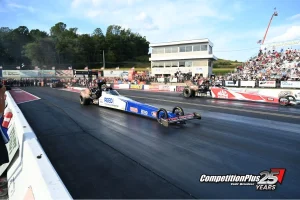
NHRA’s premier championship today is the Mission Foods Drag Racing Series, which stages roughly two dozen national events each season and ends with a playoff format known as the Countdown to the Championship. The top-level professional classes are Top Fuel Dragster, Funny Car, Pro Stock, and Pro Stock Motorcycle, with nitromethane-powered cars routinely covering 1,000 feet in well under four seconds at speeds over 330 mph, following a post‑2008 reduction from the traditional quarter-mile distance for safety reasons. Below the pro ranks, numerous Sportsman categories such as Top Alcohol Dragster, Top Alcohol Funny Car, Competition Eliminator, Super Stock, Super Comp, and the Jr. Drag Racing League provide a ladder system that emphasizes bracket and index racing for competitive balance.
Top Fuel Dragsters are long, rail-style machines powered by supercharged V8 engines delivering on the order of five-figure horsepower, fueled by a mix of methanol and nitromethane and slowed by dual parachutes at the finish. Funny Cars use similar nitro engines but in short-wheelbase, flip‑top bodied cars resembling production coupes, known for spectacular launches and rapid reaction to track conditions. Pro Stock machines are naturally aspirated “doorslammers” with precise engine and chassis rules, emphasizing driver skill and setup to achieve elapsed times in the low‑6‑second range at more than 200 mph. Pro Stock Motorcycles use highly modified bikes capable of mid‑6‑second runs, and recent seasons have highlighted rivalries between riders like Gaige Herrera and Richard Gadson, with titles often decided in the playoff races.
Sportsman racing forms the bulk of NHRA participation, with categories such as Super Comp, Super Gas, and Super Street running fixed index times and Comp Eliminator balancing a wide variety of engine and chassis combinations through handicap starts. Top Dragster and Top Sportsman classes showcase extremely fast sportsman‑level entries on full-tube chassis, while ET‑style bracket programs and the Jr. Drag Racing League introduce young drivers to the sport as early as age five. The most prestigious event on the calendar is the U.S. Nationals at Lucas Oil Indianapolis Raceway Park, where winners receive the iconic “Wally” trophy named after the organization’s founder.
Champions and records
Champions and records in the NHRA Mission Foods Drag Racing Series highlight both long‑term dynasties and the outer limits of straight‑line performance.
Season champions overview
Across the four professional classes, a relatively small group of drivers has collected a large share of titles.
| Class | First title year | Most titles (driver) | Notes |
|---|---|---|---|
| Top Fuel | 1960s | Tony Schumacher (8) | Modern era also dominated by Steve Torrence and Antron Brown. |
| Funny Car | 1970 | John Force (16) | Record for any pro class; many titles in the 1990s–2000s. |
| Pro Stock | 1970 | Bob Glidden (10) | Followed by multi‑title champions like Warren Johnson and Greg Anderson. |
| Pro Stock Motorcycle | 1980s | Dave Schultz & Andrew Hines (6 each) | Recent streaks from Matt Smith and Gaige Herrera. |
Year‑wise NHRA pro champions
Here is the year‑by‑year table of NHRA Mission Foods Drag Racing Series professional champions (Top Fuel, Funny Car, Pro Stock, Pro Stock Motorcycle) from the beginning of the modern championship table through 2025
| Year | Top Fuel | Funny Car | Pro Stock | Pro Stock Motorcycle |
|---|---|---|---|---|
| 1965 | Maynard Rupp | — | Gary Lawson | — |
| 1966 | Pete Robinson | Ed Schartman | — | — |
| 1967 | Bennie Osborn | — | — | — |
| 1968 | Bennie Osborn | — | — | — |
| 1969 | Steve Carbone | — | — | — |
| 1970 | Ronnie Martin | Gene Snow | Ronnie Sox | — |
| 1971 | Gerry Glenn | Phil Castronovo | Mike Fons | — |
| 1972 | Jim Walther | Larry Fullerton | Bill Jenkins | — |
| 1973 | Jerry Ruth | Frank Hall | Wayne Gapp | — |
| 1974 | Gary Beck | Shirl Greer | Bob Glidden | — |
| 1975 | Don Garlits | Don Prudhomme | Bob Glidden | — |
| 1976 | Richard Tharp | Don Prudhomme | Larry Lombardo | — |
| 1977 | Shirley Muldowney | Don Prudhomme | Don Nicholson | — |
| 1978 | Kelly Brown | Don Prudhomme | Bob Glidden | — |
| 1979 | Rob Bruins | Raymond Beadle | Bob Glidden | — |
| 1980 | Shirley Muldowney | Raymond Beadle | Bob Glidden | — |
| 1981 | Jeb Allen | Raymond Beadle | Lee Shepherd | — |
| 1982 | Shirley Muldowney | Frank Hawley | Lee Shepherd | — |
| 1983 | Gary Beck | Frank Hawley | Lee Shepherd | — |
| 1984 | Joe Amato | Mark Oswald | Lee Shepherd | — |
| 1985 | Don Garlits | Kenny Bernstein | Bob Glidden | — |
| 1986 | Don Garlits | Kenny Bernstein | Bob Glidden | — |
| 1987 | Dick LaHaie | Kenny Bernstein | Bob Glidden | Dave Schultz |
| 1988 | Joe Amato | Kenny Bernstein | Bob Glidden | Dave Schultz |
| 1989 | Gary Ormsby | Bruce Larson | Bob Glidden | John Mafaro |
| 1990 | Joe Amato | John Force | Darrell Alderman | John Myers |
| 1991 | Joe Amato | John Force | Darrell Alderman | Dave Schultz |
| 1992 | Joe Amato | Cruz Pedregon | Warren Johnson | John Myers |
| 1993 | Eddie Hill | John Force | Warren Johnson | Dave Schultz |
| 1994 | Scott Kalitta | John Force | Darrell Alderman | Dave Schultz |
| 1995 | Scott Kalitta | John Force | Warren Johnson | John Myers |
| 1996 | Kenny Bernstein | John Force | Jim Yates | Dave Schultz |
| 1997 | Gary Scelzi | John Force | Jim Yates | Matt Hines |
| 1998 | Gary Scelzi | John Force | Warren Johnson | Matt Hines |
| 1999 | Tony Schumacher | John Force | Warren Johnson | Matt Hines |
| 2000 | Gary Scelzi | John Force | Jeg Coughlin Jr. | Angelle Sampey |
| 2001 | Kenny Bernstein | John Force | Warren Johnson | Angelle Sampey |
| 2002 | Larry Dixon | John Force | Jeg Coughlin Jr. | Angelle Sampey |
| 2003 | Larry Dixon | Tony Pedregon | Greg Anderson | Geno Scali |
| 2004 | Tony Schumacher | John Force | Greg Anderson | Andrew Hines |
| 2005 | Tony Schumacher | Gary Scelzi | Greg Anderson | Andrew Hines |
| 2006 | Tony Schumacher | John Force | Jason Line | Andrew Hines |
| 2007 | Tony Schumacher | Tony Pedregon | Jeg Coughlin Jr. | Matt Smith |
| 2008 | Tony Schumacher | Cruz Pedregon | Jeg Coughlin Jr. | Eddie Krawiec |
| 2009 | Tony Schumacher | Robert Hight | Mike Edwards | Hector Arana |
| 2010 | Larry Dixon | John Force | Greg Anderson | L.E. Tonglet |
| 2011 | Del Worsham | Matt Hagan | Jason Line | Eddie Krawiec |
| 2012 | Antron Brown | Jack Beckman | Allen Johnson | Eddie Krawiec |
| 2013 | Shawn Langdon | John Force | Jeg Coughlin Jr. | Matt Smith |
| 2014 | Tony Schumacher | Matt Hagan | Erica Enders | Andrew Hines |
| 2015 | Antron Brown | Del Worsham | Erica Enders | Andrew Hines |
| 2016 | Antron Brown | Ron Capps | Jason Line | Jerry Savoie |
| 2017 | Brittany Force | Robert Hight | Bo Butner | Eddie Krawiec |
| 2018 | Steve Torrence | J.R. Todd | Tanner Gray | Matt Smith |
| 2019 | Steve Torrence | Robert Hight | Erica Enders | Andrew Hines |
| 2020 | Steve Torrence | Matt Hagan | Erica Enders | Matt Smith |
| 2021 | Steve Torrence | Ron Capps | Greg Anderson | Matt Smith |
| 2022 | Brittany Force | Ron Capps | Erica Enders | Matt Smith |
| 2023 | Doug Kalitta | Matt Hagan | Erica Enders | Gaige Herrera |
| 2024 | Antron Brown | Austin Prock | Greg Anderson | Gaige Herrera |
| 2025 | Doug Kalitta | Austin Prock | Dallas Glenn | Richard Gadson |
Official NHRA national records change as conditions and technology evolve; below is a snapshot of headline marks in key classes.
| Class | Record type | Mark | Driver | Track / Year |
|---|---|---|---|---|
| Top Fuel | ET (1,000 ft) | 3.62 s range | Brittany Force | Maple Grove Raceway, late 2010s. |
| Top Fuel | Speed | 340+ mph | Brittany Force | zMAX Dragway, early 2020s. |
| Funny Car | ET (1,000 ft) | 3.79 s range | Robert Hight | Brainerd International Raceway, late 2010s. |
| Funny Car | Speed | 330+ mph | Various (e.g., Hight) | Multiple tracks in the late 2010s. |
| Pro Stock | ET (1/4 mile) | 6.45 s | Erica Enders | Gainesville Raceway, early 2020s. |
| Pro Stock Motorcycle | Speed (1/4 mile) | just over 205 mph | Matt Smith | Sonoma, early 2020s. |
Top Fuel and Funny Car now run to 1,000 feet for safety, while Pro Stock and Pro Stock Motorcycle still use the full quarter‑mile, so record tables are separated by distance.
U.S. Nationals prestige
The NHRA U.S. Nationals at Indianapolis is the single most prestigious event, where a win can define a driver’s legacy as much as a season title.
Recent U.S. Nationals winners in the pro classes usually come from the same core group of championship contenders, concentrating both records and trophies among a relatively small set of elite teams.
Safety innovation and procedures
NHRA safety innovation has evolved from basic organization of street racers into one of the most sophisticated safety ecosystems in motorsport, covering equipment, car design, track infrastructure, and dedicated response teams.
Driver gear and cockpit protection
NHRA mandates multi‑point safety harnesses with SFI‑rated belts that must be periodically replaced, ensuring drivers remain secured even during violent crashes.
Fire protection includes multi‑layer Nomex suits, gloves, shoes, and head socks in nitro and alcohol classes, combined with on‑board fire systems that automatically or manually flood the engine bay with suppressant.
Head‑and‑neck restraints (HANS‑type devices) are required in faster classes to reduce fatal neck injuries, and dragsters/Funny Cars add titanium or similar shields behind the driver’s head to stop debris entering the cockpit.
Vehicle systems and chassis rules
NHRA vehicle systems and chassis rules form a comprehensive framework balancing extreme performance with crash survivability, mandating containment, redundancy, and certification that escalates with speed and power.
Chassis certification and materials
All competition chassis over specific thresholds require annual SFI (Safety Foundation Institute) certification stickers from NHRA-approved inspectors, verifying construction meets exact specs for tube diameter, wall thickness, welding, and geometry.
Top Fuel dragsters follow SFI 2.3P (rear-engine, 4.99 ET quicker), using chromoly or high-strength Docol R8 steel tubing (added 2013) with serialized stickers; Funny Cars use SFI 10.5A (nitro fuel, same ET limit) for short-wheelbase flip-tops. Pro Stock doorslammers hit SFI 25.1-25.3 for small-tire radial configs.
Certification includes hydrostatic testing, magnetic particle inspection for cracks, and rules banning brittle chrome-moly post-2007 John Force shake-rip; yearly re-cert mandatory, with plating prohibited to ensure weld visibility.
Engine and drivetrain containment
Nitro and high-hp classes demand multi-layer protection against blow-ups. Superchargers (Roots-type, 71-series max helix) require SFI 14.1/14.2 restraints—straps covered in fire-resistant material, preventing rotor shrapnel; manifold burst panels vent pressure safely.
Lower engines use SFI 7.1/7.2 ballistic blankets or containment devices; flywheels get SFI 4.1 shields or blankets. Transmissions mandate SFI 4.1 shields (or blankets) for autos, plus locking dipsticks and aftermarket axles/retainers at 135+ mph.
“Diapers” (SFI 9.2 catch pans with absorbent mats) or retention tubes under engines collect oil, clutch dust, and nitro spills during failures—oil-downs trigger fines, points loss, and cleanup delays.
Parachutes, wheelie bars, and aerodynamics
Parachutes mandatory at 150 mph (dual on Top Fuel/Funny Car), with SFI 15.4 rear wheels (harder compounds post-2004 Darrell Russell tire burst) at 7 psi min; auto-deployment electronics trigger 400-600 ft post-finish if driver incapacitated.
Wheelie bars (long struts with sliders) cap front-end lift, preventing flips; adjustable for tuning. Aerodynamics include Lexan windows (fire-rated), titanium cockpit shields (post-Russell), and frame rail retention for clutch material.
Electrical, fuel, and fire systems
Master cut-off switches (labeled “PUSH OFF”) mandatory, accessible externally; batteries secured (no driver compartment unless sealed), with max two units. Fuel cells replace tanks in fast cars, with shutoff valves and sampling ports.
Onboard extinguishers (Freon or equivalent, 10-20 lbs) auto-aim at engines, manual override required; nitro cars add burst-panel sensors for fuel pump kill. Hoses must be steel-braided or NHRA-accepted.
| Threshold | Chassis/Fuel | Engine/Trans | Parachute/Wheelie |
|---|---|---|---|
| 11.50+ ET | Roll bar optional | Basic belts | None |
| 9.99 ET/135 mph | SFI cage cert | Diaper optional | 150 mph+ |
| 7.49 ET/200 mph | Full SFI chassis | Blankets/shields | Dual chute req. |
| Nitro/Pro | 2.3P/10.5A | 14.1 restraints | Auto-deploy sys. |
These rules ensure failures stay contained, scaling from street-legal basics to pro-level fortresses while allowing innovation within tested bounds.
Track length, shutdown, and barriers
NHRA’s approach to track length, shutdown, and barriers focuses on providing time and space to decelerate 300+ mph vehicles safely while protecting drivers and spectators.
Track length: 1,000 ft vs 1,320 ft
Traditional drag racing uses a quarter-mile (1,320 ft), which Sportsman and Pro Stock classes still run.
Top Fuel and Funny Car races were shortened to 1,000 ft after a fatal 2008 incident, cutting terminal speeds and adding shutdown margin at tracks unable to extend physically.
Nitro cars still hit near-300 mph with sub-3.8-second elapsed times, but extra distance lets parachutes fully deploy and brakes engage before the sand trap.
Shutdown area design
Shutdown zones begin at the finish line with paved runoff, followed by sand traps and optional nets or padded barriers.
Design elements include:
-
Extended paved sections for parachutes to open fully and initial braking.
-
Deep sand or pea gravel traps where tires bury in, slowing cars through drag; many were deepened/lengthened post-2008 with smoother entries to prevent skipping.
-
End-zone catch-nets or fencing to redirect airborne cars back into gravel rather than off-site.
Engineering from motorsport barrier experts standardized sand geometry, fence specs, and wall closures for better containment.
Guardwalls, barriers, and fencing
Concrete guardwalls line both sides of the strip, with heights set by safety standards.
Key improvements:
-
Sealed crossover gaps replaced by lockable gates used only between sessions, eliminating escape routes.
-
Overhead catch fencing above walls at the top end to deflect cars inward, borrowing from oval-track tech.
Barrier systems balance rigidity (to contain impacts) with energy absorption (to limit g-forces), tested to avoid spearing or vaulting.
Operational practices in shutdown
Race control and Safety Safari manage the zone actively.
Protocols cover:
-
Pre-run parachute/brake tech inspections, especially for nitro cars prone to compound failures.
-
Drilled response for chute/brake losses: immediate equipment deployment to stabilize, extract drivers, and clear debris/sand.
Shorter nitro distances, refined traps/barriers, sealed walls, and procedures have slashed high-speed failure risks despite rising performance.
Safety Safari and event operations
The Safety Safari is NHRA’s traveling first‑response and track‑prep unit, arriving early in race week to clean and prepare surfaces with scrapers, sweepers, vacuums, and traction compound, then remaining on station for every run.
During events they act as first responders: extinguishing fires, stabilizing cars, assisting drivers before medical teams arrive, and executing rapid oil‑down cleanup to keep the surface consistent and safe.
Their presence, combined with local EMT and air‑medical support, has been a key factor in reducing fatality rates despite ever‑increasing speeds.
Rulebook evolution and “newbie” safety
NHRA’s rulebook has grown from a slim 1950s pamphlet into a 1,000+ page annual tome, scaling safety requirements precisely with vehicle performance to protect everyone from casual street drivers to nitro pros.
Early rulebook milestones (1950s–1970s)
NHRA’s first rules focused on basic organization: class structures by engine size/weight, tech inspections for leaks and tires, and parachutes mandatory for 150+ mph cars by 1959.
1963 introduced flame-proof aluminized suits for fuel/supercharged classes, ending T-shirt era amid nitro’s return. 1970 mandated 5 lbs of onboard Freon extinguishers for Funny Cars (upped to 20 lbs by 1973 with engine-directed nozzles); 1973 added firewall “fire windows” and banned open breathers.
1978 required Top Fuel arm restraints after tumbling cars injured drivers’ limbs, while 1980 made line-lock reversers compulsory to speed turnaround and reduce push risks.
ET/mph-based safety thresholds
Modern rules tier by elapsed time (ET) and speed, ensuring progressive protection without over-regulating slow cars.
| ET Threshold (¼ mile) | Key Requirements |
|---|---|
| 11.50+ sec / <135 mph | Street basics: good tires, battery hold-down, overflow tank, neutral safety switch, seat belts, long pants/shoes, valid license. |
| 10.00–11.49 sec / 135+ mph | Snell/SFI helmet, fire jacket for forced induction/nitrous, roll bar (OEM-bodied cars exempt full cage). |
| 9.99 sec or 135+ mph | Full-face helmet/shield, SFI chassis cert, competition license, head sock if open-face. |
| 7.49 sec or 200+ mph | HANS device, full Nomex suit/gloves/shoes/head sock, onboard extinguisher, fuel cell. |
| Nitro/pro classes | Titanium shields, supercharger blankets, engine diapers, auto-shutoff sensors. |
Eighth-mile equivalents apply (e.g., 7.35 = 11.50 ¼-mile). Newer OEM cars (2014+) get slightly looser limits like 9.00/150 mph street-legal.
Newbie and street-legal progression
Street Legal program welcomes daily drivers: tech card inspection verifies tires, fluids, belts—no major mods needed for 11.50+ cars.
First‑timers get “tech sheets” listing basics; passing unlocks test passes. Quicker? Apply for Level 1–7 competition license via physical, supervised runs, and chassis cert (e.g., 9.99 needs NHRA stamp). Jr. Dragster tiers by age: 6–7 max 13.90 eighth-mile, up to 7.90 for 13–17.
Bracket racers follow same ET rules; violations void best times until re‑tech’d.
Pro and chassis certification
High-end classes demand annual SFI chassis certs (e.g., 9.99 chromoly, 7.49 steel), periodic belt/suit re‑cert, and data loggers for black-box incident review.
Rule amendments yearly tweak thresholds (e.g., 2024 gear ratio limits, 2025 air-pressure switches), informed by crashes and tech feedback, ensuring evolution matches tech advances like carbon brakes and electronic chutes.
Cultural and operational impact
NHRA’s cultural and operational impact extends far beyond the starting line, shaping American motorsport as a family-driven, inclusive powerhouse that blends grassroots roots with professional spectacle.
Family dynasties and talent pipelines
Multi-generational teams define NHRA’s DNA, from the Forces (John’s 16 titles, Brittany’s Top Fuel wins) to Torrences (father Steve, son Nat, multiple championships). These clans create natural rivalries and mentorship, with paddock kids growing into pros—mirroring stock car heritage but emphasizing straight-line speed over ovals. Diversity thrives organically: women like Erica Enders (six Pro Stock titles) and minorities like J.R. Todd (first Black Top Fuel winner) compete without formal programs, outpacing other series in driver inclusivity.
Fanbase and community culture
NHRA draws 40+ million fans annually, second to NASCAR in U.S. attendance, with demographics skewing male (72%), white (85%), and older (35%+ 55-64). Tailgating, open pits, and scanner access foster immersion—fans chat with drivers, tour haulers, and share barbecue in a blue-collar vibe rooted in post-WWII hot rodding. Events like U.S. Nationals (1M+ viewers) build rituals: “The Big Go” draws pilgrims for four days of nitro thunder, embodying communal Americana from dry lakes to modern strips.
Operational structure and venues
Dual headquarters in San Dimas, CA (tech/marketing) and Brownsburg, IN (racing ops at Lucas Oil Raceway) oversee 100+ member tracks, leasing icons like Pomona and Gainesville rather than owning post-Atlanta sales. 2025 modernization at IRP adds towers/suites; 24 nationals plus divisional/Lucas Oil series feed 40,000+ licensed racers. COVID adaptations (2020-21 cuts) and 75th anniversary (2026) projects—like books and media—sustain growth amid TV surges (FOX’s Texas FallNationals record).
Economic and media footprint
Sponsorships (Mission Foods, In-N-Out) fuel $25M+ purses; fanbase expansion from 28M (2018) to 40M+ reflects streaming gains. No diversity mandates needed—NHRA’s open-door ethos attracts broad talent, influencing culture via museums preserving hot rod history. From bootlegger origins to 330-mph nitro, it celebrates ingenuity, fellowship, and thunderous escapism, sustaining a paddock where pros and Sportsmen (10:1 ratio) coexist in motorsport’s most accessible elite.