
The Aston Martin Aramco AMR26 has become one of the most talked-about Formula One cars as teams prepare for the 2026 season. Revealed at the Barcelona Shakedown, the vehicle showcases unconventional design choices that have generated widespread debate among teams, engineers, and fans. Legendary designer and newly appointed Team Principal Adrian Newey discusses the radical approach behind the AMR26 and calls for openness to its innovative features.
Design Strategy Aligned with New Regulatory Landscape
The 2026 Formula One rules introduce a historic simultaneous reset of power unit and chassis regulations, presenting unprecedented challenges. Adrian Newey, known for his aerodynamic expertise across Williams, McLaren, and Red Bull, describes the AMR26’s design as a comprehensive response to these new requirements. He explains,
“We took a really close look at the regulations and what we believe we want to achieve from a flow field perspective to suit them, and from there started to evolve a geometry that attempts to create the flow fields that we want.”
Despite his extensive experience, Newey acknowledges the uncertainty inherent in developing a car under completely new rules.
“With a completely new set of regulations, nobody is ever sure what the right philosophy is,”
he admits, dismissing the idea that his past successes shield him from doubt. Time pressures meant the team committed to an approach including features
“that haven’t necessarily been done before,”
which some view as aggressive, though Newey disagrees:
“I never look at any of my designs as aggressive. I just get on with things and pursue what we feel is the right direction.”
Core design elements of the AMR26 include tightly integrated packaging, front and rear suspension geometries aimed at optimizing airflow, a reworked front wing and nose, redesigned sidepods, and a distinct rear end. Newey highlights the collaboration between aerodynamic and mechanical engineers to achieve the compact layout:
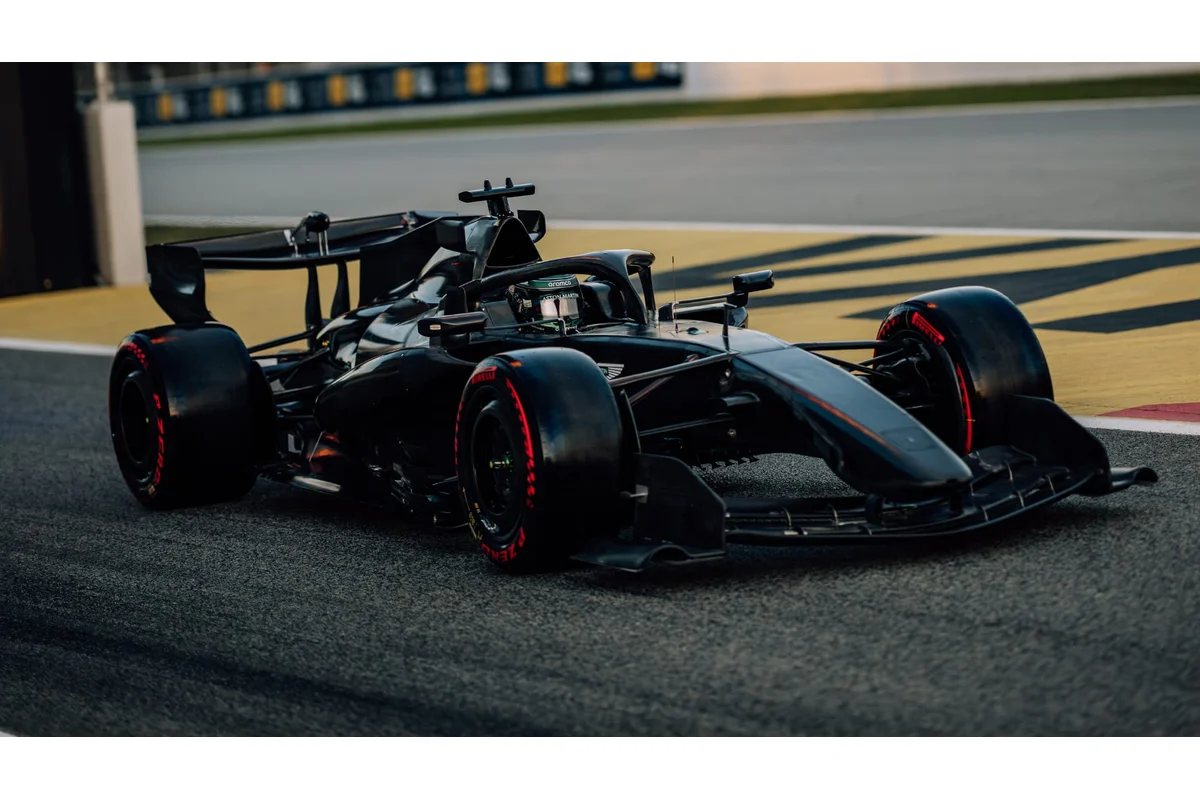
“The car is tightly packaged. Much more tightly packaged than I believe has been attempted at Aston Martin Aramco before.”
Facing Time Constraints and Development Challenges
The development of the AMR26 confronted significant time limitations. Newey joined Aston Martin in March 2025, and the team’s advanced CoreWeave Wind Tunnel was not operational until April, by which point rival teams had already started aerodynamic testing months earlier. Reflecting on this accelerated timeline, Newey describes the past ten months as
“a very compressed timescale and an extremely busy 10 months.”
The car’s debut at the Barcelona Shakedown only occurred in the final days of that session, intensifying pressure on the team.
The design philosophy prioritized a solid foundation with growth potential rather than early performance peaks. Newey remarks,
“We’ve attempted to build something that we hope will have quite a lot of development potential,”
aiming to avoid stagnation later in the season. Drivers Lance Stroll and Fernando Alonso are expected to benefit from a vehicle that is more manageable compared to the challenging ground-effect cars raced from 2022 to 2025.
As Team Principal, Newey views his role primarily as one of leadership and culture-setting rather than direct technical intervention:
“In many ways, to me, it’s simply a title. The role within the team is to try to provide a direction, an ethos, a culture, that we all work by.”
Collaboration with Partners Drives Technological Advances
The new regulations emphasize sustainable fuels, and Newey credits the partnership with Aramco as crucial for the power unit’s development.
“Without having a technical partner and fuel supplier with Aramco’s expertise, Honda’s development of the power unit would be restricted,”
he states. Another key partner, Valvoline, is contributing specially formulated lubricants to improve efficiency, supported by its long motorsport heritage.
Newey regards sustainable fuels as a vital component of achieving carbon neutrality and sees them complementing rather than competing with electric or hydrogen technologies.
“Sustainable fuel is a huge energy solution for the future… It’s really exciting that Formula One is embracing that,”
he remarks.
The CoreWeave Wind Tunnel, recognized as one of the most advanced facilities for Formula One, incorporates artificial intelligence and enhanced computing power to analyze airflow. Newey briefly touches on AI’s role beyond aerodynamics, stating,
“What’s new now will be pretty much out of date in 12 months,”
highlighting the rapid pace of technological change, including in areas such as race strategy.
Anticipating Evolution Throughout the Upcoming Season
The version of the AMR26 seen during the Barcelona Shakedown is far from final. Newey emphasizes,
“The car that races in Melbourne is going to be very different to the one people saw at the Barcelona Shakedown.”
As other teams reveal their interpretations of the 2026 regulations, the true potential of Aston Martin’s design will face scrutiny on track. Newey cautions patience with results:
“Whether that proves to be the right one or not, only time will tell.”
In a period marked by major regulatory transformation, Newey’s call to keep an open mind underscores the risks and possibilities embodied by the AMR26. If its innovative approach proves successful, the car could significantly impact the competitive landscape of Formula One in 2026 and beyond.
