
Francesco Bagnaia has pointed out that the recent equalisation of equipment across the MotoGP field has significantly raised the level of competition, making it harder for star riders to stand out. This season, factory-level bikes from Aprilia, KTM, Honda, and Yamaha are also being provided to their satellite teams, while Ducati extends this to riders Alex Marquez of Gresini and Fabio Di Giannantonio of VR46.
With only Franco Morbidelli and Fermin Aldeguer competing on older bikes this year—both machines having previously claimed world titles—the technological gap is nearly closed. This was evident in Thailand, where despite Yamaha’s struggles, polesitter Marco Bezzecchi was just 1.5 seconds ahead of rookie Toprak Razgatlioglu, the slowest full-time rider in the championship.
Narrow time differences now define the MotoGP grid’s competitiveness
On The BSMT podcast, Bagnaia explained that the time spread separating pole position from the back of the grid is now around eight-tenths of a second. In earlier eras, this gap could reach up to three seconds, as super-factory bikes dominated the field by a wide margin. Today, even a small performance dip can push top riders like Bagnaia well into the midfield ranks. For context, the two-time MotoGP champion finished ninth at the recent Buriram race and ended last season outside the top six on fifteen occasions.
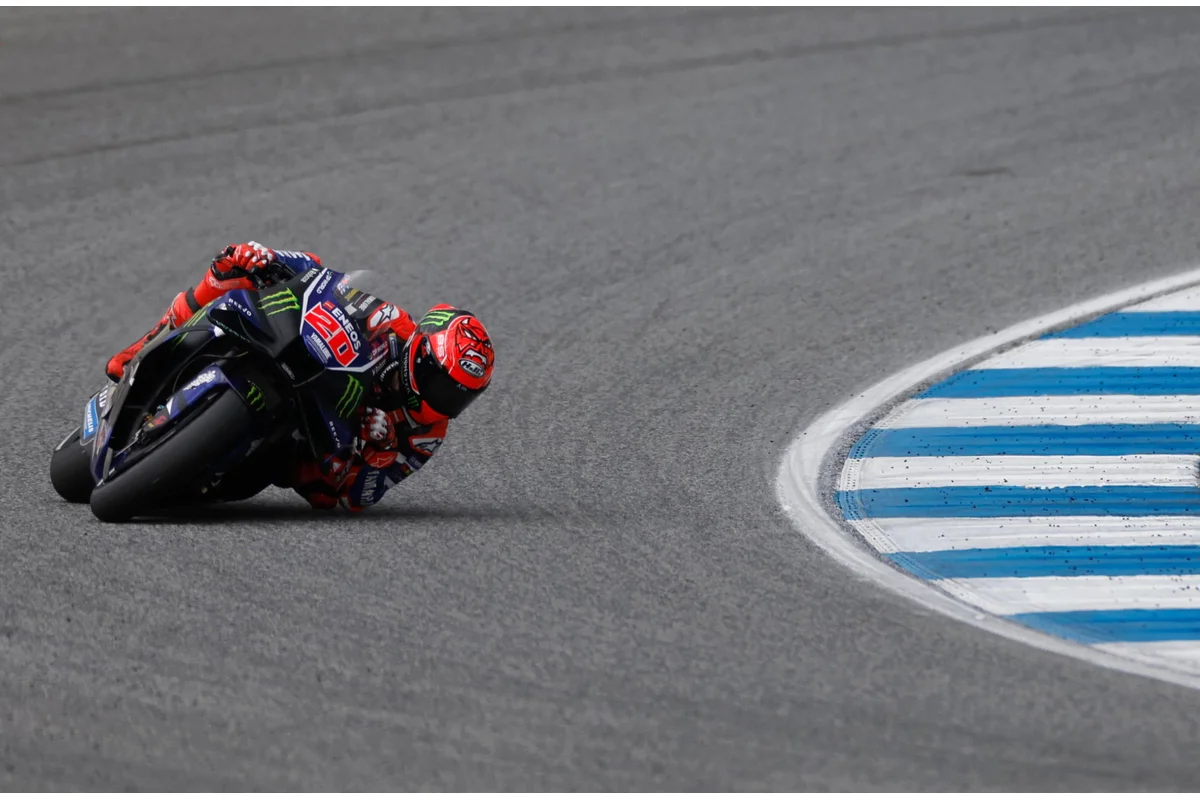
“For me, the top 10 are all incredible in the sense that they are the strongest in the world,”
Bagnaia said.
“And so, from first to 15th, from first to last, there are seven, eight-tenths. Maybe you lose half a tenth per corner, you’re last. It’s such a subtle difference. It’s no longer like once upon a time when there were four riders going very fast with four super factory bikes, the others went a little slower and the difference from first to last was three seconds or two and a half seconds.”
“Now seven, eight tenths makes all the difference.”
The depth of talent on the MotoGP grid surpasses previous eras
A top team manager remarked last season that despite Marc Marquez’s dominance as one of the more experienced riders, MotoGP’s roster is incredibly deep and packed with talent. Out of 22 riders, only five have yet to claim a premier-class victory. Among these are Moto2 champion Diogo Moreira and renowned three-time World Superbike winner Toprak Razgatlioglu, indicating a highly competitive environment.
Emerging stars signal a new era beyond the ‘Fantastic Four’
Rising talents such as Pedro Acosta, currently viewed as one of motorcycle racing’s most exciting prospects, add to the grid’s strength. Ai Ogura, who recently secured the 2024 intermediate class championship, and Luca Marini, with two poles and podium finishes already, also contribute to this new era of competition. Although Marc Marquez remains the last active member of the so-called ‘Fantastic Four,’ the sheer quality of riders now in MotoGP hints at an even stronger and more unpredictable championship.
The increasing parity in equipment and the influx of talented riders make this MotoGP season one of the most fiercely contested in recent history, promising highly competitive races and uncertain outcomes as the year progresses.
