
Joe Gibbs Racing driver Denny Hamlin spoke with the media on Wednesday before the Daytona 500, sharing insights on his current mindset and preparations. Hamlin, piloting the No. 11 National Debt Relief Toyota Camry XSE, reflected on regaining his competitive edge after recent challenges while emphasizing his motivation rooted in a desire to win.
He explained,
“Good. Feel like we’re kind of getting back into the swing of things. Certainly, would be lying and saying I am as highly motivated as I’ve been in years past. I said last week that I would just take some time. Every day at a racetrack is certainly getting there. I know I’m way too competitive to just go through the motions. So, as we get on the racetrack and go through practices and qualifying, we are slowly getting there.”
Motivation from Personal Experiences and Past Challenges
When asked about how recent personal events have influenced his drive, Hamlin revealed that his late father’s presence during his last race was a significant motivator. He described the rekindling of his intense competitive spirit, which had waned in recent months.
“Everyone has different motivating factors, no doubt about it. I feel good about the last race my Dad got to see I was at my best. He got to see as good as I’ll ever be, he got to see that moment. I don’t know where it goes from here, but I certainly feel as though I’m a competitive person and I’m motivated by winning. Doesn’t matter what I’m doing, whether I’m racing or doing a hobby or whatever that might be. I just haven’t been in that fierce competitor type of mindset in months and months now. It’s just now starting to get back. Last week was a good warm up for that. Still wasn’t all the way there, I’m still not all the way there today, but we’re getting there,”
he stated.
Commitment and Adaptation to the Revised Championship Format
Hamlin addressed questions about how his dedication will adapt to changes in the NASCAR playoff format, which now emphasizes a 10-race finale rather than a single championship event. His competitive fire remains strong, and he believes the new structure plays to his strengths.
“Simply because of how competitive I am, that’s where it comes out. The format is a little different, so it’s not going to be all about the one race. How can I distribute that effort into those 10 races at the end of the season, all of that is going to matter. But, it’s still there. I’ve still got plenty of fire left and plenty of ability left and it will happen more natural than you would think.”
Rebuilding Routine and Preparing Physically for the Season Ahead
The driver reflected on the process of reestablishing his rhythm in the car, which he finds crucial for performance, especially early in the season. He explained how specific sessions, like practice and qualifying, help him reconnect with the physical and mental aspects of racing.
“It’s days like this where I’m getting fitted back into the racecar, braking and going up through the gears. Those are the things that really get you excited for this race weekend. For me personally, it’s a way for me to understand I’m back in the routine now,”
Hamlin explained.
The Significance of a Potential Fourth Daytona 500 Victory
Hamlin addressed the prominence joining the elite ranks of multiple Daytona 500 winners would bring. He acknowledged the challenges of achieving four wins at such a prestigious event but remained hopeful due to his past opportunities and competitive capability.
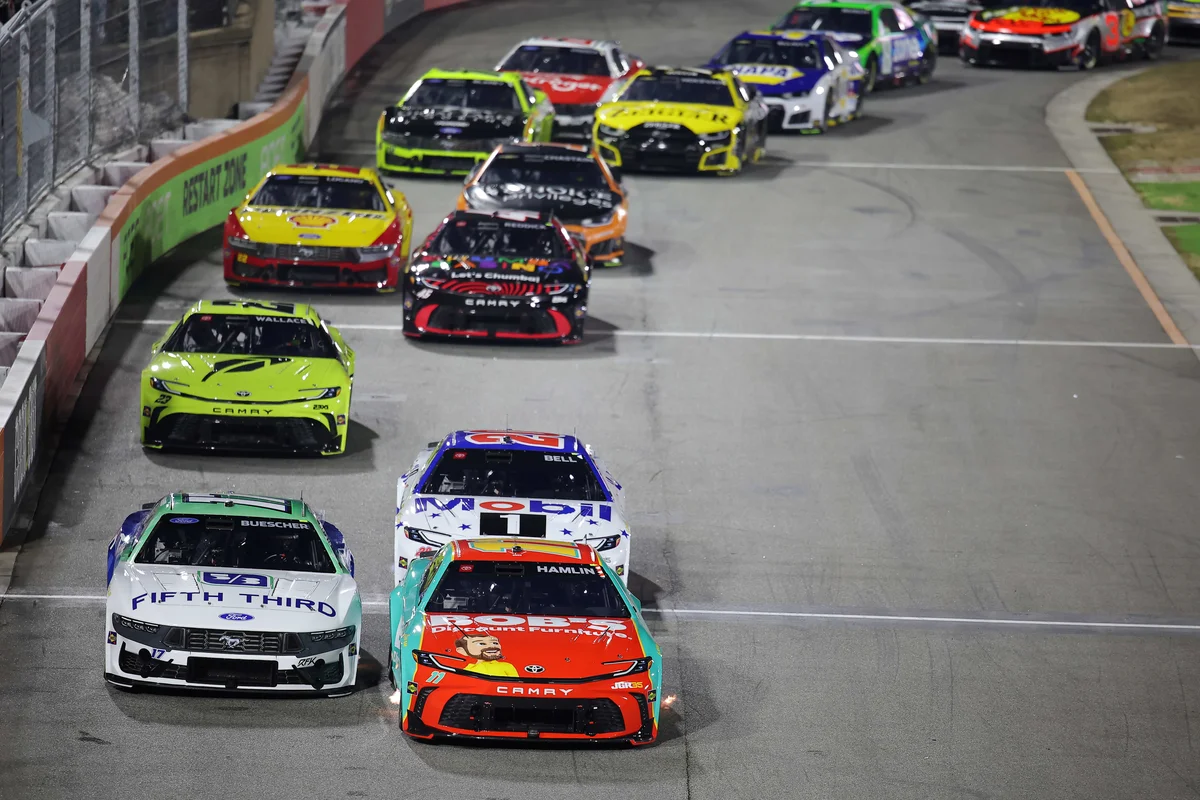
“Every win that gets you here puts you in a certain list. The list is so small at that four number, it certainly was on my mind on the last lap last year when we were leading, that we are going to get another one. I’ve just been really lucky to have the opportunities I’ve had to win these races, but also been very unfortunate in the NextGen era to not have won more. I feel as though the opportunity will be there, and hopefully we can put ourselves in position to move ourselves up that Daytona 500 winners board.”
Contributions to NASCAR’s Evolution and Advocacy for Race Teams
Discussing his role in NASCAR’s recent transformations, Hamlin highlighted his efforts alongside team owners to advocate for fair changes benefiting all teams, emphasizing a collective approach rather than individual gain.
“I heard from most of all the team owners and one way, shape, or form. We really stuck our neck out for all the race teams. There’s no doubt it would have not lasted as long as it did if we were just looking to change for ourselves. We were very adamant that the changes had to be given to the rest of the race teams and hopefully they can appreciate that.”
Managing Physical Challenges: Shoulder Health and Race Demands
Hamlin provided updates on his shoulder condition, which has been a concern affecting his endurance during races. He remarked that although soreness was present after the recent Clash event, he felt better prepared than last year and is focusing on week-to-week physical management.
“It was ok. Truthfully, it wasn’t too bad. Most of the soreness came the day after, where usually at the end of 2023, I was getting fatigued a bit at the end of races. I didn’t have any of that at the Clash, so I’m in a better position then I was then, but we are only on race one of the long season. I think it’s yet to be seen where it goes from here.”
Regarding more physically demanding tracks like Martinsville, he emphasized the importance of ongoing training and muscle activation to compensate for his injury.
“Really the preparation happens during the week, making sure I’m activating all the muscles behind it so I’m helping support it. I don’t have the rotator like it’s supposed to be there. Most of that work comes during the week. Pre-race I do things to try to loosen it up as much as I possibly can. It’s going to be week to week. But on the racetrack, I don’t think there will be a time where I’m holding the car back from performing.”
Emotional Support from Michael Jordan and Joe Gibbs
Hamlin shared reflections on the support he received following personal loss, particularly noting how Michael Jordan reached out to offer help, although their conversations centered around other topics. More intimate support came from Joe Gibbs, who has acted as a mentor and close personal figure for Hamlin.
“No. He obviously reached out multiple times and offered any help he could. Since we were in Winston-Salem, he knew a lot of people in that area. Not really, we didn’t talk about that kind of stuff, more so with Joe (Gibbs). Joe is certainly someone who is very, very, special to me and has been. Joe beat me to the hospital the night of. He’s just unbelievable how he is as a leader and obviously he has been through it. My connection on that personal level is more so with Joe, and it’s always been that way since he took over as my at-track Dad.”
Further emphasizing Joe Gibbs’s compassion, Hamlin revealed the frequent visits Gibbs made to his father and their shared prayers, providing important comfort in a difficult time.
“He made it a point to go if not every week, every other week to visit him for the bulk of last year. Talked stories with him, prayed with him. My Dad was really trying to get right with the Lord last year and felt like Joe was someone who kind of helped with that. It’s not like my parents lived right down the street, he took his time out of his day to go visit him and share stories. I know my dad really, really appreciated that.”
Impact of the New Chase Format on Hamlin’s Strategy and Outlook
Regarding the championship format introduced this year, Hamlin expressed confidence that it promotes consistency and rewards top performers over multiple races rather than isolated victories, which aligns well with his style of racing.
“I don’t think so, but who knows. I don’t think we would have won anyway because I had multiple blown engines in the playoffs last year. Those are the things the champion will not have. I don’t think you are going to have multiple DNF’s in 10 races. I think you can have a bad race, I just don’t think multiple DNF’s are something you are going to be able to overcome without winning lots of races. I think the format is better for me, it’s better for the top six or seven who run up front every week. That’s who it’s going to benefit and that’s who the champion is going to be. The other people have flashes, but it’s always going to be the same six or seven.”
Reflecting on Jimmie Johnson’s Championship Legacy
Hamlin acknowledged the tremendous challenge and quality of competition posed by Jimmie Johnson during his dominant championship runs beginning 20 years ago. He highlighted how changes in technology and competitive balance have made records unlikely to be broken.
“It was amazing because I had to go against it, and it was really, really, really tough to beat. Back then things were different, the teams could build extremely fast race cars. The advantages your team could build into your car were just a lot bigger than what it is today. You can’t build that much speed in your car like you could back then. Those records probably won’t be broken because of how diversified the field is and how much parity is in our sport now. All I can speak to is what I competed against which was one of the best drivers I’ve ever seen and competed against in Jimmie (Johnson).”
Challenges of Specific Tracks and Importance of Early Momentum
Discussing individual track difficulty, Hamlin named Darlington as the most demanding circuit due to its narrow lanes and physical requirements. He also spoke about the significance of a strong start to the season, particularly with two speedway races opening the schedule.
“Darlington is the most challenging track. Just because of how narrow it is and how small of a lane you have to hit to go fast at that track, physically demanding. That’s definitely the far and away the toughest.”
“Is it critical, no. But is it important, I think so. Starting the race season with two speedway races could cause panic if you think you should be one place and find yourself somewhere else after the first two races. If I’m down I won’t panic. Take a deep breath, we are about to go to the tracks where we can score 60 points. It’s all going to work itself out in the wash eventually, but there will be a two-race panic for some guys.”
Intensity and Strategic Positioning in the Closing Stages of the Daytona 500
Hamlin described the high stakes and constant adjustments required during the critical final laps of the Daytona 500. He underscored the necessity of being in the lead pack and managing fuel, teammates, and race conditions to maximize chances of victory.
“I need you to tell me how much fuel I’ve got, where I’m at, how many teammates are around me, what line I’m in and how many laps are to go because it constantly changes. For me as a general rule of thumb, I want to be in the top eight inside 20 laps to go. I think that’s where you have to be. There’s not enough passing after that last stage until the very, very end and you are not going to do it from 15th. When you get inside that last fuel window and at that point it’s all circumstantial. Last year I thought for sure we were going to win it, just where we were and who we were racing and I was positioning ourselves and then you just crash. That’s just the Daytona 500 nowadays, getting crashed is a large possibility. I don’t think I’ve finished well in the NextGen era here, but I’ve ran well. I’ve been very unfortunate. I’m still trying to figure out how to finish these races without getting crashed in any way, shape, or form.”
Fan Support and its Impact on Hamlin’s Performance
Hamlin recognized the increasing fan encouragement he received towards the end of the previous season, which positively influenced his morale despite mixed race results. He welcomed the sound of cheers over boos as a sign of connection with supporters.
“I’m into whatever the fans want to do. It’s the noise that you really want. The fans have been really supportive over the last few months and after Phoenix and how that ended it’s just how many comments and messages I got from fans. It made me feel like I was a champion even though I didn’t have the ring and the trophy. They certainly made me feel like I had accomplished what I was hoping to accomplish. If the boos turn to cheers, that will make me happy.”
Observations on William Byron’s Pursuit of a Three-Peat Daytona 500
Commenting on William Byron’s remarkable achievement of winning three consecutive Daytona 500s, Hamlin acknowledged the difficulty of maintaining such a streak. He noted the importance of strategic positioning and luck at key moments to secure victory.
“It’s hard. You’re going to need things to fall your way. In 2021, I legit thought we were going to get three in-a-row, we led the most laps in that race. Just was really fast, but didn’t work out on the last pit sequence. There’s an element of fortunate there that has to fall your way. Last year, he was fortunate on the last lap there, but if you put yourself in the top eight you can get fortunate at times. He puts himself in the top eight which is what matters.”
Focus on Developing Corey Heim and Expanding Manufacturer Presence
Hamlin addressed the dual purpose of providing rookie Corey Heim with Cup Series experience at Daytona while also increasing Toyota’s manufacturer presence on the track. Both factors are viewed as essential to competitive success.
“It’s both. Giving him an opportunity on a Superspeedway to learn the NextGen car and how different it’s going to drive and feel and draft compared to a truck. But the other one is the numbers, it certainly seems at the end of these races it comes down to numbers and manufacturers and the more we can put on the racetrack the better opportunity we are going to have to win.”
The Importance of Simplifying Competition Formats for Fans
Discussing changes intended to enhance fan engagement, Hamlin expressed support for simpler competition formats that improve understanding among casual viewers. He believes clearer rules and qualification processes foster greater enjoyment and accessibility.
“The more simple things can be, the better off it will be. It helps the casual fan to understand when they are watching the duel tomorrow that they are just looking for the top two finishers, versus who falls back on time and things like that. I understand why things were the way they were for so long, but simplicity is the winner today.”
Strategies for Leading and Managing Risks in the Daytona 500 Final Laps
Hamlin described how being either in the lead or close behind at the race’s conclusion requires careful judgment, as aggressive blocking can lead to crashes while composure can create winning opportunities. He feels confident managing these high-pressure moments without causing incidents.
“It’s all circumstantial. I never don’t want to be in the lead, but I feel really good about being second or third. It all depends on who I’m racing against and what are their tendencies and who can I use their tendencies to help myself. There’s no bad time to be up front. While the wrecks start up front, it’s typically because the leader throws a block that then causes a chain reaction. I typically don’t throw crazy blocks that cause the wrecks because I feel comfortable up front. I don’t mind someone getting beside me and we race it out. It’s really the crazy blocks that end up causing the wrecks. I feel good about controlling the race and feel like we have a good chance if we do.”
Experiencing the Growing Tension and Adrenaline in Race’s Final Moments
Hamlin acknowledged the universal increase in tension as the Daytona 500 draws to an end, comparing the surge in adrenaline and heightened decision-making to the experiences of fans watching from the stands. The skill to slow down mentally remains key to success.
“You do. I think if you looked at everyone’s heart rate raises and continues to raise as it gets closer to the end. It’s very typical, adrenaline starts to hit at that moment. Who can slow the game down and make those crucial decisions at the end are the ones who usually end up winning. You just have to find a way to slow it all down.”
Memorable Moments with Greg Biffle Early in Hamlin’s Career
Recalling early racing days, Hamlin shared a significant memory of competing against Greg Biffle in the Xfinity Series two decades ago. Biffle represented a high standard of competition for the rookie Hamlin, setting a benchmark for speed and skill.
“My biggest memory of Greg Biffle was just racing him in the Xfinity Series, or O’Reilly Series now 20 some years ago. I was a rookie and he was one of the Cup guys who would come down and race on Saturday’s and just trying to beat that guy was incredibly difficult, if not impossible. He was just the gold standard for me when I came into the sport in 2004 on speed.”
