
During the 68th running of the Daytona 500, one of NASCAR’s swiftest and most critical decisions unfolded amid intense action at the famous drafting track. As the race reached its final lap, a massive crash erupted in Turn 1, but officials made the unexpected choice to avoid a caution flag, letting the event conclude under green conditions. This decision sparked controversy but also highlighted NASCAR’s decisive handling of the situation.
Denny Hamlin Supports NASCAR’s Choice to Keep the Race Green
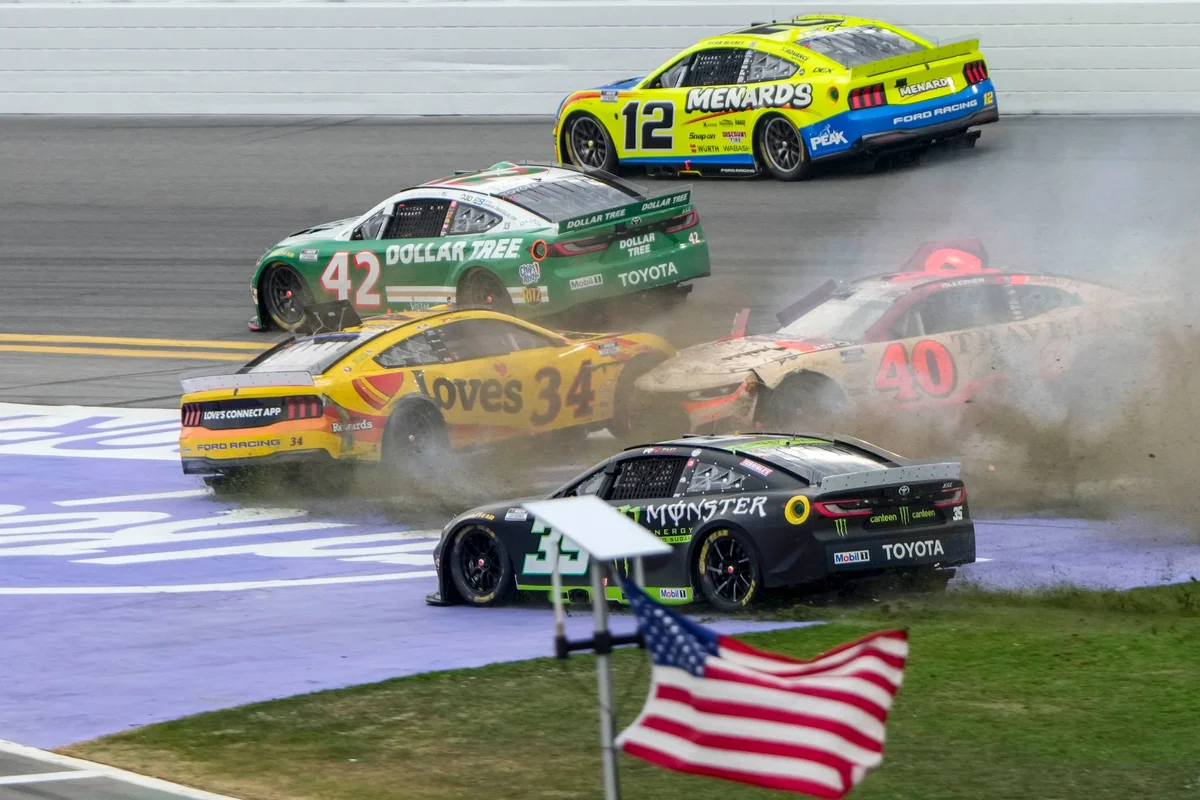
NASCAR’s unconventional call was met with mixed reactions throughout the pit lane and the fanbase. However, Denny Hamlin, a seasoned driver known for candid opinions on race control, commended the consistency behind the no-caution ruling. The incident began as the field approached the white flag, with Spire Motorsports’ Carson Hocevar leading rather than 2020 Cup Series Champion Chase Elliott. Contact between Hocevar and Erik Jones in Turn 1 sparked a chain-reaction wreck involving multiple competitors, including Michael McDowell, John Hunter Nemechek, Ty Dillon, Ryan Blaney, Cole Custer, Corey Heim, Jimmie Johnson, Ross Chastain, Ryan Preece, AJ Allmendinger, and Ty Gibbs.
Despite the crash’s severity, NASCAR declined to throw the caution flag late in the race, allowing the leaders to sprint to the checkered flag instead of an overtime restart that many expected. This decision stunned many teams but was seen by Hamlin as a well-reasoned judgment by race officials, contrasting sharply with the officiating controversies from the recent Truck Series event.
Reflecting on the call during his Action Detrimental podcast, Hamlin shared,
“It was a great finish. I didn’t get to see it, I was on the other side of the racetrack, just trying to get my car to minimum speed in case there was another crash, maybe I gained few spots.”
Tyler Reddick’s First Daytona 500 Victory Amid Intense Chaos
Shortly after the incident, Chase Elliott briefly took the race lead, but further chaos unfolded behind him as Riley Herbst became involved in the scramble. Meanwhile, Tyler Reddick navigated through a second flashpoint near the tri-oval, ultimately charging to the checkered flag to claim his first ever Daytona 500 win. This milestone victory was significant for team co-owners Michael Jordan and Denny Hamlin, adding a historic layer to the outcome.
Hamlin, however, was not close enough to witness Reddick’s winning move directly. He recalled,
“They told me that the No. 45 had won, I had no idea in what shape or fashion,”
and added,
“I went through the Turn 1 wreck, I mentioned it in the media center what I thought about the caution in Turn 1.”
Balanced Perspective on NASCAR’s Race Control Decisions
Unlike his usual vocal critiques of NASCAR’s officiating, Hamlin adopted a more understanding tone when evaluating the choice to keep the race green. On returning to the crash site shortly after the incident, he noticed the track had cleared significantly.
“When I drove through there again about 30 seconds later, after the wreck had happened, there was nobody left on the racetrack; everybody had washed down to the bottom, either to the grass or the apron,”
the driver explained.
He continued,
“I was the only car really coming. Me and maybe the No. 2, were left to have to go through the crash scene, but again, by the time we were there, they were already gone. So, I think NASCAR looked at it holistically and said, ‘There’s no immediate danger.’ Well it was a consistent call from what we saw on Friday.”
The Broader Implications of NASCAR’s Final Decision at Daytona
In a sport where race control decisions often attract as much attention as the competition itself, NASCAR’s restraint to hold green on the final lap at Daytona may signal a shift toward more consistent and holistic officiating. This approach could help rebuild trust between teams, drivers like Denny Hamlin, and race officials moving forward. As the Daytona 500 continues to be a marquee event in the racing calendar, how NASCAR manages these critical moments will remain under close scrutiny from the racing community and fans alike.
