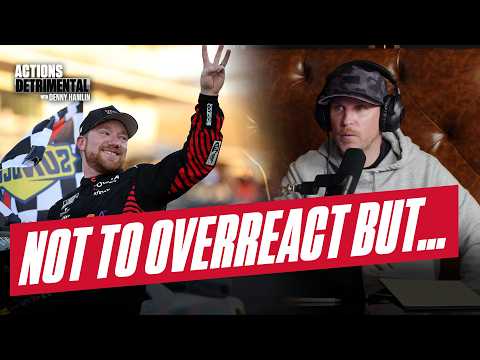
Veteran NASCAR driver Denny Hamlin has openly criticized Corey Day, a development driver for Hendrick Motorsports, after a chaotic start to the O’Reilly Auto Parts Series season. In the first three races, Day was involved in several crashes, mostly attributed to his own errors, with little accountability shown. Hamlin’s concerns stem from Day’s repeated mistakes and escalating conflicts with other drivers, jeopardizing his standing in the sport.
The clash between Day and Connor Zilisch at COTA exemplified the mounting tension. Hamlin, co-owner of 23XI Racing, warned the young dirt racer that his future in NASCAR depends on cleaning up his driving style and delivering better results, as his current approach is creating friction across the series.
How long does the experiment continue to go? I mean you’ve seen good runs out of him. I haven’t seen a lot of great runs out of him. You’ve seen more mistakes than you’ve seen great runs. And like when I say mistakes, like big ole blatant mistakes. And every weekend there’s some guys that are upset.
Denny Hamlin said via Actions Detrimental.
Comparing Corey Day’s Driving Style with Carson Hocevar’s Aggression
Hamlin further distinguished Day’s approach from that of other aggressive drivers like Carson Hocevar. While Hocevar is known for calculated aggressiveness that earns track position, Day’s contact with other racers often appears unnecessary and counterproductive. This difference has contributed to the skepticism surrounding Day’s performance and temperament on the track.
It’s very different than Carson Hocevar, right? Like it feels different in the sense of like Carson’s just really, really aggressive and makes contact where Day just makes contact. There’s a difference.
Denny Hamlin added.
Questions Raised About Hendrick Motorsports’ Patience with Day’s Development
Hamlin onlooked Hendrick Motorsports’ tolerance for Day’s ongoing mistakes with skepticism. He questioned how long the team intends to give Day the benefit of the doubt before expecting consistent race wins. Hamlin implied that the development period might soon reach a critical point where continued underperformance could affect Day’s position with the team.
My question will be for Hendrick, because obviously I don’t think they’re in this to, just, for charity reasons. I think they’re trying to develop someone. How long do of a rope do you give him? Is it to the end of the year? Is it next year also? Like, OK, by next year you need to be winning three or four races or more. How long is the rope?
Denny Hamlin said.
Despite comparisons between Day and reigning Cup Series champion Kyle Larson—who also had his share of on-track mistakes early in his career—the key difference is Larson’s ability to convert risk into wins. Hamlin emphasized that frequent mistakes without corresponding success diminish the justification for leniency.
Because when you make a ton of mistakes like it seems like he’s making, you’ve just got to think that you’re not as willing to deal with not winning if you’re also making mistakes. If you win a lot of races and you’re making a lot of mistakes, it sounds like Kyle Larson. You know what I mean? But yeah, you’re willing to deal with it in the Kyle Larson sense because the guy’s going to win you a ton of races.
Denny Hamlin added.
Implications for Corey Day’s Career and Hendrick Motorsports’ Strategy
The pressure on Corey Day to refine his driving and avoid alienating fellow competitors is mounting. Denny Hamlin’s vocal critique signals that teams and fans alike expect more than erratic performances from a promising young driver backed by a major organization like Hendrick Motorsports. Ultimately, Day’s ability to evolve could determine whether he remains a part of the competitive NASCAR landscape or loses his seat to emerging talents.
For Hendrick Motorsports, balancing patience with performance could prove critical as they aim to cultivate a winning driver without enduring damaging mistakes. The comments from Hamlin underscore the urgent need for Day to demonstrate growth and consistency in upcoming races to justify the investment in his development.