
The 2026 MotoGP preseason test unfolded in Sepang, Malaysia, marking the beginning of the final year for the current 1000cc motorcycles. Ducati, the team that has controlled much of the past five years, reaffirmed its dominance by setting the fastest lap times and showcasing significant technical improvements across their lineup.
The three-day test also saw promising developments from Aprilia, KTM, and Honda, who all improved their performance metrics compared to previous years. However, Yamaha faced considerable difficulties both with rider injuries and mechanical failures, raising questions about its competitiveness early in the season.
Ducati’s Continued Supremacy and Technical Innovations
Ducati maintained its remarkable form after winning 17 of the 22 races and 19 sprint events in 2025. General Manager Gigi Dall’Igna emphasized the desire to reclaim dominance fully following a dip last fall due to Marc Marquez’s absence. The factory arrived in Sepang with a range of upgrades, including a new ride-height device significantly larger and positioned at the bike’s front. Additional fine-tuning to the engine, chassis, and swingarm were complemented by aerodynamic trials, particularly testing bulky front winglets, though engineers leaned toward last year’s aero package by the end of testing.
Alex Marquez, riding for Gresini Ducati, set the quickest lap at 1:56.402 on this 3.8-mile circuit, narrowly missing the track record by less than a tenth of a second. Other Ducati riders dominated the top rankings with Fabio Di Giannantonio third, Marc Marquez fourth, Pecco Bagnaia fifth, and Franco Morbidelli sixth.
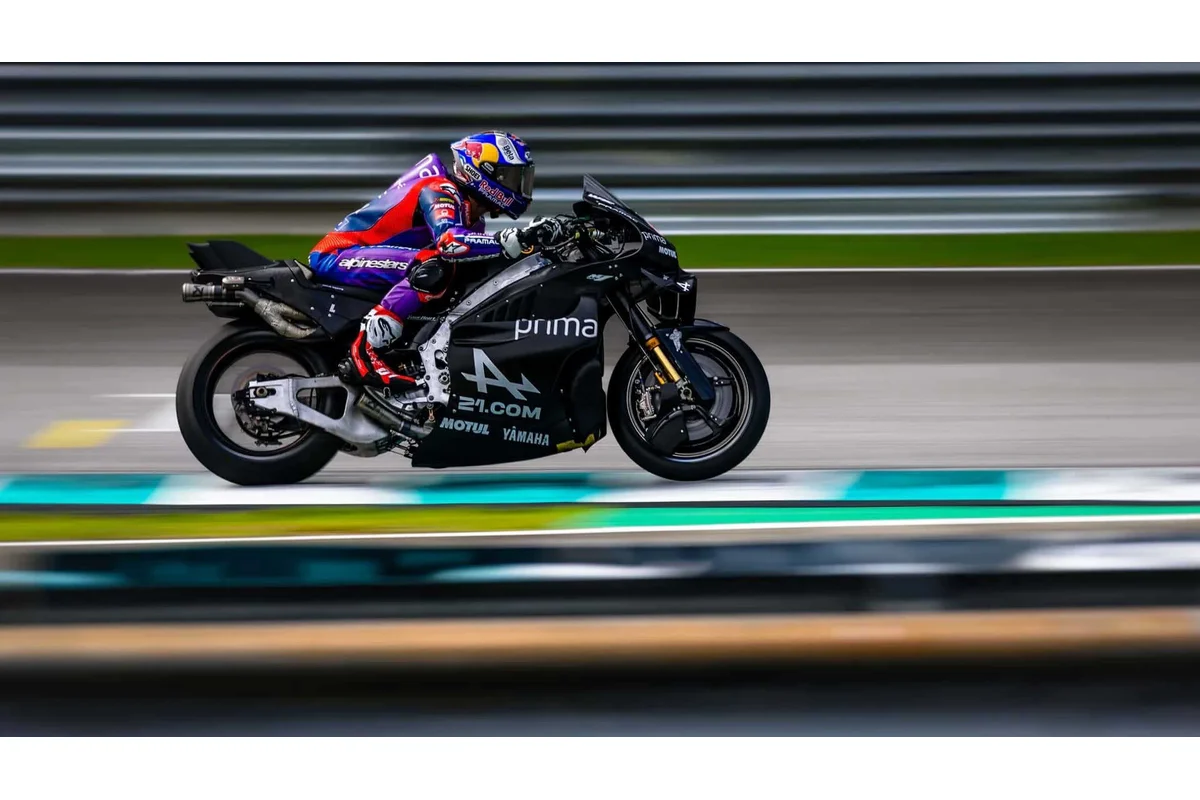
Di Giannantonio indicated that
“90 percent of their preseason work is now complete,”
marking strong confidence in the bike’s readiness. Ducati’s advantage extended into the Sprint race simulations on Thursday, where Alex Marquez again led the timesheet with an average lap time of 1:58.027 over ten laps. Bagnaia and Marc Marquez followed closely, while the fastest non-Ducati, Pedro Acosta, lagged by over six-tenths of a second per lap.
Marc Marquez’s return from a significant right shoulder injury showed constructive progression. Reflecting on his condition, he stated,
I noticed, especially on [Thursday] afternoon, my position on the bike was not the best one, but this will help me for the Thai GP,
demonstrating cautious optimism about his form ahead.
Improvements were also evident in the GP26’s top speed, with four Ducati bikes topping speed charts during the test. Notably, Bagnaia and Di Giannantonio, riders who struggled previously on the GP25 model, showed marked performance improvements. Bagnaia commented,
From the first lap on day one, I felt better,
adding,
The biggest issue [last year] was to find consistency in feeling from the front. And here, with all the ‘tries’ we’ve made, the front was feeling good.
Aprilian Advancements and Bezzecchi’s Strong Showing
Aprilia entered the test week with spirits buoyed by Marco Bezzecchi’s contract extension through 2028, celebrated in an unusual ceremony themed like a wedding with his RS-GP. The Italian rider combined strong on-track performance with guarded media interactions, revealing little about the bike’s specifics even as his pace impressed. Aprilia’s 2026 model was notably reworked in aerodynamics, featuring a distinctive halo-shaped tail and updated electronics. Bezzecchi ranked second overall on the timesheets and was the only non-Ducati rider among the top four.
Despite Bezzecchi’s simulation laps being on average nine-tenths slower than Alex Marquez’s, his slower times were partly due to running highly worn tires, suggesting potential for greater speed. Aprilia Racing CEO Massimo Rivola expressed satisfaction with the team’s progress, saying,
I’m happy about the fact that the ’26 [bike] is better than the ’25,
and added,
Again, it shows that Noale is quite a good company, able to improve the performance every year. Again, someone [else] is leading. But we’ll stay in the slipstream.
However, the team was without Jorge Martin, who was sidelined recovering from wrist and shoulder surgeries. Despite this, Martin expressed positive support from the sidelines, stating,
[It seems] we’re picking the thing up from where we left it [at the end of ’25]. I feel the bike is working really good,
highlighting steady development.
There were challenges for Aprilia’s Trackhouse riders Raul Fernandez and Ai Ogura, finishing 10th and 12th respectively. Both riders found that the new package did not fully suit their riding styles, indicating room for adjustment as the season approaches.
KTM’s Significant Progress and Rider Confidence
KTM’s performance at Sepang marked a sharp improvement compared to last year when the team struggled through financial issues and project instability. The Austrian manufacturer has since stabilized and entered the 2026 test with renewed vigor. Pedro Acosta, returning aboard the RC16, expressed pleasant surprise at the extent of the bike’s development, saying,
I was surprised by how much they were able to develop,
and,
I think they made a really big step.
Acosta’s confidence was further boosted by the RC16’s improved front-end stability, reducing the number of crashes that had marred his previous outings. He noted,
Generally, this KTM feels more natural,
adding that the bike no longer demands 100 percent effort for solid lap times, making riding easier and safer.
Despite a reality check during Thursday’s Sprint simulation, rating the test a “six out of 10,” Acosta acknowledged that KTM is closer to the front pack than before. Another rider showing promise was Maverick Viñales, recently recovered from serious shoulder tendon injuries. Viñales was third fastest on the first day and secured ninth overall by the end of testing. He credited Jorge Lorenzo for pushing him to work harder during difficult conditions, highlighting the beneficial influence of Lorenzo’s mentorship.
Honda’s Encouraging Strides and Ongoing Challenges
Honda entered the preseason on a positive note after test rider Aleix Espargaro’s impressive pace at the preceding Shakedown test, during which he declared,
This is the best bike I’ve ever ridden,
setting high expectations for the official Sepang event.
Over three days, Honda built on this foundation with key upgrades including a lighter RC213V chassis, a more powerful engine, and revamped aerodynamics inspired by Ducati’s winglets. This culminated in Joan Mir topping the timesheets on Wednesday, the first Honda rider to do so in an official test since early 2022, although rain cut short his day. Team manager Alberto Puig confirmed,
We made big progress with the machine. It’s not been a revolution. But small points in areas we knew we needed to improve—small things that make the final result quite big.
He added,
The target is to win as soon as possible, clearly.
Despite this optimism, Mir was more reserved after the test concluded, deeming the package “slightly better in every area,” and predicting he could realistically fight for a top-four finish if a race were held immediately. However, he acknowledged Ducati’s edge after observing Alex Marquez’s near-qualifying pace in the Sprint simulation, commenting,
Some of his laps were like qualifying.
An ongoing issue for Honda remains rear grip, which is still lacking compared to rivals. Mir emphasized this concern, stating,
[In terms of] grip, still we’re very far. That’s the only thing we should focus on from now.
Yamaha’s Struggles and Setbacks in Preseason Testing
Yamaha’s 2026 MotoGP preseason began with substantial hurdles, as the team confronted early mechanical problems and injuries that severely compromised their test progress. Star rider Fabio Quartararo withdrew on the first day after fracturing his right hand during a high-speed crash. His early assessments of the new V4 YZR-M1 motorcycle were bleak, admitting,
I cannot say I’m confident because we see how much we suffer; we see that our lap times are not very good,
underscoring critical performance deficits.
The situation worsened on Tuesday when Quartararo and newcomer Toprak Razgatlioglu both suffered engine failures, prompting Yamaha to pull all their riders from the track amid safety concerns. Technical director Max Bartolini explained the cautious approach, saying,
[We know] what the issue is, yes,
and,
What caused it is what we are trying to figure out. Considering the safety of our riders and the other riders, we decided before to come back on track to really understand which was the problem.
When riders Alex Rins, Jack Miller, and Razgatlioglu returned on Thursday, their lap times were uncompetitive. Their bikes consistently registered the slowest speeds through the speed trap, falling about seven mph behind the leaders. Significant ongoing adjustments to chassis and swingarm configurations were made throughout the day, reflecting Yamaha’s struggle to find stability.
Razgatlioglu, a 21-time WorldSBK winner, faced his own challenges adapting to the bike, finishing 19th overall and nearly two seconds slower than leading times. He described his experience saying,
My feeling with the [Michelin] front is good; I’m strong on the brakes,
but added,
But I still can’t understand the rear. It’s so sensitive, and I’m struggling in long corners.
On the final day, the Turkish rider’s frustration was evident, as he noted,
In Superbike, I rode aggressive. Here I need to be much smoother.
His comments reflect the difficult transition and the harsh learning curve Yamaha riders face in adapting to the new machine and MotoGP competition.
Significance of the Sepang Test and Outlook for the 2026 Season
The 2026 MotoGP preseason test in Sepang underscored Ducati’s overwhelming favor as the team to beat, with multiple riders setting blistering lap times and showcasing enhancements that build on their recent dominance. Their extensive technical developments and superb rider performances suggest the Italian manufacturer is well-positioned to continue leading the championship fight.
Meanwhile, Aprilia, KTM, and Honda all demonstrated viable signs of progress, raising hopes for a more competitive field, although none presently challenge Ducati’s supremacy fully. Aprilia’s aerodynamic advancements combined with Bezzecchi’s speed and KTM’s improved handling provide intriguing storylines for the year ahead. Honda’s moderation between cautious optimism and lingering issues emphasizes their ambition tempered by technical challenges.
Conversely, Yamaha’s ongoing difficulties could impact their season strongly unless swift solutions emerge. The team’s mechanical troubles and rider injuries highlight the challenge of fielding a competitive package in an increasingly advanced field.
As the final year for the 1000cc bikes begins, teams will now focus on refining these developments before the season opener. Ducati’s head start sets a high benchmark, but ramped-up competition from others could create a gripping contest, provided rivals can close the gap. The coming months will be critical for all manufacturers aiming to capitalize on the 2026 MotoGP preseason test momentum.

