
During the opening Formula 1 pre-season test held at the Circuit de Barcelona-Catalunya last week, George Russell offered an optimistic assessment of Mercedes’ 2026 car. The test marked the beginning of F1’s new era, centered around a significant technical overhaul including a completely new engine formula aimed at reshaping competition.
Mercedes, often touted as the front-runner for the upcoming season, benefited from their experience in the turbo-hybrid era, which brought the team eight consecutive championships starting in 2014. The Brackley-based squad appears to have crafted a powerful new engine, a claim reinforced by a solid performance during the Barcelona test sessions.
Reliability and Performance Milestones from Mercedes’ Testing
The Mercedes power unit logged over 1,000 combined laps with all customer teams involved, with the factory team itself completing 501 laps alone. Russell notably recorded the second-fastest lap time of the test, finishing less than a tenth of a second behind teammate Lewis Hamilton’s best effort of 1:16.348. Despite these impressive numbers, Russell emphasized aspects beyond pure speed.
The driver expressed satisfaction with the absence of “porpoising,” a persistent problem for many teams with ground-effect designs in recent years. Highlighting this, Russell said,
“It’s been a positive test; we had lots of mileage on the car, which was the main focus of the test,”
adding,
“The car is feeling nice to drive, there are no major issues, and no porpoising, which is pretty good news for all of us.
It will save a few years on the back, so all in all, it was a decent few days.”
These remarks suggest that Mercedes has made significant strides in addressing reliability and handling issues that affected many competitors early in the new regulations.
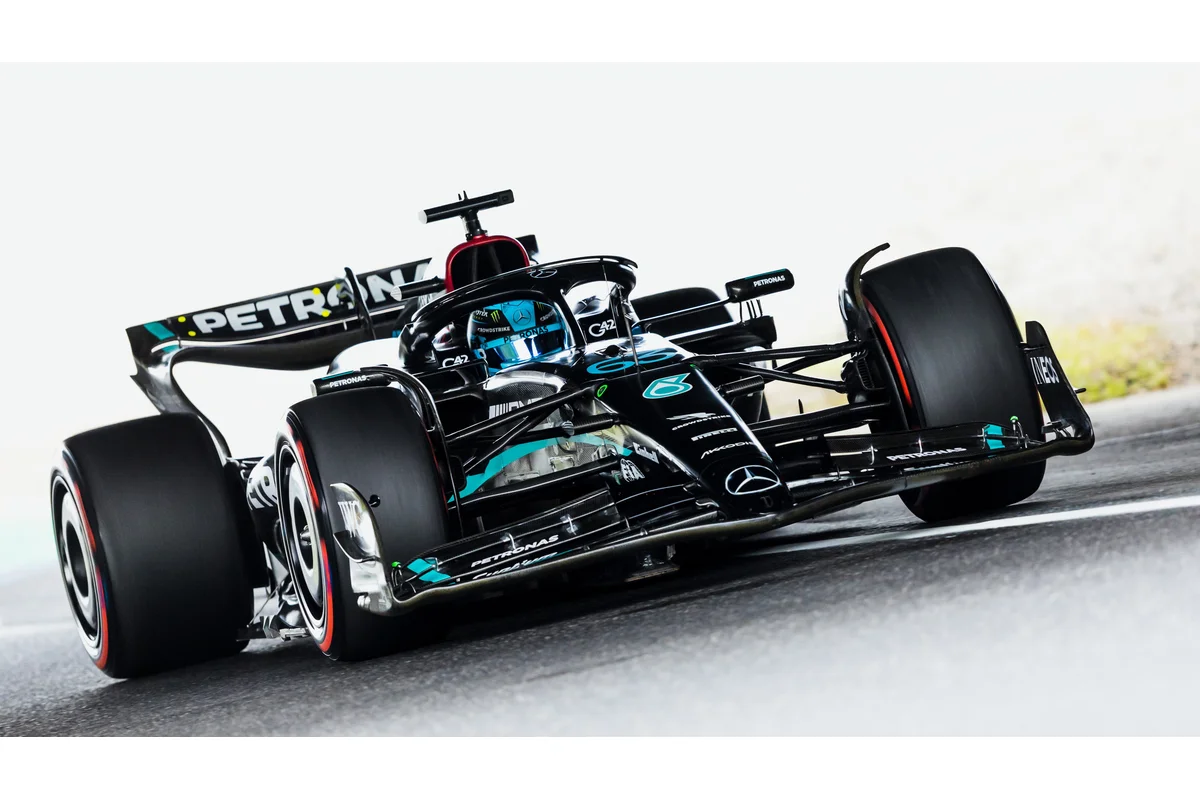
George Russell’s Measured View on Mercedes’ Current Standing
Despite the promising indicators, Russell remained cautious about immediately gauging outright competitiveness from the Barcelona test results. He pointed out that early-season testing often does not reflect the true pecking order, especially given the preliminary nature of the 2026 cars. For example, Ferrari admitted bringing only a spec-A version of their car to this initial test.
The primary aim for most teams in Spain was to focus on durability and getting valuable mileage before moving to the upcoming pre-season tests in Bahrain in February. In reflecting on this, Russell commented,
“The car has been working well, but it is not about how well it works; it is about how quickly it goes around the track, and we don’t really have an indication of that at the moment,”
further noting,
“But we’re in a reasonably good place, but I’m sure things are going to change a lot between now and the next Bahrain test, and then I am sure people will be bringing upgrades to the car, so it is still very much early days.”
His remarks underscore the uncertainty that still surrounds team performances as the pre-season progresses and upgrades are introduced ahead of the season opener in Australia in March.
Implications for Mercedes and the Upcoming F1 Season
Mercedes’ strong showing in the first test, coupled with Russell’s positive yet cautious feedback, positions the team as a serious contender entering the 2026 season. Their apparent success in overcoming early technical challenges like porpoising could give them a competitive advantage as the field adapts to the new regulations.
Looking ahead, the real assessment of each team’s potential will emerge after the Bahrain test and once all upgrades have been incorporated into the cars. For Mercedes, the focus remains on refining the W17 and maximizing pace, while maintaining reliability. Russell’s measured optimism hints at a team keenly aware that early promise must be translated into consistent race-day performance.
With the season opener in Australia a few months away, fans and analysts alike will watch closely to see if Mercedes can re-establish dominance in Formula 1’s newest era.
