
Mercedes has positioned itself as a frontrunner in Formula 1’s 2026 regulation cycle following a strong performance at the Barcelona Shakedown, where George Russell and Kimi Antonelli demonstrated notable pace and reliability. Over three days of private testing, the Mercedes team logged more laps and distance than any other outfit, highlighting their early advantage in preparation for the upcoming season.
Throughout the testing, Mercedes completed 500 laps and covered over 2,300 kilometres, with Russell contributing 265 laps and rookie Antonelli adding 237. This extensive mileage provided the team with crucial data across various performance parameters. In comparison, Arvid Lindblad of Racing Bulls completed 167 laps, with his team second overall at 319 laps, underlining the substantial gap between Mercedes and other contenders.
Andrew Shovlin, Mercedes’ trackside engineering director, praised the team’s reliability during the testing phase.
“From a reliability perspective, it’s been a good week for us. The car has enabled us to run the programme exactly as we wanted, each of the three days, and that’s what we hoped for coming here to Barcelona,” Shovlin said (via Mercedes debrief). “It is a huge testament to the hard work of everyone at Brackley and Brixworth in bringing this car to life. We’ve also made good progress with some of the challenges we saw on days one and two, and that is pleasing.”
Though Mercedes team principal Toto Wolff has downplayed speculation about having the fastest car, the data from Barcelona fuels optimism. The team outpaced rivals such as Ferrari, Red Bull, and Racing Bulls not only in total distance but also by setting the two fastest lap times of the test week.
Russell set the quickest lap at 1m16.445s, closely followed by Antonelli at 1m17.081s. Meanwhile, Red Bull’s Isack Hadjar was over a second slower in third place, with Ferrari’s Charles Leclerc further adrift. Several competitors faced interruptions due to red flags, but Mercedes maintained consistent running across all days.
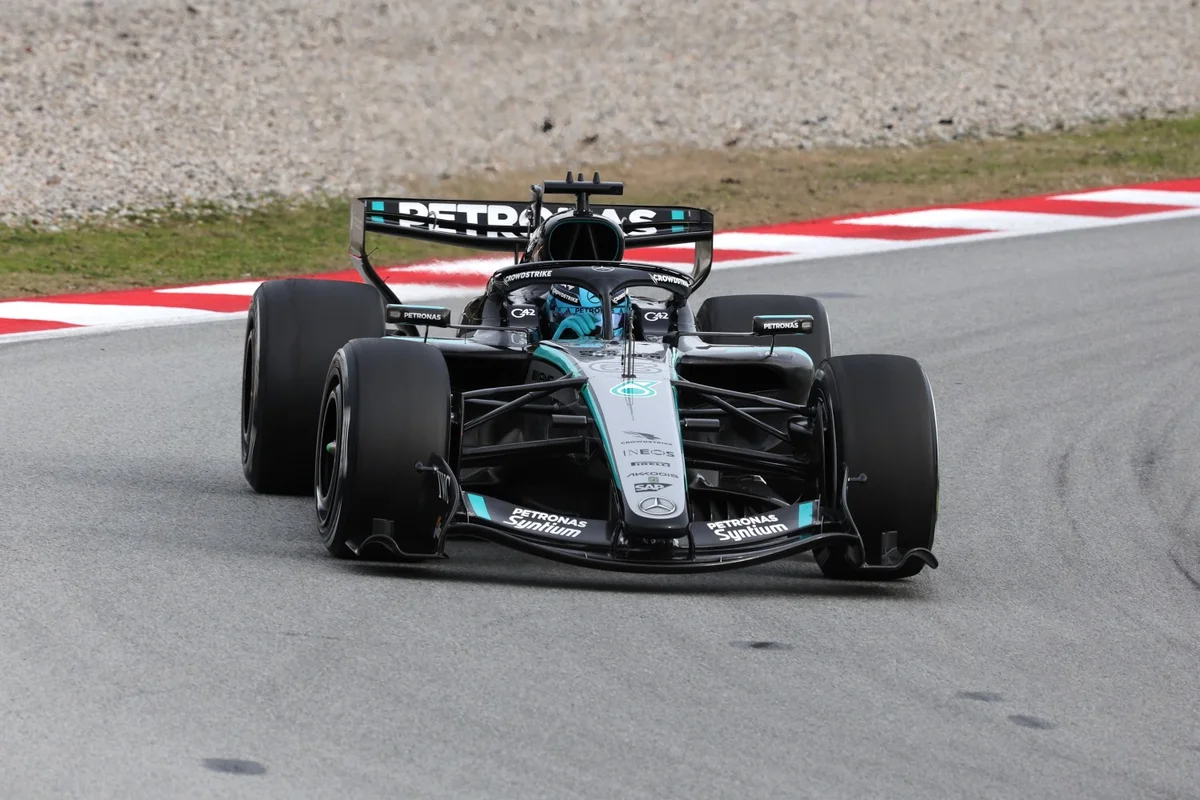
Russell echoed the positive outlook, emphasizing the importance of reliability as a solid foundation for the season.
“I think it was a very positive test, to be honest, and we had lots of mileage on the car, which was the main focus of the test,” Russell told F1.com. “The car’s feeling nice to drive, no major issues, no porpoising, which is pretty good news for all of us, so all in all a decent few days.”
Detailed Progress of Mercedes Across the Barcelona Shakedown Sessions
Kimi Antonelli opened Mercedes’ testing schedule on Day 1, completing 56 laps and achieving a best time of 1m20.7s in the morning. Russell then took over, finishing the afternoon session with 93 laps and second-best lap time, trailing Isack Hadjar by just over half a second.
The team opted out of running on Day 2 but returned strongly on Day 3, with Antonelli leading the timesheets at 1m17.362s, narrowly ahead of Russell. Both drivers combined for 168 laps on Day 4, with Russell setting the fastest lap once more. This consistency clearly illustrates the effectiveness of Mercedes’ W17 car package.
For George Russell, now entering his fifth year with Mercedes and the team’s lead driver following Lewis Hamilton’s departure, this momentum is a significant step. At 27 years old, Russell appears well-positioned to take full advantage if the positive signs from testing carry forward into race conditions.
Looking Ahead: Shifting Attention to Bahrain and Structural Changes Within Mercedes
Mercedes’ encouraging results at Barcelona mark a contrast to the challenges faced in the previous ground-effect era from 2022 to 2025, offering renewed optimism as the team prepares for official pre-season testing at the Bahrain International Circuit. The sessions in Bahrain are scheduled for February 11-13 and February 18-20, ahead of the Australian Grand Prix on March 6.
Russell remains cautious about overestimating current performance, acknowledging the ongoing development across teams.
“We’re in a reasonably good place, but I’m sure things are going to change a lot between now and the next Bahrain test,” he said. “People will be bringing upgrades, so it’s still very much early days.”
Shovlin also highlighted the differences Bahrain’s warmer conditions will bring to testing strategies.
“In Barcelona, we have only really been focused on proving out the W17,” he added in the debrief. “In Bahrain, we will switch to set-up exploration, which you can’t do here when it is so cold. That will give us a much better idea of the car’s relative abilities.”
Meanwhile, Mercedes is preparing for a mid-season personnel transition within its technical leadership. Giacomo Tortora will succeed John Owen as car director, marking a shift for a key figure who has overseen the design of all 17 Mercedes Formula 1 cars to date. Owen’s departure will be managed under the supervision of deputy technical director Simone Resta.
These developments, combined with the promising early performance seen at Barcelona, suggest that Mercedes and George Russell are building a strong foundation to challenge for the 2026 championship. How well the W17 and the team’s strategies perform during upcoming tests will critically influence their prospects as the season approaches.
