
Jimmie Johnson has highlighted the significant challenges involved in transitioning between IndyCar and NASCAR, emphasizing the complexities beyond what casual observers might assume. The seven-time NASCAR Cup champion, now engaged in multiple racing disciplines, explained how the learning curve varies considerably depending on the direction of the switch.
Drawing from his personal experience, Johnson discussed his move from NASCAR to IndyCar starting in 2021. After stepping away from full-time NASCAR competition in 2020, he joined Chip Ganassi Racing for a partial IndyCar schedule and then competed full-time in 2022, fulfilling a longtime aspiration. Despite moments of strong performance, such as a top-five finish at Iowa Speedway on an oval track, Johnson found road courses particularly difficult to master, illustrating the technical demands of the open-wheel series.
The distinct challenges between IndyCar and NASCAR driving
During a recent episode of the SPEED show, hosted alongside Kevin Harvick and Will Buxton, Johnson detailed what he found most difficult when switching to IndyCar. He explained that success in IndyCar requires a level of aggression that felt counterintuitive compared to NASCAR driving.
“You’re rewarded for aggression in an Indy car. The more air speed you have over the car, the more downforce it has, more grip you have. I got to a point where I’d stick it in the fence, I’d come in and Dario (Franchetti) was my coach, and he’d compare my center corner speed and why I made a mistake. He’s like, ‘Oh, well, you crashed cuz you’re going too slow,” he said. (13:31 onwards)
Johnson described how the concept of “overdriving” was essentially flipped from what he was used to in NASCAR. In stock cars, pushing too hard through a turn often results in losing control, but in IndyCar, increased speed can actually increase aerodynamic grip, improving cornering performance.
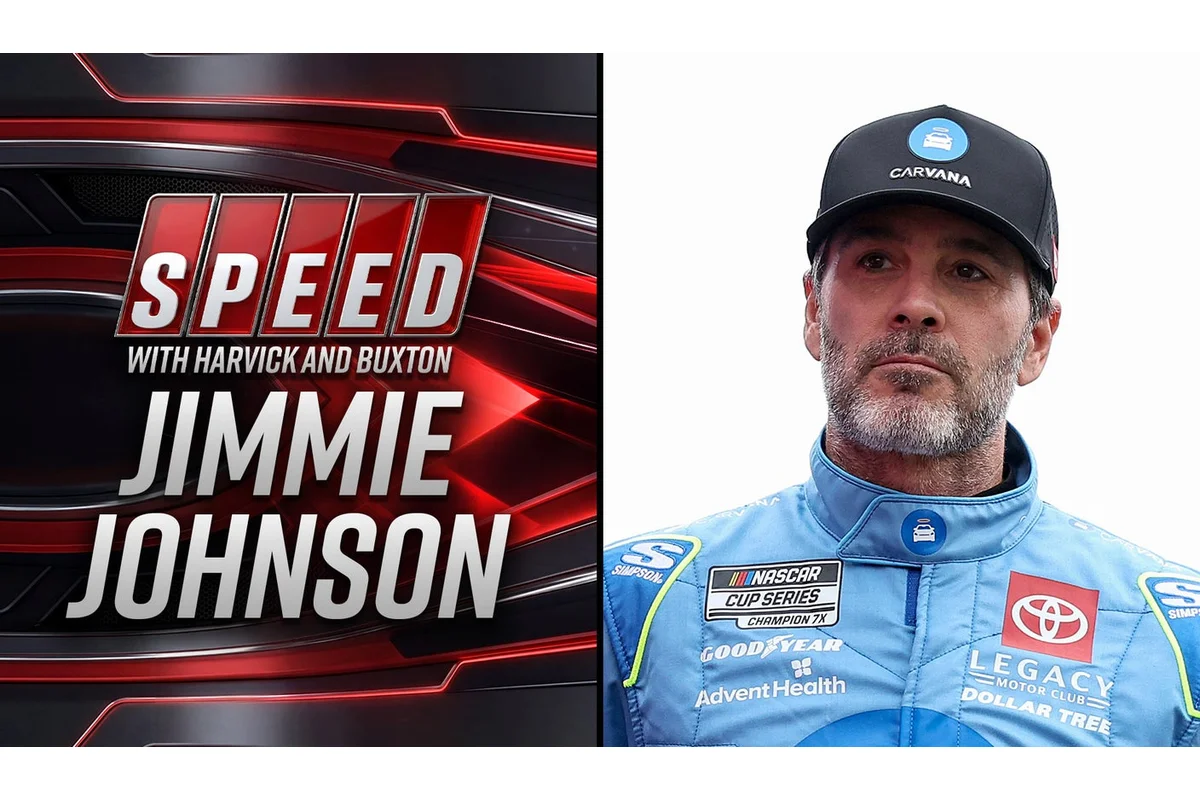
“He’s like, ‘Yeah, if you went 5 miles an hour faster, you would have had 200 more counts of downforce, you would have been fine’… But I think for the IndyCar guys coming this way, they’re like, ‘All right, I’m going to go hustle the vehicle,’ they’re so far over the sweet spot of what a Cup car can handle that they’re kind of in no man’s land, and it’s easier for a NASCAR guy to challenge himself into that.”
Johnson pointed out that NASCAR drivers must learn to trust the additional downforce in IndyCar to be competitive, while open-wheel racers face the opposite challenge when adapting to the heavier and less aerodynamically reliant stock cars. The handling margin in a NASCAR Cup car is much narrower, meaning any mistake beyond the grip limit is harder to recover from.
Other drivers such as Danica Patrick have noted similar difficulties when moving between series. However, some like Shane van Gisbergen adapted rapidly, successfully transitioning from Supercars to a full-time role in the NASCAR Cup Series with Trackhouse Racing.
Throughout this period, Johnson balanced his IndyCar commitments with selective NASCAR starts. After his final full-time Cup season in 2020, he has competed part-time while expanding his role as an owner at Legacy Motor Club.
The necessity of specialization in modern top-level racing
Johnson was also asked about the feasibility of drivers competing across multiple premier racing series simultaneously, a practice more common during the 1960s and 1970s when the differences between cars and circuits were less pronounced. He noted that modern motorsport demands greater specialization to achieve excellence.
“To really be good you need to be in your peak window of driving and I think you need to be a specialist. I went to IndyCar for a couple of years and I was able to run 12th on a street circuit and run in the top five on an oval. But from there forward it takes years to move forward,” he responded. (10:33 onwards)
Johnson cited examples of drivers who have successfully transitioned with significant time investment, including Juan Pablo Montoya, who moved from Formula 1 to NASCAR, and Scott McLaughlin, who progressed from V8 Supercars to IndyCar.
“If you remember Juan when he came over to NASCAR, it takes time. I think you need four or five years to really invest in that series to see where you land… One that stands out to me that I don’t think gets a ton of respect is McLaughlin and what he’s done from V8 Supercar to go to IndyCar and have the success,” Jimmie Johnson added.
As Johnson approaches the final stages of his career, he has announced that the 2027 Daytona 500 will be his last NASCAR race start. Prior to that, he plans to race selectively in 2026, focusing more on his leadership responsibilities at Legacy Motor Club rather than full-time competition.
Johnson’s insights underscore how the modern demands of top-tier racing require driver dedication and adaptation far beyond previous eras. The technical and physical differences between disciplines like IndyCar and NASCAR create barriers that make dual-competition extremely challenging, highlighting why specialization remains key for success.

