
As the NASCAR Cup Series prepares for Sunday’s race at the Circuit of the Americas (COTA), several drivers including Joey Logano and Chase Elliott have expressed agreement with NASCAR’s new approach to prevent drivers from cutting corners. The introduction of large tire packs at critical corners aims to restrict shortcuts that caused confusion in last year’s event and ensure fair competition on track.
During last season’s race, numerous drivers exploited the Esses and Turn 6 to gain track position illegally, making it difficult for officials to determine when an advantage was gained. NASCAR responded by placing physical tire barriers at key apexes to enforce limits more clearly. This solution also seeks to enhance viewer experience by simplifying officiating decisions during the broadcast.
Drivers Address Last Year’s Issues and the Effectiveness of Tire Packs
Journalist Jeff Gluck spoke with multiple drivers about the effectiveness of these tire packs before the race, including Daniel Suarez of Spire Motorsports. Suarez criticized the confusion caused by corner cutting last year, describing it as a “domino effect” that detracted from the race’s quality on television. He acknowledged that the tire barriers might be the best available measure to prevent such problems, despite introducing some risks.
“Corner six, they were not officiating that. One guy started calling a little bit. Then you see another guy calling a little more. And then by the end of the race, we’re scoring like two car links. Like it’s bad, it looks bad on TV,” Suarez said (00:38 onwards).
“I don’t like to put a lot of decisions on NASCAR because it’s tough on them. … They are going to make some good calls, and they’re going to make some bad calls. So, I think that the tire barriers are the best way to do it but it’s dangerous, too.” (03:08)
Suarez also mentioned the serious crashes that resulted from cars running off the racing line. He recalled a significant collision at last year’s race when Connor Zilisch spun suddenly, causing him to lose visibility and reaction time, which led to contact with Suarez on lap 50.
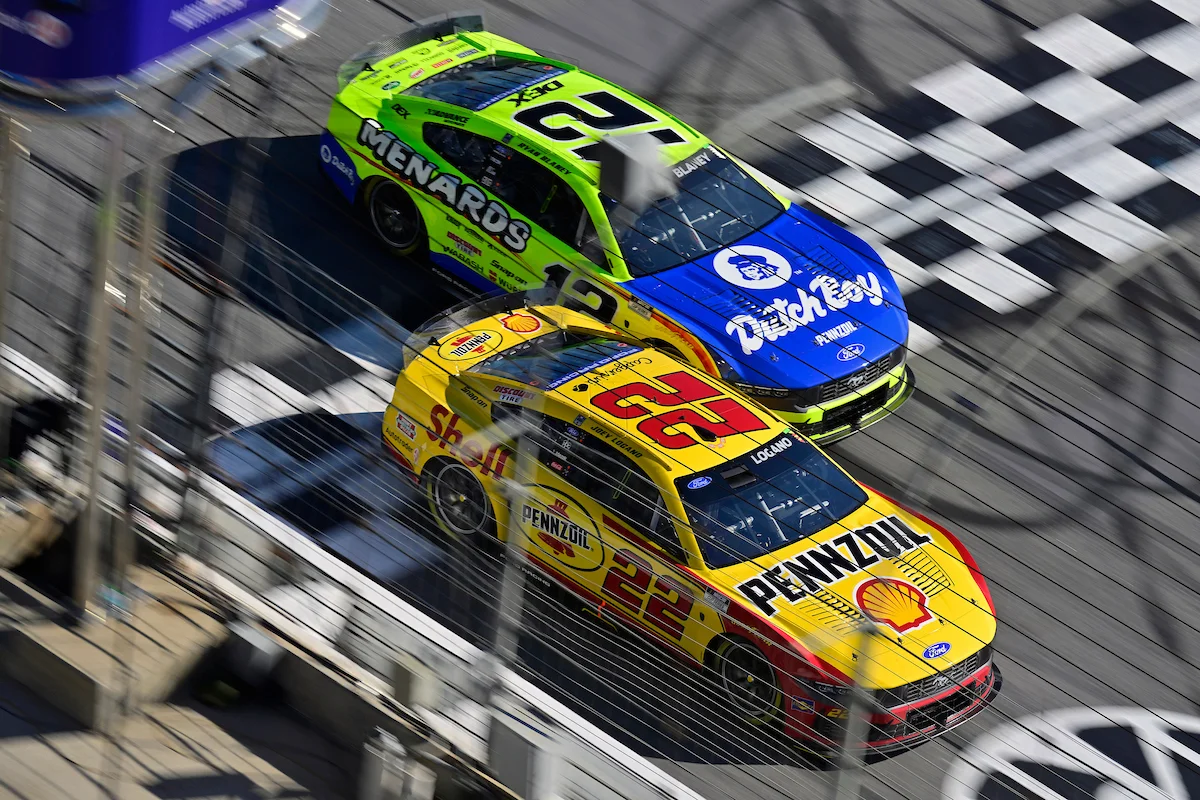
Joey Logano and Chase Elliott Affirm Clarity Brought by Tire Packs
Chase Elliott, who starts the race from fifth position, reflected on last year’s difficulties and supported the new tire pack rule for providing clear physical boundaries. He highlighted that before these barriers were installed, officials struggled to monitor infractions accurately.
“I think it came down to the fact that they simply just couldn’t see that area super well. But yeah, I guess nobody knew. So I think having the tire packs at least makes it a little more black and white. You either hit them or you don’t. I think it makes sense.” Chase Elliott said (00:58).
Joey Logano echoed this viewpoint by emphasizing how tire packs simplify judging for NASCAR and make it easier for drivers to understand the limits on course.
“You start rolling through there, behind cars especially. It’s really hard to know. Like one guy goes off, you’re going to follow him right off. Or if you just try to offset a little bit, like right on him, you can’t see it, and then you get kind of caught. So I think it’s easier for NASCAR to officiate it, and it’s easier for the drivers to see it. It kind of makes sense to me,” he said (02:24).
2024 COTA Race Preview and Defending Champion Status
This season’s NASCAR Cup race will continue using the 2.3-mile configuration of the Circuit of the Americas, the same layout used last year. Christopher Bell returns as the defending event winner and is positioned eighth on the grid, aiming to improve on his performance against a field determined to avoid past controversies and race with clearer boundaries established by these tire packs.
The implementation of physical tire barriers at key turns at COTA reflects NASCAR’s commitment to maintaining fair and safe racing conditions while addressing televised clarity for fans and officials alike. Drivers like Logano, Elliott, and Suarez backing these changes signal a move toward stronger enforcement of track limits and minimizing confusing penalties during road course events.
Less of a storyline but possibly still quite relevant to the race is the presence of tire packs to police pretty much every conceivable corner-cutting opportunity. I spoke to drivers about it and made a video here: https://t.co/qoC7riDOsg pic.twitter.com/cGB4SfyCKR
— Jeff Gluck (@jeff_gluck) March 1, 2026
