
The announcement that Cleetus McFarland will compete in the NASCAR Xfinity Series has sparked diverse opinions within the NASCAR community. While some supporters view his participation as a positive development that could bring new fans to the sport, many critics have questioned the driver approval process that allowed his entry. McFarland is set to drive for Richard Childress Racing in three races spanning two seasons, a deal highlighting his growing presence in the series.
Kyle Busch, McFarland’s teammate and an established figure in NASCAR, offered his perspective on the situation in a concise manner, simply stating, “Good for him.” He acknowledged that financial backing often plays a major role in opening opportunities within NASCAR, even if experience levels sometimes raise concerns among fans and insiders alike.
Kyle Busch Reflects on the Changing Entry Pathway in NASCAR
Busch compared McFarland’s debut to his own early years in racing, highlighting how the process has evolved over time. When Busch entered the sport at 17 or 18 years old, rookies were provided up to five official tests on different tracks before being allowed to compete. In contrast, current drivers may not have the same level of in-person testing available.
He remarked,
“So I don’t know. It’s a different time, man,”
pointing to how the pathway into NASCAR has transformed since his rookie days.
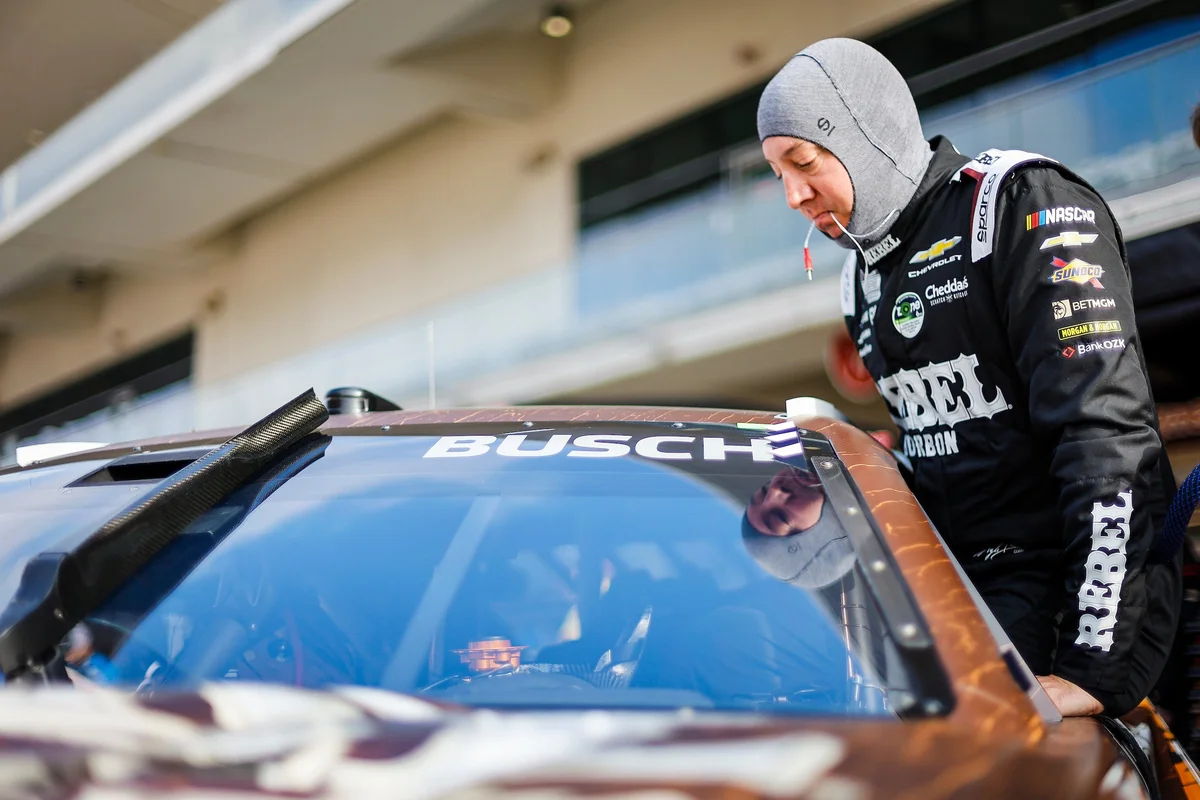
While recognizing the shift, Busch also addressed the criticism surrounding driver approvals today. He said,
“I feel like when you’ve got drivers that have funding that are able to come up here and do this sort of stuff, then by all means, there’s going to be the critics that where’s the approval process, and I’m probably one of those to some, and this might be one of those cases, but we haven’t stopped letting people race yet, so why now?”
The Role of Experience and Simulation in Preparing New Drivers
When asked about how McFarland could prepare for his transition to NASCAR’s competitive environment, Busch pointed out that on-track testing has diminished in recent years, making simulators the primary means for drivers to learn new tracks. Despite wishing McFarland success, he acknowledged the large difference in experience compared to more seasoned drivers.
Busch noted,
“I don’t know how many races he’s run. Denny Hamlin ran 10,000 before he got here, right? So I don’t know if Cleetus has run 10 or not,”
illustrating the extent of preparation veteran racers accumulate.
He also cited his own son, Brexton Busch, who at the age of 10 has already amassed many youth racing starts, emphasizing the value of time behind the wheel. This underscores how crucial track experience remains for drivers aiming to compete at a high level in stock car racing.
What McFarland’s Entry Means for NASCAR’s Future
Cleetus McFarland’s involvement with Richard Childress Racing and the NASCAR Xfinity Series reflects a broader conversation about how new talent enters the sport and how experience is considered alongside financial support. While some see fresh faces with online followings as a way to expand NASCAR’s audience, others stress that race mileage and skill should continue to be the primary benchmarks for success.
Kyle Busch’s insights highlight the ongoing balance NASCAR faces between tradition and change, showing that while the door remains open to newcomers funded to compete, the sport’s core values around experience and proven performance persist. Observers will be watching closely to see how McFarland’s attempt at the national series unfolds and what it signals for future driver development.
For context, here's the full exchange between Kyle Busch & @NoahReedReports on the Cleetus McFarland approval process.#nascar #racing pic.twitter.com/mPIpCIh9Ux
— Charlie Marlow (@CharlieMarlow_) March 8, 2026
