
Marc Marquez has revealed that his recent decision to switch aerodynamic setups ahead of the 2026 MotoGP season is primarily driven by physical factors related to a previous injury. Following a shoulder injury sustained in Indonesia last year that prematurely ended his season, Marquez adjusted his approach to better suit his current physical condition.
Evolution of Ducati’s Aerodynamic Packages from 2024 to 2026
At the start of the 2025 MotoGP preseason, Ducati introduced a redesigned fairing featuring a small step on the lower front wing and a restructured side fairing to accommodate larger downwash ducts. In 2024, Marquez began the season using the aerodynamic specifications from that year, similar to his Ducati factory teammates Francesco Bagnaia and Fabio Di Giannantonio. However, at the Dutch TT in 2024, Marquez switched to the 2025 aero package and maintained this choice afterward, unlike Di Giannantonio who alternated between the two, and Bagnaia who largely remained with the 2024 design.
Later updates appeared at the Valencia test with new side fairings featuring a KTM-style channel between outer and inner panels. These modifications returned at the Sepang test in 2025, incorporating updated front wings with a dual-plane bottom element and increased overall surface area.
Despite these ongoing developments, none of the Ducati riders adopted the 2026 aerodynamic update at the Buriram test, opting instead between the 2024 and 2025 configurations. Interestingly, Marquez chose to revert to the 2024 package during the Thailand test, which diverged from his earlier preference for the 2025 setup.
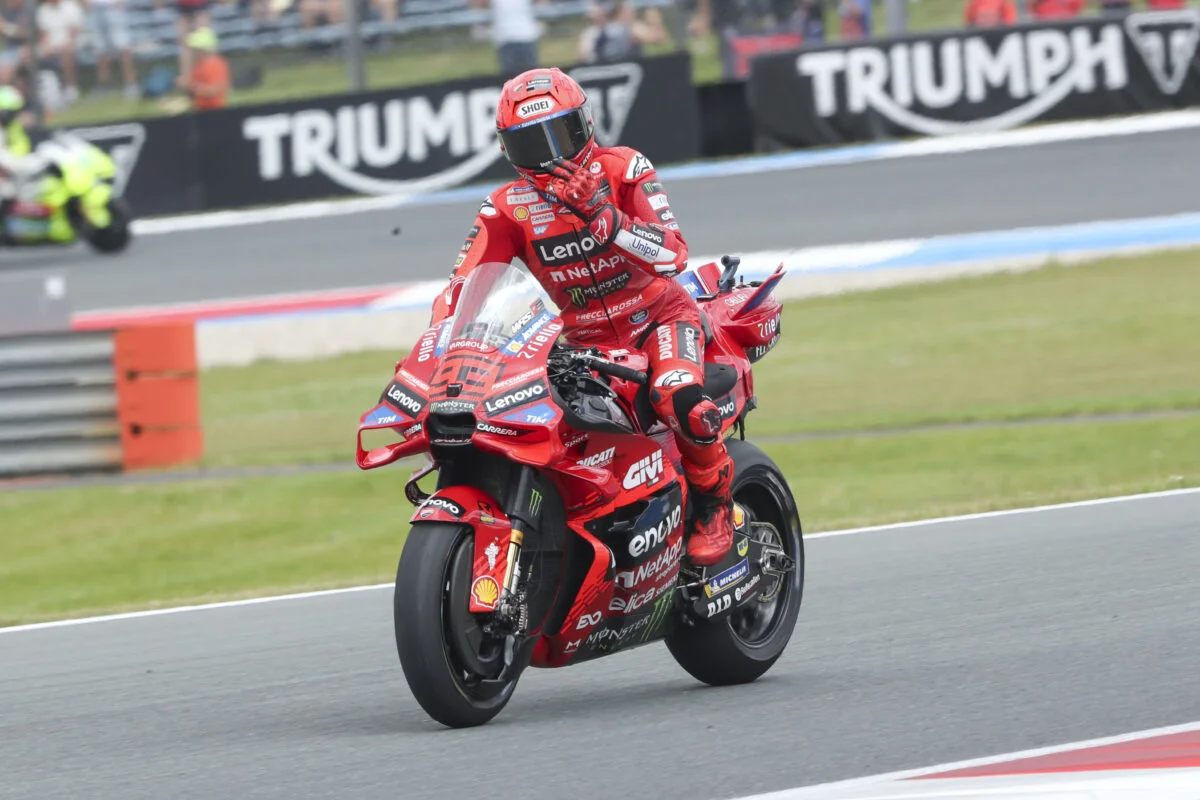
Injury Impact Shapes Marquez’s Riding and Aero Preferences
Ahead of the Thai Grand Prix, Marquez explained the reasoning behind his surprising aerodynamic choice. Due to the shoulder injury sustained in Indonesia, he is no longer able to ride the bike in the same manner as he did previously, prompting the need for a less physically demanding aero package.
“Basically, about the aerodynamics, aero package, you need to find the best for your moment, for your riding style, and the one that performs better,”
Marquez said.
He added,
“The fact that I stepped back in aerodynamics – one of the reasons – is because I cannot ride the bike in the same way as last year at the moment. So, the 2025 aerodynamics was a little bit more heavy, the bike, more demanding for the physical condition, and then just I’m trying to adapt my riding style to what I have now in my physical condition.”
Marquez emphasized that both packages perform well but fit different circumstances and that his adaptability is key moving forward.
“So, I will try one more time in my career to adapt my riding style to this new situation until I feel more ready.”
Significance of Marquez’s Choices for His Future Competitions
Marquez’s shift back to earlier aerodynamic packages reflects the ongoing challenge he faces in adapting his performance to physical limitations. This careful balance between technical setup and personal health underscores his cautious yet determined approach to returning to peak form. His testing and adaptation during key events, such as the Thai Grand Prix and Buriram tests, suggest a methodical effort to maximize performance without risking further injury.
The developments with Ducati’s aerodynamics and Marquez’s individual adjustments highlight the dynamic interplay between rider capability and machine configuration, which will continue to evolve as the 2026 MotoGP season approaches.
