
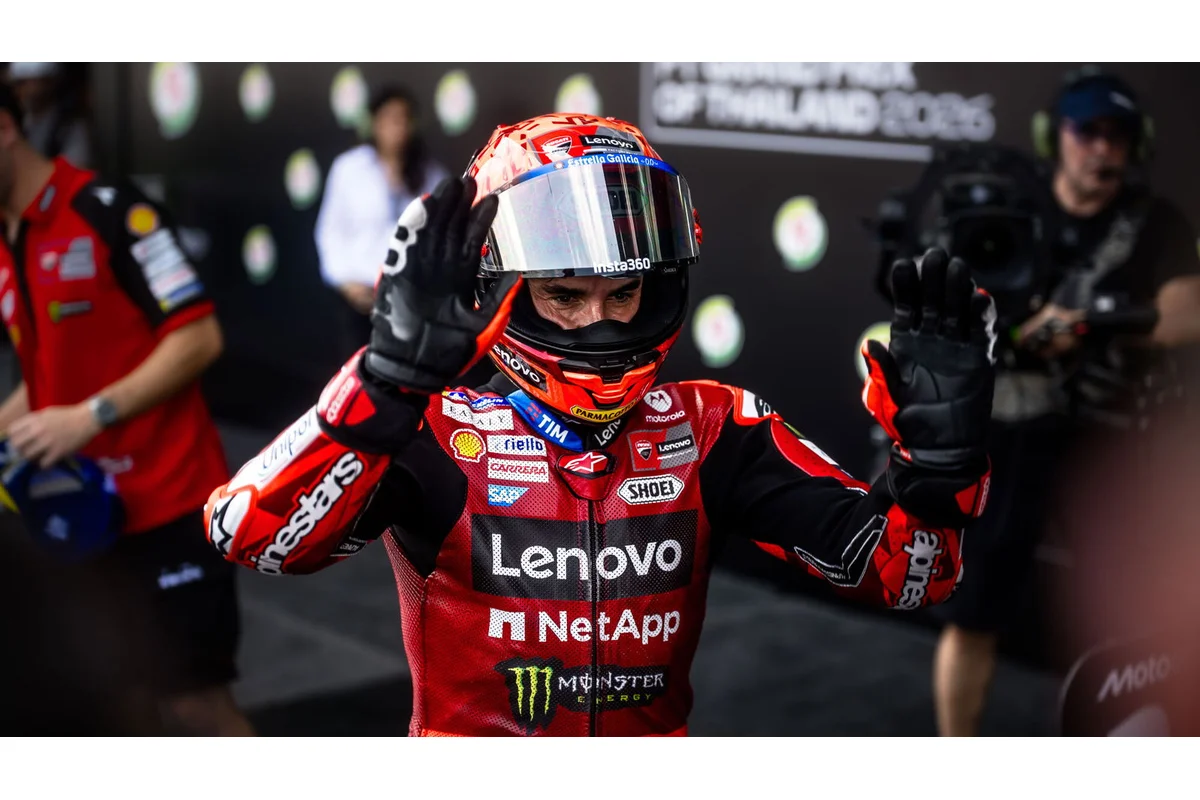
The penalty handed to Marc Marquez at the Thailand Grand Prix has divided opinions, but MotoGP riders are largely supportive, according to Neil Hodgson. Marquez lost what could have been a Sprint race victory after a bold maneuver against Pedro Acosta, which led race officials to penalize him for forcing Acosta off the track during the final corner.
Hodgson explained that Marquez’s penalty was justified because he came from too far behind and endangered the KTM rider at a critical moment in the race. This incident put an end to a thrilling contest between Marquez and Acosta, who are set to become teammates in the future. The penalty required Marquez to drop a position on the last lap, effectively awarding Acosta his first career victory.
Why Fans and Riders View the Penalty Differently
While some MotoGP fans expressed frustration over the penalty, others within the racing community appreciate its safety implications. On the “Gas It Out” podcast, Hodgson highlighted that although viewers often desire dramatic events for entertainment, the priority must be rider safety. He noted that ‘silly lunges,’ such as Marquez’s aggressive pass on Acosta, are now considered unacceptable.
Riders reportedly feel more protected under FIM race director Simon Crafar’s leadership, which continues to refine the sport’s safety rules. Chicho Lorenzo remarked that under the current stewardship, Marquez can no longer use his trademark tactic of forcing opponents off their lines—a hallmark of his racing style.
How Simon Crafar’s Leadership Aims to Make Racing Safer
Hodgson shared insight into the broader campaign led by Simon Crafar: creating safer MotoGP races by preventing reckless moves.
“What the stewards are trying to achieve – Simon Crafar is leading it – is safer racing,”
Hodgson stated.
“We are trying to prevent silly lunges. If you’re a rider, you want to be protected. Essentially, that’s what Simon’s doing.”
He contrasted this with a neutral spectator’s perspective, acknowledging that non-racing fans may favor crashes and collisions for excitement, but professional standards must focus on safety. Hodgson emphasized,
“At the end of the day, you have to think about the line of safety. That’s why Simon Crafar is doing a fantastic job. His opinion was, ‘Marc’s just over the line there’, so he dealt with it.”
Marc Marquez on the New ‘Red Line’ Set by Race Officials
When asked about the penalty at a recent Estrella Galicia 0.0 event, Marc Marquez compared the evolving MotoGP rules to changes in football’s handball regulations. He acknowledged that race officials, led by Simon Crafar, have established a “red line” riders must not cross and expects consistent enforcement going forward. Marquez recognized that this would require all riders to adopt a less aggressive approach on track.
“You have to adapt – it’s like penalties in football,”
Marquez said.
“A handball that wasn’t a handball before is now, or vice versa. Each season, there’s a red line set by the stewards, and in this first Grand Prix, they lowered it a bit.”
He added,
“Well, that’s what they’ll have to maintain throughout the season, and the riders will have to adapt.”
Impact of the Penalty and What Lies Ahead for Marquez
Marquez’s efforts in Sunday’s race ended prematurely due to a tire failure, leaving him with only the points earned from the Sprint race. His current standing places him eighth in the championship as the MotoGP season moves on to Brazil.
The controversy surrounding Marquez’s penalty has brought to light the ongoing tension between race excitement and rider safety. With Simon Crafar’s firm approach setting a clearer boundary, MotoGP is steering toward a safer future. Riders like Marquez and Acosta will need to adjust their racing styles accordingly, while fans watch to see how this evolving enforcement shapes the championship battles ahead.
