
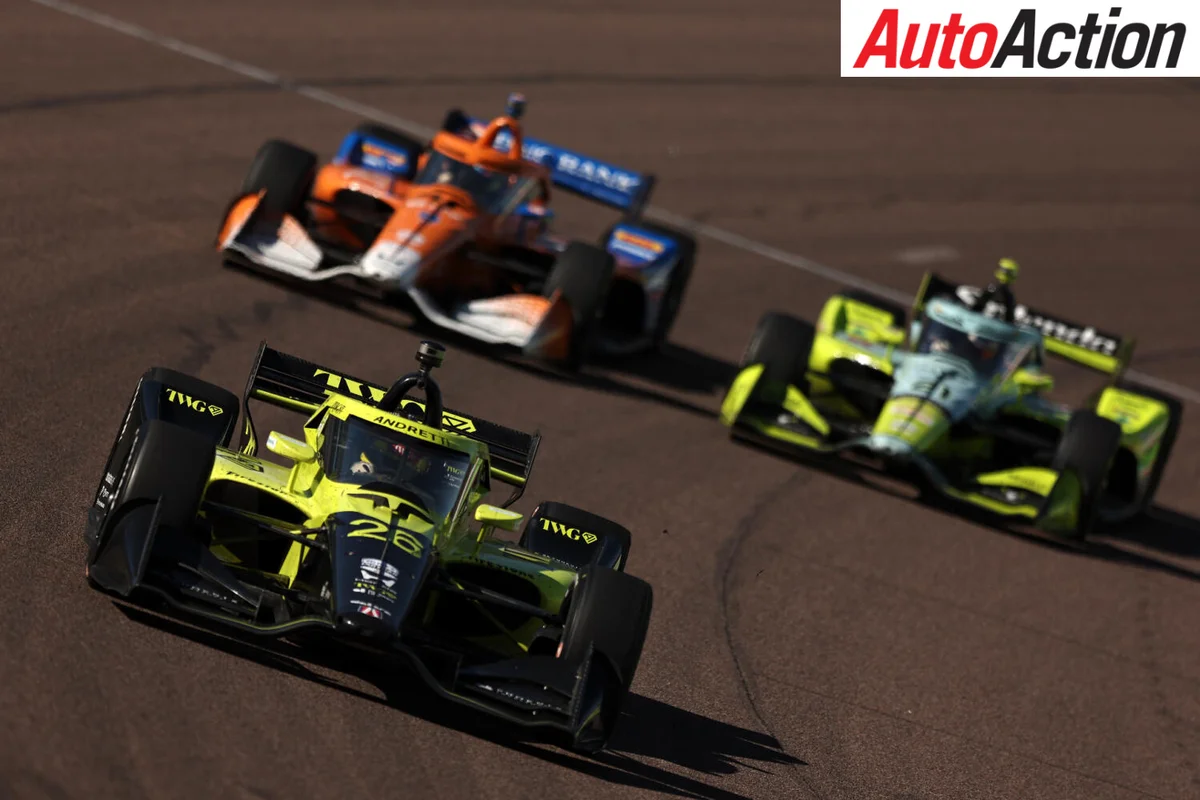
Will Power expressed regret to Ed Carpenter following a key collision with Christian Rasmussen during Saturday’s IndyCar race at Phoenix Raceway. Starting at the back after a qualifying crash, Power impressively advanced to the lead by lap 200 out of 250 but soon faced intense pressure from Rasmussen, who was rapidly closing in.
Rasmussen, driving for Ed Carpenter Racing (ECR), had started 18th and was delivering a remarkable performance featuring over 60 on-track overtakes. His aggressive maneuvering on short ovals has proven difficult for competitors to counter, making him a formidable contender in this race.
As Power endeavored to block the young Danish driver’s advances, Rasmussen attempted a high-risk pass on the outside exiting Turn 2. Unaware that Rasmussen occupied the outer line, Power drifted higher on the track, pinning Rasmussen between his car and the wall and causing contact between the two.
The crash damaged Rasmussen’s front wing and forced Power to pit due to a right-rear tire puncture. Rasmussen’s race deteriorated, and he slipped back to finish 14th, while Power ended the event in 16th place.
In a post-race discussion with Bob Pockrass, Power reflected on the confrontation.
“Yes, I do. It was for the win, and maybe I should have just, you know, if I could have held him for another couple laps, he would degrade (his tires). But yeah, he’s very good on the short oval, and he won’t relent. So maybe, I shouldn’t…”
He then spotted team owner Ed Carpenter nearby and directly apologized.
“He, sorry for that man,”
Power said to Carpenter before ending the interview and approaching him.
After the race concluded, Power was seen speaking with Rasmussen, where they discussed the incident and the track positioning that led to contact.
Power Points to Spotter Miscommunication as Factor in Collision
Christian Rasmussen showed visible frustration after the race, blaming Power for forcing him into the wall and ruining his chance at a second IndyCar victory. Power acknowledged his error and attributed part of the misjudgment to complications with his new spotter at Andretti Global.
Having used the same spotter for 17 years at Team Penske, Power admitted that terminology differences caused some confusion during the race.
“If I heard he’s got a wing on you, it’s on me,”
he said, taking full responsibility.
“I can’t blame anyone but myself. There it was for the win. So, you keep it tight. But I should have given him more (room). New spotter this year. He’s really good, (but) there’s a little bit of terminology that would be different there. My old spotter I had for 17 years. He has different terminology. It’s just teething things, you know, I feel bad.”
Power expressed respect for Rasmussen’s speed and competitiveness during the event.
“Rasmussen deserves that win. He is very quick. It was going to be a good fight to the end, but he was strong. I was trying my best to take his air and try to use his tires up. But, you know, ultimately, you could see like, if he had the run there, he was going to get me next corner,”
Power added, recognizing the battle they engaged in on the track.
Josef Newgarden Claims Victory as Power and Rasmussen falter
Ultimately, Josef Newgarden secured the win at Phoenix Raceway, maintaining his status as the reigning champion at this venue since the last IndyCar race took place there in 2018. Power’s Andretti Global teammate Kyle Kirkwood finished second, with pole-sitter David Malukas completing the podium in third position.
This race emphasized the complexities that can arise from split-second decisions and team communication, especially under pressure near a race’s conclusion. Power’s Phoenix apology highlights the fine margins that shape outcomes in IndyCar racing, underscoring how key moments affect championship trajectories and individual reputations.
The incident between Power and Rasmussen also draws attention to the adjustment period drivers face when adapting to new team dynamics, including critical race listeners such as spotters. Moving forward, both drivers and teams will undoubtedly analyze this clash for lessons to avoid costly mistakes in future contests.
Will Power’s thoughts after the race: @IndyCarOnFOX pic.twitter.com/7fDX6ahqXq
— Bob Pockrass (@bobpockrass) March 7, 2026
