
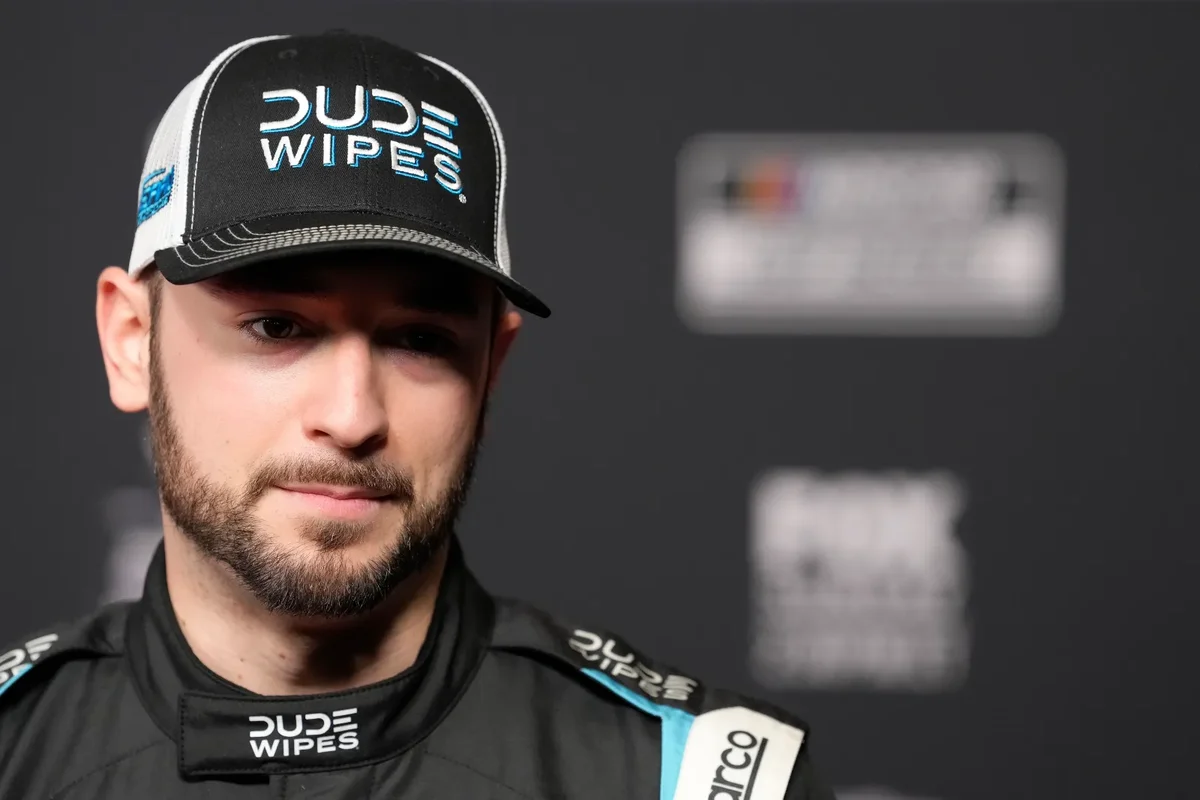
Zane Smith, piloting the No. 38 Front Row Motorsports Ford Mustang Dark Horse, recently secured a sixth-place finish at the Daytona 500, where he also claimed victory in the opening stage of the race. Following this strong showing, Smith currently holds the fourth position in the Cup standings. As the series prepares for its next challenge at EchoPark Speedway in Atlanta, Smith shared his insights on Sunday’s “Great American Race” and his expectations for the upcoming weekend.
Smith Analyzes Key Moments and Strategy in Daytona’s Final Sprint
Smith recalled the critical phase after an incident unfolded in turns one and two, which drastically changed the makeup of the lead group. He described his efforts to stay connected with the No. 9 car and the strategic choices made in pursuit of a victory.
“So many thoughts run through your head after the race and you’re waiting to see a replay of what fully unfolded, and, to me, I felt like we were in a great position throughout the day and throughout the race. Ultimately, I found myself behind the 9 after that wreck unfolded down in turns one and two. NASCAR, I feel like, has done a good job of letting us race back to the line if it’s safe. There was no hesitation of lifting there and I got connected with the 9 pretty well. I just remember glancing in my mirror and seeing a lot of separation in the cars. I honestly just kind of thought it was about a five-car breakaway and kind of unorganized and was just mainly focused on the 9 at first, and then I think we were trying to get clear of the 45. The 9 did a good job of keeping me connected and we hooked up well down the backstretch and then my goal was just to kind of get us two away and what it looked like from my seat a lot of things were unorganized, so my goal was to shove him out and get him into a position to where he’s got no momentum and kind of a sitting duck, and then hopefully a momentum shift into my hands. I just tried to somewhat back up to get some help for the front stretch and he was really well prepared for that, obviously, and it was just a little bit too much of a momentum shift from both of our ends. I thought it was just the 45 mainly behind me. I didn’t know the 35 was that close to him and it was just perfectly timed for them of where there was a momentum shift on our end and those two were hooked up pretty good. At that time, I was just kind of hoping. I didn’t know what Fords were up there, but I think the 22 and the 6, and hoping that they would maybe pick my up, but there were coming with a lot of momentum. A block on the 45 ran through my head, but he was coming a lot faster and then you kind of think, ‘Man, do I keep pushing the 9?’ From my seat, it was really hard to stay connected from when I landed in turns three and four. I got super tight and the car did not want to turn well and just naturally there was some separation there, so regardless I don’t think I could have stayed that connected to him. Fortunately, I’m not wired that way to just push someone across the line and not go for a Daytona 500 win. If I knew the 45 and the 35 were as connected as they were, I don’t know, I guess maybe try to shove the 9 or stay as close as I can down the front stretch and hopefully them two are really connected and a bad block or two gets thrown into the equation and maybe I could go bottom or something, but that’s so hard to say. The odds are kind of stacked where I had to stay in second and wait for the 45 to come with a huge run. Who knows what happens, so I was trying to control my own destiny and try to back up to help as we did all day, and I feel like anyone would do – not just settle for second in the Daytona 500. I was really proud of my team throughout the whole day. It was really cool to get a stage win and ultimately leave with a great finish and some great points scored. It was just a great car and a lot to be proud of and it just makes me that much more excited for the superspeedways throughout this year and obviously somewhat one this weekend, but I’m gonna be really hungry for a Daytona 500 next year and hopefully we can carry this momentum throughout the year and score a win or two.”
Building Momentum and Confidence After Daytona Success
Looking beyond his Daytona results, Smith spoke about the momentum gained from the early season performance and how important a strong start is, especially with the new points system in NASCAR. He explained how scoring 41 points at Daytona set a valuable tone for the season ahead.
“There’s definitely a level of confidence, but momentum I feel is the better word for that and it’s really important to just get off to a good start, especially with this new point format. I think I scored 41 points, which is a great day for us, and how our season starts is it’s definitely a superspeedway and somewhat a superspeedway, but what I’m getting at is a lot can go wrong in those two races how you start out, and I think we’ve got a road course next, so just a strong start is so important to get those valuable points and hopefully carry that into these more normal racetracks coming up, like Phoenix and Vegas, where hopefully we have some of that positive momentum still going where you get to go out later in qualifying. That goes a long way and just carry that throughout the year. There’s a long way to go, but definitely I feel like there’s a confidence booster there throughout the whole team and the depth of the team, of the speed that we brought, and just how our race played out. I feel like there’s a lot of confidence there, but more so a momentum shift in a good way to start the year.”
Smith’s Perspective on Fuel Saving and Race Dynamics at Superspeedways
Fuel conservation has become a significant talking point in recent superspeedway racing, and Smith provided his perspective, emphasizing the complexity and strategic nuances involved in this aspect of racing.
“I don’t really have an opinion to give on that because I feel like I don’t have enough experience of what it used to be. I’ve obviously raced in the Truck Series where fuel-saving isn’t really a thing and you’re just battling throughout the whole stage, which is fun, but I just feel like in every situation we’re always gonna be trying to save more fuel than the next guy, so I don’t know the solution to that. From a tire fall off standpoint, I don’t want to speak for everyone else, but at the end of the stages my car was a complete handful, and then with the combination of the wind, it looked like a lot of guys had their hands full, so I don’t know if that’s the answer to everything. Like, more power? I don’t know about that. I felt like it was somewhat like the other fuel-saving races, but at the same time I felt like there were more people in different situations. I remember there were a couple guys who could possibly make it to the very end there and that kind of changed the strategy for everyone. All of our teams and everyone is communicating that, so the pace got picked up. I just feel like people maybe have to understand the strategy side more of that. They’re definitely not the most fun thing to find yourself just riding in line and trying to save more fuel than the next guy, but I don’t know the answer to that and I don’t really have an opinion to give. I’ll leave that up to the guys who have been doing this a lot longer than me.”
Emotional Moments and Competitor Respect in Racing
Smith opened up about the rare but real instances of empathy drivers feel for one another, recalling an example involving Denny Hamlin, a competitor who missed clinching a championship in dramatic fashion.
“Yeah. I definitely feel like we’re all selfish, but I certainly felt bad for Denny Hamlin this year in the championship. That’s painful, and that’s a long career he’s had with a lot of success and a lot of wins and in contention to win one. I forgot what it was, but he was like literally one lap to go with plenty enough of a lead to go win his first championship and with everything going on in his life, I felt that one for him. But, that’s racing. A lot of us, I feel like, go through a lot of ups-and-downs and it’s always the one that never gives up will ultimately win in the end. In that situation, that’s the first one that comes to mind for me.”
He also explained why such feelings are uncommon, due to the competitive nature among drivers and the challenges of forming close friendships in the high-stakes environment of NASCAR.
“It’s certainly rare and it’s hard to have close friends in this industry because we’re all competing against each other every week. In that scenario where I’m not competing for a championship and I don’t have a teammate that’s competing for it, you kind of see what unfolded at the end of the race and you’re like, ‘Holy cow.’ You kind of try to put yourself in his shoes and it’s hard to fathom with what he’s accomplished, but you try your best to put yourself in his shoes and that was painful for him, especially with just going back to everything that unfolded in his personal life throughout the offseason. I feel he deserved that, but that’s my opinion. It doesn’t matter. He’s had a lot of success in this sport, and I feel he should definitely have a championship, or multiple, and, unfortunately, things just haven’t gone his way, but that is literally the definition of racing.”
Offseason Developments and Team Chemistry Fueling Early Success
Smith attributes part of his team’s advancement this season to the improved chemistry he shares with his crew and spotter. This dynamic, he believes, fosters smoother communication and better performance on race weekends, particularly during his second year with the organization.
“Yeah, I feel like the easy thing that stands out to me is the chemistry that we got to have throughout the year. I spoke about this a lot throughout our couple media days that this is my second year with this team and that’s a really valuable thing to have in our industry and our sport. I haven’t really had that since the Truck Series. You look at these guys on Sunday that have a lot of success each and every week, when you look at their whole team, a lot of it is the same guys. I feel like that chemistry of working alongside of each other, I feel like speed naturally comes. Everything throughout the race weekend flows a little bit smoother and I feel like it’s a product of some of that. It’s the second year working with my spotter. I feel like we’ve communicated great. It’s a combination of things, but I feel like the easy answer is a year of experience together and we’re off to a strong start.”
Anticipations for Circuit of the Americas and Adapting to New Car Package
With the upcoming race at Circuit of the Americas (COTA), Smith noted the importance of managing tire degradation under a revised car package. He highlighted the advantage for drivers who are smooth in their driving style and careful with tire wear, especially in warmer conditions.
“I think tire fall off is definitely gonna be a big thing and the guys that are just naturally smoother and maybe don’t abuse stuff as much as the others will shine later in the race and later in the run, especially if it’s a hot day at COTA. We’ll see, but I’m excited for the changes. It’s always exciting to get to go to COTA, but I’m curious with this change coming up. I feel like when we tested at Wilkesboro I got to feel some of it, but it was also about 30 degrees, I think. It will be a lot different – I feel like it will really stand out if it’s a warmer day.”
Balancing Aggression and Consistency While Holding Fourth Position
Despite his current top-four standing in the points, Smith emphasized that his focus remains on securing his first career Cup Series win. At the same time, he acknowledges the importance of consistency and smart racing to maintain a competitive position over the long season.
“To me, I’m looking for my first win, so I’m as hungry as ever and gonna be as aggressive as ever to accomplish that, but, at the same time, I sound like a broken record saying it, but consistency is gonna be everything this year. I feel like those days of guys who maybe have a ton of speed every week and then wreck and not really care because they can, I feel like those days are just long gone. I’m trying to take advantage of that and just maybe try to be smarter and make my bad days not so bad and making my good days good, where we get some stage points like we did and putting ourselves in contention. I feel like that’s all I can do. I would love to be a name in this Chase, but, at the same time, we’re taking it one week at a time and just trying to roll with them on that.”
Superspeedway Racing’s Element of Luck and Possible Improvements
Smith explored the inherent unpredictability of superspeedway racing, noting how luck often shapes outcomes on tracks like Daytona, especially late-race scenarios involving alliances and drafting partners. While he believes the excitement and electric atmosphere of such events are unmatched, he also suggests that reducing the luck factor could improve the fairness of determining a winner.
“It’s a combination of both. I feel like anytime we’re gonna race on a superspeedway, no matter what package or anything, there’s a level of luck that’s gonna be involved. I feel like that race at the very end looks completely different if Chase Elliott has a Hendrick car behind him, and it looks completely different if I have a Ford that’s closer to me. It’s so situational on a superspeedway. I think we can do a better job of lowering the luck level that you need to win the Daytona 500, but at the same time, the vibe and how electric it was this past weekend was awesome. That was my fourth Daytona 500 and that was the coolest one I’ve ever been at. That’s what makes it so crazy. The vibe that it brings is electric and you feel that from the moment you start qualifying on Wednesday night and then the amount of people that are there Sunday at driver intros is just next level, so that part is what makes it so special. So, I think it’ll always be that way, but I feel like we could certainly do something. I don’t know what to lower that amount of luck you need to win the Daytona 500, but I feel like what you could do from a driver standpoint is consistently put yourself in contention and hope eventually that one goes your way.”
Ford Team Dynamics and Challenges of Collaboration at Atlanta
Discussing manufacturer teamwork in upcoming races, Smith acknowledged the communication among Ford drivers at Daytona but noted the difficulties in coordinating perfectly during dynamic race situations. He explained that while some collaborative effort is possible during stage runs, the full race’s intensity often requires drivers to focus on individual tactics to maintain competitiveness.
“There hasn’t been any of it, yet. I don’t want to speak for the other manufacturers, but there was a ton of communication this past week and I feel that all of the Fords worked well together. It’s just that it’s coming to the end of the Daytona 500. It’s tough to get us all in line in a perfect world, and then talking about Atlanta it’s just a whole other animal. The runs are gonna be 10 times as big and you’re gonna do something with it. You can play teamwork some in the stages, but it gets pretty tricky and sometimes you don’t want to do too much or else you can get you and all of your teammates and all of your other Fords in a bad situation of just trying to make it a perfect world for everybody. I feel like there’s definitely some good teamwork to discuss for the stages and hopefully scoring some stage points amongst us, but at the end of the race at Atlanta is always crazy with the amount of runs that you get and it’s just constant sliders. You’ve got to do something with your run or else you get passed, so I don’t know how you control that for a whole race without getting wrecked or getting yourself in a bad spot. I might get proven wrong, but until then I’m gonna do something with my run.”
Looking Ahead: Maintaining Momentum and Chasing Victory
Zane Smith’s rise to fourth in the NASCAR Cup standings marks a significant step forward in his career with Front Row Motorsports and the Ford Mustang Dark Horse program. His Daytona 500 stage win and solid finish have positioned him well as the series moves to more varied circuits, including Atlanta’s EchoPark Speedway and then the challenging Circuit of the Americas road course. With a combination of aggressive ambition, team chemistry, and improved strategy, Smith aims to build on this promising start to contend for wins across the 2024 season.
