
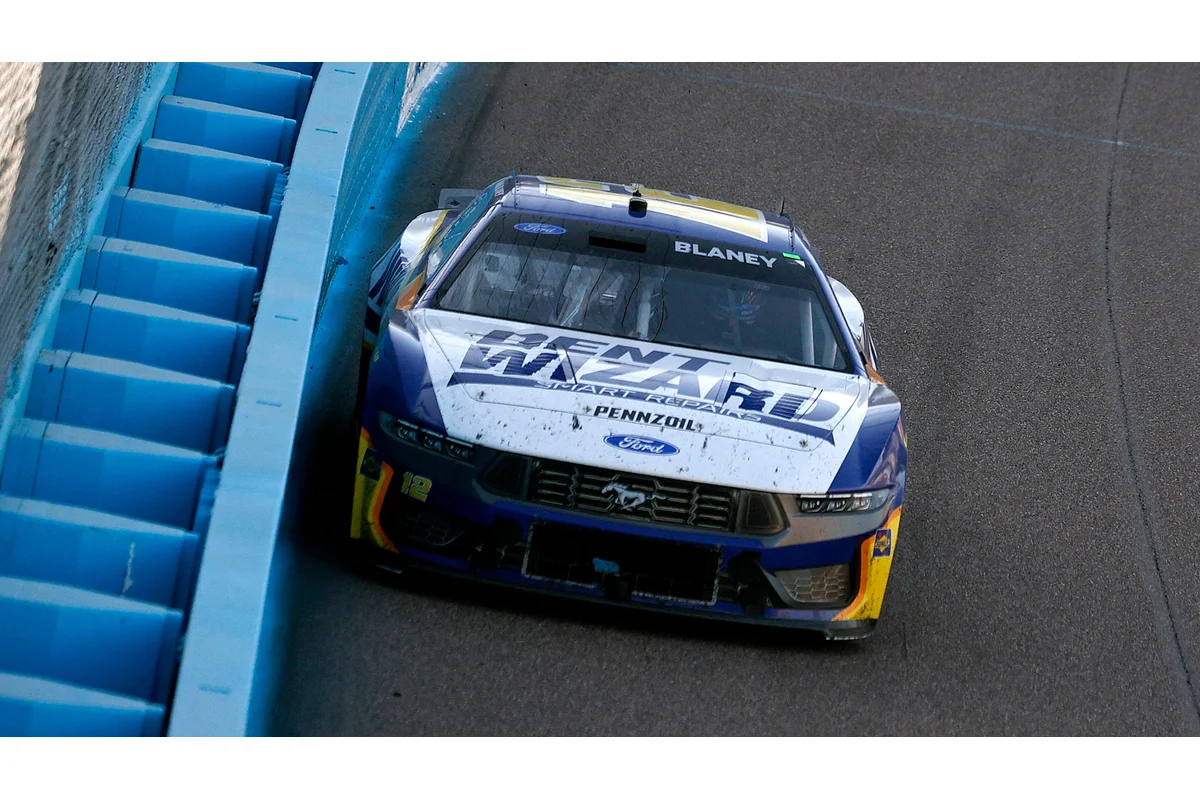
At Phoenix Raceway on Sunday, Ryan Blaney secured a dramatic win in the Straight Talk Wireless 500, edging out Christopher Bell by less than half a second. The race outcome was shaped by a pivotal pit strategy, with Bell’s crew chief, Adam Stevens, openly admitting responsibility for a critical call that may have cost them the victory. Blaney’s bold decision to take only two tires on the final pit stop, contrasted with Bell’s four-tire change, ultimately determined the race’s closing laps.
Race Dynamics and Strategy Decisions That Shifted the Lead
Starting outside the top 10, Bell surged early in the race, finishing the first stage in second place and challenging polesitter Joey Logano for the lead. Utilizing skillful moves around Phoenix’s ‘dog leg’ section, Bell emerged out front and dominated much of the event, leading 176 of the total 312 laps.
Late in the race, Bell followed a four-tire pit stop strategy on the final stop, mirroring a similar approach used by Denny Hamlin previously in the 2025 finale, where Kyle Larson had gained an advantage by choosing only two tires. Ryan Blaney capitalized on this by coming in for just two tires and aggressively pursued the lead, battling Ty Gibbs before overtaking Bell with ten laps remaining. Bell restarted in eighth position but was unable to close the gap, finishing 0.399 seconds behind Blaney.
Reactions from Key Figures Reflecting on the Outcome
Adam Stevens accepted full blame for the strategy that influenced the final moments of the race. NASCAR reporter John Newby quoted Stevens saying,
“That was on me,” Christopher Bell’s crew chief said.
Meanwhile, Blaney praised the performance of Bell’s team while acknowledging his crew chief’s successful call. He remarked,
“Honestly, the 20 was the best car, but Jonathan did a great job, great call to take two, and we were able to get the lead and just hold them up. I don’t know how many more laps to hold them off, but we were able to do that.”
Bell earned valuable points by winning Stage 2 and moved up 18 positions in the point standings to sixth place after the race.
Christopher Bell’s Perspective on the Narrow Defeat
Despite the close loss, Christopher Bell remained positive about the team’s performance but acknowledged the sting of just missing out on victory. He highlighted the teamwork that contributed to their strong showing and expressed hope for future success. Bell stated,
“If we had more green flag laps, I think we could have made a run (at Blaney). But I don’t know. You win some, you lose some. This one stings, but on a positive side, I’m really proud of our entire team. The pit crew did amazing. (Crew chief) Adam (Stevens) brought an amazing car. Our engineers, our mechanics did really good. It’s something to build on. It was a day we needed. We got a lot of stage points, finished second. Just bummed whenever they get away like that,” he said.
Context of Recent Performances at Phoenix Raceway
Christopher Bell’s recent performances at Phoenix have been impressive, with last year’s Spring Phoenix race marking his third consecutive victory at the track. Conversely, Ryan Blaney’s win on Sunday represents his second consecutive victory at Phoenix, having also won the 2025 finale. However, Blaney was not among the final four contenders in that previous season finale, highlighting his ongoing development as a championship threat.
Implications of the Phoenix Race Results Moving Forward
The outcome at Phoenix Raceway adds complexity to the NASCAR standings, with Bell gaining momentum despite the narrow loss and Blaney reinforcing his status as a top competitor. The crew chief’s admissions underscore the critical nature of pit strategy and tactical decisions under duress. As the season progresses, teams will likely scrutinize their choices more closely to avoid similar costly errors, potentially altering how the final laps of future events unfold.
