
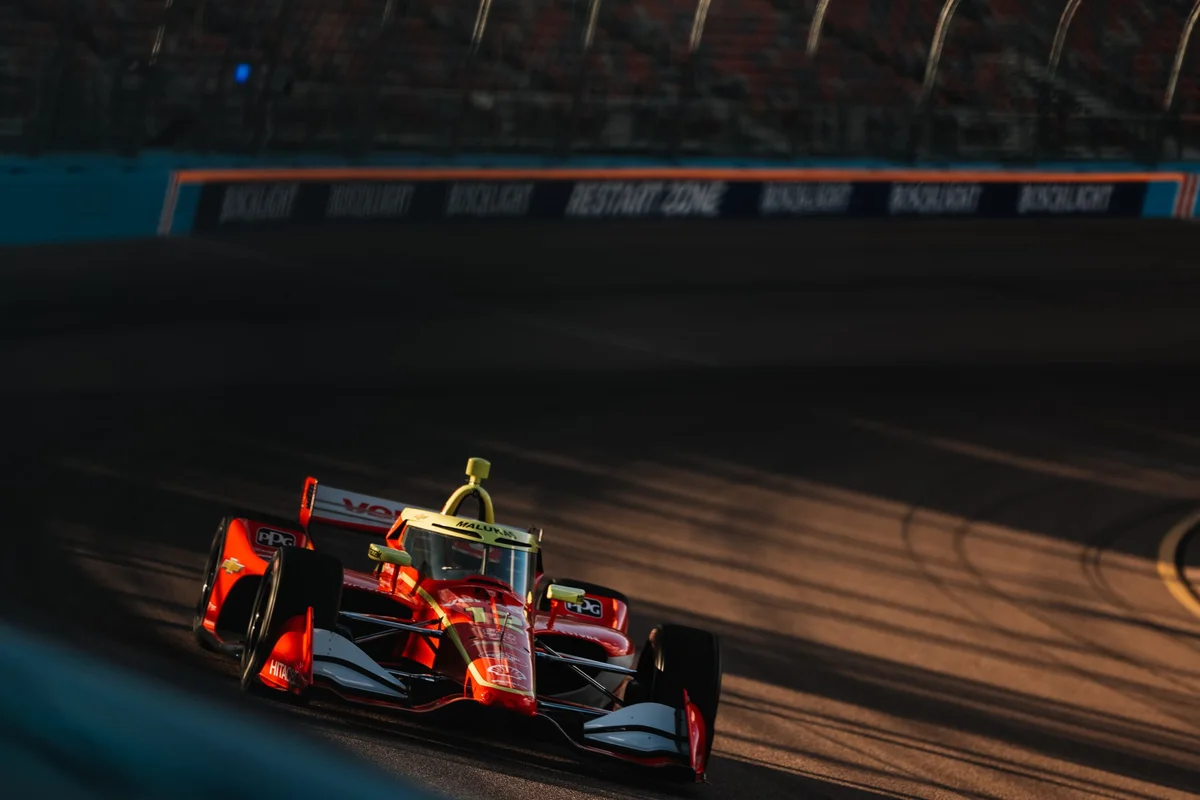
David Malukas, now with Team Penske, marked a strong beginning with his new team by setting the quickest lap during the NTT IndyCar Series testing session Tuesday at Phoenix Raceway. His fastest lap reached 172.605 mph on the mile dogleg oval as drivers prepared for the Good Ranchers 250 scheduled for Saturday, March 7. This top performance placed Malukas ahead of teammate Josef Newgarden and Will Power, who was third fastest for Andretti Global.
Malukas Expresses Enthusiasm for Phoenix Raceway
After clocking the fastest time in the final hour of the opening day, Malukas shared his impressions of the track. Speaking about his experience at the Unser IndyCar Open Test, he said,
“I love it—very, very nice. It can take a lot of grip. It’s definitely already one of my favorite tracks.”
He acknowledged the session as a testing phase rather than a direct pursuit of top speed, noting,
“I feel confident. Was it what we were aiming for? No. We just ran through our test plan, and we managed to get a time on the board.”
Incidents and Participants at the Phoenix Test Session
Rookie Caio Collet of A.J. Foyt Racing was involved in a minor incident when he lightly contacted the Turn 4 wall as Tuesday’s session neared its final hour. After evaluation by the IndyCar medical team, Collet was cleared with no injuries. The event was particularly meaningful for drivers with limited previous experience at Phoenix Raceway, as only four current IndyCar drivers have competed there before—Josef Newgarden, Alexander Rossi, Scott Dixon, and Will Power.
Veteran Drivers Reflect on Testing Challenges and Track Conditions
Four-time series champion Alex Palou described the learning curve for many drivers considering Phoenix as a new venue. He called the track “exciting” but noted the team started with no prior data, emphasizing the importance of adaptability:
“You always want to go fast, even if you are not trying to go, like, quick. You just want to feel fast.”
Palou explained that testing conditions differ significantly from race weekends, making it easier to set fast laps when alone on the track.
Pato O’Ward of Arrow McLaren highlighted the significance of comfort with the car on ovals. He observed,
“You obviously need something that is under you to be able to just be running out there. Like what Alex said, you have to be comfortable. You have to be happy with what you have, and this will be a huge opportunity to see the car in every aspect rather than just a performance run and then kind of guessing what the car is going to be like in the first stint.”
Comparisons of Phoenix Raceway to Other Circuits
Before the session, O’Ward compared Phoenix Raceway to other ovals, noting,
“a bit of a mix of maybe Gateway and Iowa. Obviously looks old-school, typical IndyCar. Hopefully we can get a second lane working. We’ll see what it’s all about, but it looks quite quick.”
Similarly, Kyle Kirkwood of Andretti Global, who finished fourth Tuesday with a lap of 171.423 mph, described Phoenix as a “fun track” with distinctive characteristics, likening it to World Wide Technology Raceway near St. Louis and calling it
“very, very smooth and very fast.”
Alexander Rossi Looks Forward to the Return of Phoenix Track
Returning IndyCar driver Alexander Rossi expressed excitement about racing again at Phoenix Raceway, reflecting on his positive experience during the 2018 event. He said,
“I was bummed when we left after ’18 because I had one of the best oval races of my life that year [he finished third], then we never went back again. I’m excited to get back there. It’s a cool track. It’s a great part of the world. Having a doubleheader with Cup is awesome. Having done the Firestone test out there in November, I think they found a pretty great tire which will make it an amazing show.”
Tire Developments and Efforts to Encourage Overtaking
Palou approved of the new, tougher right front Firestone tire introduced for the Phoenix race weekend, stating,
“My understanding is that it’s wider, the front right tire. I think it’s actually what we need at some of these ovals, just to get more grip from the tire itself so we are able to go in the second lane when it’s not so grippy and just kind of still be able to run it.”
The introduction of a viable second racing lane is vital to avoiding a predictable, processional race, which could dampen excitement at the event held in Avondale, Arizona.
Newgarden on Racing Dynamics and Track Specificity
Josef Newgarden emphasized the complexity of simulating race conditions during tests. He remarked,
“The only way you’re going to learn how the thing is going to race is when everybody is there and they’re trying to run in some sort of race situation. Even open tests can be tricky. You got to try to force people to run somewhat in a race condition. Then you’ll be able to see if we can work with what we got or not.”
He also explained the importance of customizing car setups for each track, saying:
“They’re all different. What works at Iowa doesn’t work at Gateway doesn’t work at Nashville. They all need a specific tuning to it as far as the downforce and tire package.”
Scott Dixon Observes Potential for Multiple Racing Lines
Chip Ganassi Racing’s Scott Dixon shared his thoughts after a limited 20-lap test at Phoenix last fall, noting signs that a second racing lane might develop over time.
“It became usable. I think if you get a full field doing it, it could transition pretty quickly,”
he said. Dixon also touched on the uncertainty regarding how NASCAR’s Goodyear tires might affect track conditions, adding,
“That could be good for us if they’re on the bottom, then it’s going to make us move higher. We want it to be a great race.”
O’Ward Comments on NASCAR Rubber Influence and Track Variability
O’Ward explained that the presence of NASCAR tires on the track can impact the IndyCar racing surface differently than when the Firestone rubber alone is present.
“The NASCAR rubber [tires by Goodyear] sometimes affects the IndyCars a little bit differently than if it’s just all Firestone rubber for us. Sometimes it varies from track to track, so you just have to wait for the race weekend and see if it decides to throw the balance upside down or not,”
he said.
The Dogleg Feature Adds Unique Challenges to Phoenix Raceway
The dogleg turn, a distinctive element of Phoenix Raceway’s mile oval layout originally influenced by its road course design, poses an additional challenge for IndyCar drivers. Dixon described the circuit as “tricky,” observing that without the ability to fully use the dogleg’s wider apron, the racing can become more single-file:
“It kind of makes that big straight single lane a little bit just with how you can place the car and nobody can go around you. But if that second lane comes in, it would be a game-changer.”
Restrictions on Using the Dogleg Apron Receive Support
While NASCAR drivers can take advantage of the dogleg’s wide apron to shorten the corner, IndyCar drivers are prohibited from using that area. Palou revealed he tested this possibility in a simulator but acknowledged its difficulty. He stated,
“because I thought it would have been great. It’s very tough on IndyCars. But on top of that, they don’t allow us. So even if it was doable in IndyCar, you’re not going to be able to see it, because it’s forbidden to go there.”
Palou supported IndyCar’s strict enforcement of this rule, explaining,
“For sure. I think honestly, with our cars, it’s actually good. For the show, it would be if you could have a couple of cars spinning on the straights because they bottom out. But it’s very rough. What I saw today during the track walk, it doesn’t look very nice. It’s very—I think there would be a big crash if somebody tries it.”
Phoenix’s Early Place on the Schedule and Impact on Indy 500 Preparation
Discussion has arisen about whether holding the Phoenix race early in the season benefits drivers preparing for the Indianapolis 500. However, drivers agree that little translates from other ovals to Indianapolis Motor Speedway, a circuit with unique demands. Dixon explained,
“There’s nothing really that aero package-wise or mechanical grip or anything that really passes on to Indy. No, Indy is really its own thing.”
O’Ward concurred, saying,
“Indy is Indy—like, Indy is very different. Even when we had Texas before Indy, it doesn’t fully translate. Indy just decides what it wants, and obviously the car can be good one day, and then the other day it’s like, ‘What’s going on with it?’ Indy is its own beast.”
He added,
“I would say it really doesn’t have too much of a comparison if we were to start with an oval or not.”
Anticipation for Race Conditions Despite Variable Weather
Although the data from this test week at Phoenix is valuable, it might have limited applicability for the race in April when conditions could be warmer by 10 degrees or more. Despite this uncertainty, the test provides all drivers with an opportunity to familiarize themselves with the facility and refine car setups ahead of the official events.
