
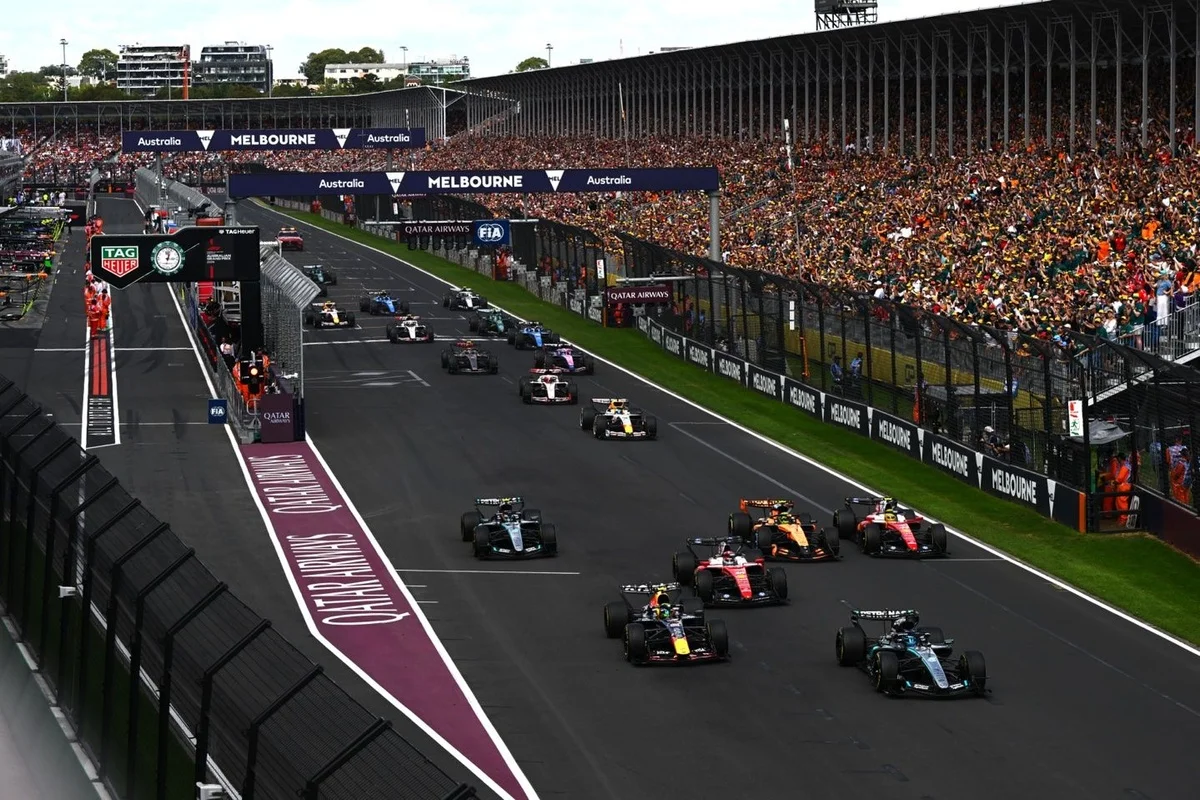
George Russell secured a commanding victory at the 2026 Australian Grand Prix held at Albert Park, but controversy quickly arose regarding his race start. A fan-recorded video circulated online suggesting that Russell’s Mercedes W17 may have moved prematurely, sparking accusations of a jump start on social media platforms such as F1 Twitter. This generated tension among fans and commentators, questioning whether the driver broke the rules to gain an unfair advantage.
Despite the heated speculation, closer examination shows the Briton’s start complied with official regulations, leaving stewards without grounds to penalize him. The FIA’s rulebook clarifies the conditions that define a jump start, and in Russell’s case, the evidence supported a legal launch from the grid.
Understanding the Rules Governing Jump Starts in F1
FIA Sporting Regulation Article B5.11.1 outlines the strict criteria drivers must meet to ensure a fair standing start or restart in Formula 1. Drivers are required to remain stationary in their allocated grid positions during the red light phase and must not move forward until the start signal is given by the extinguishing of all red lights. Additionally, the position of the car’s front tires relative to the grid box lines is monitored to detect any illicit movements.
The regulation states that:
“At the sole discretion of the stewards, a five-second penalty, a 10-second penalty, a drive-through penalty or a stop-and-go penalty will be imposed on any driver who is judged to have breached this article.”
This penalty framework highlights the importance the FIA places on clean race starts, aiming to prevent any driver from jumping the gun and gaining an advantage at the outset.
Why George Russell’s Start Was Within the Rules
Video analysis shows that Russell’s Mercedes W17 rolled slightly as the light sequence began, but crucially, the car remained stationary once the red lights went out, indicating the official start. His front tires did not cross any boundary lines on the grid box at that moment, satisfying all conditions prescribed by the FIA.
Given these facts, stewards found no evidence to justify a jump start penalty against Russell. His clean launch at the Australian GP allowed him to complete a strong first win of the season without sanction, maintaining the integrity of the competition.
Reactions and the Broader Context in F1
The debate around Russell’s start reflects broader tensions in the current Formula 1 season, where teams and drivers face increasing scrutiny over compliance with evolving regulations. Controversies have also involved prominent figures such as Lewis Hamilton, Max Verstappen, and Christian Horner, each linked with their own disputes on and off track.
Incidents like these fuel passionate discussions among fans and stakeholders, emphasizing the fine margins and high stakes that define modern F1 racing. For Russell, the controversy proved a distraction from his promising performance, but his message to teammates and rivals alike was to focus on racing rather than off-track drama.
Significance and What to Expect Moving Forward
The incident at Albert Park serves as a reminder that even minor moments on the grid can provoke intense scrutiny and debate in Formula 1. Ensuring clarity and fairness in race starts remains fundamental to the sport’s credibility, especially as new technical regulations and team strategies continue to evolve in 2026.
As the season progresses, drivers like George Russell will remain under the watchful eyes of fans and officials alike, with every move dissected for compliance. The FIA’s consistent application of the rules in situations like this helps maintain a level playing field, which is critical amid the fierce competition between teams such as Mercedes, Red Bull, and others pushing for championship success.
https://twitter.com/F1tutkumuz/status/2030689389043437601
