
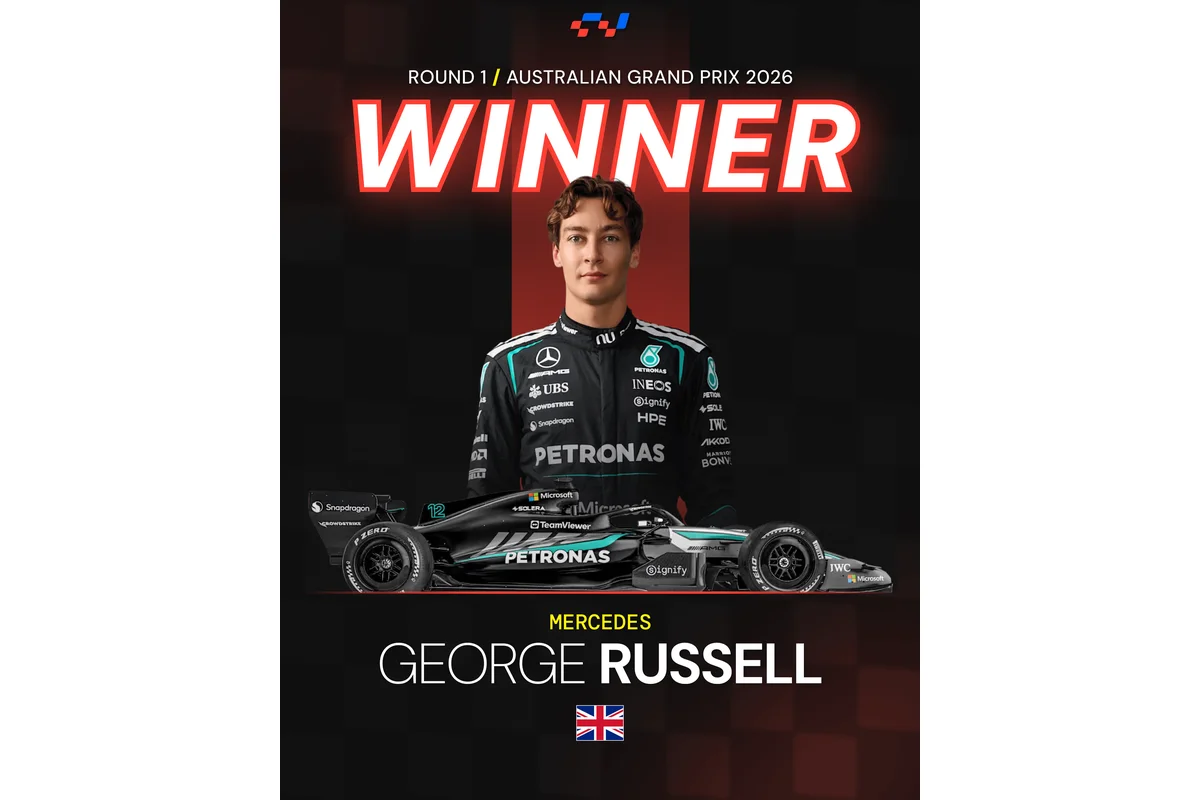
George Russell secured a commanding victory at the Australian Grand Prix in Melbourne, launching the new Formula One season with a dominant performance. Racing from pole position, Russell led a Mercedes one-two finish with teammate Kimi Antonelli finishing second, while Ferrari’s Charles Leclerc and Lewis Hamilton rounded out the top four after an intense early battle.
Early Stage Battle Between Mercedes and Ferrari Sets the Tone
The race began with a fierce contest between Russell and Leclerc, who blazed off the line to fight for the lead in the opening laps. Leclerc’s remarkable start from fourth on the grid allowed him to take the lead initially, demonstrating Ferrari’s promising pace that was honed during testing. Russell quickly responded, reclaiming the lead by the second lap as his superior race pace became evident.
Hamilton also advanced early, moving into third place to keep Ferrari closely matched with Mercedes. Over several laps, Russell and Leclerc exchanged positions multiple times, with car energy deployment strategy playing a critical role in their wheel-to-wheel contest. This thrilling duel lasted until an early virtual safety car (VSC) period, which Mercedes exploited to execute pit stops and gain a decisive advantage on track position and fresher tires.
Local Hopes Dashed as Piastri Crashes on Formation Lap
A heartbreaking moment unfolded for local fans when Melbourne-born Oscar Piastri crashed during the formation lap, clipping a kerb at turn four and spinning into the wall before the race start. Piastri acknowledged the incident as an important learning step while adapting to the handling characteristics of the new Formula One cars this season. Meanwhile, his teammate Lando Norris managed to finish fifth, representing McLaren’s respectable showing.
Strong Comebacks for Verstappen and Impressive Debut for Lindblad
Max Verstappen demonstrated tenacity by finishing sixth after starting from 20th on the grid in his Red Bull. His recovery drive underscored his resilience and racing skill. British rookie Arvid Lindblad also made an impressive F1 debut by securing eighth place for Racing Bulls, showcasing promising potential by earning points in his first race.
Mercedes Prove Early Dominance with Superior Car Performance
Russell’s victory underscored Mercedes’ position as early favourites in this season’s championship hunt. After a dominant qualifying session where Russell outpaced rivals by nearly a full second, the race confirmed Mercedes’ power and efficiency advantage. The Mercedes engine showed strong performance under the strict energy management regulations that govern the sport, particularly excelling in the harvesting and deployment of electrical energy.
The team’s chassis has evolved significantly from previous years, with improved stability and drivability that made the cars easier to control under race conditions. Despite sharing the same Mercedes power units, McLaren lagged behind, indicating that Mercedes’ package as a whole—engine, aerodynamics, and chassis balance—was more effective on race day.
Strategic Pit Stops Shape the Race Outcome
The turning point in the race came during a virtual safety car triggered by Isack Hadjar’s retirement on lap 12 due to an engine failure. Mercedes capitalised by pitting both Russell and Antonelli, gaining clean air and fresh tires, while Ferrari’s choice to delay their stops initially left them at a disadvantage. Hamilton and Leclerc’s later pit stops could not reverse the momentum, allowing the Mercedes drivers to pull away and secure the top two spots comfortably.
Race Results Highlight Rising and Established Talents
Russell’s victory in Melbourne marked the sixth win of his career and his first triumph in Australia, ending Mercedes’ wait since Valtteri Bottas’ last win here in 2019. His composed performance in front of tough rivals stands as a clear statement of his title credentials. Ferrari’s competitiveness throughout the race indicates they remain close contenders capable of challenging Mercedes in future rounds.
Cadillac made a noteworthy entry into Formula One, completing the race with Sergio Pérez finishing 16th despite being three laps behind the leader. Having built their team rapidly over the past year, Cadillac’s successful finish lays a foundation for gradual improvement. Audi, also debuting this season after taking over the former Sauber outfit, earned points with Gabriel Bortoleto finishing ninth, signaling a solid start for the new manufacturer.
Looking Ahead: What This Means for the Season
George Russell’s commanding performance at the Australian GP has set a confident tone for Mercedes, positioning them as a leading force in this fiercely competitive season. The close early battle with Ferrari demonstrates that the title fight is likely to remain intense and unpredictable, providing fans with high-stakes racing throughout the year.
Emerging talents like Arvid Lindblad and the resilience shown by established drivers such as Verstappen and Norris promise an exciting grid dynamic. Meanwhile, new entrants Cadillac and Audi have laid down markers for growth and competition beyond the established teams. As the championship progresses, energy management, race strategy, and vehicle development will be critical in determining who ultimately claims the world title.
“We were able to make our superior pace tell after the VSC, and that put us in the winning position.” ?George Russell, Driver
“I had a blistering start and managed to take the lead, but Mercedes’ strategy was very strong.” ?Charles Leclerc, Driver
“Piastri’s crash was tough for us here at Albert Park, but it’s part of learning the new car’s behavior.” ?McLaren Team Principal
