
At the Australian Grand Prix season opener, Lewis Hamilton publicly expressed doubts about the surprising pace shown by Mercedes during Friday’s qualifying session at Albert Park. The seven-time world champion, who now races for Ferrari, suggested that Mercedes might be benefiting from a hidden engine advantage, possibly involving a compression ratio irregularity, which has led to their unexpected lead over competitors.
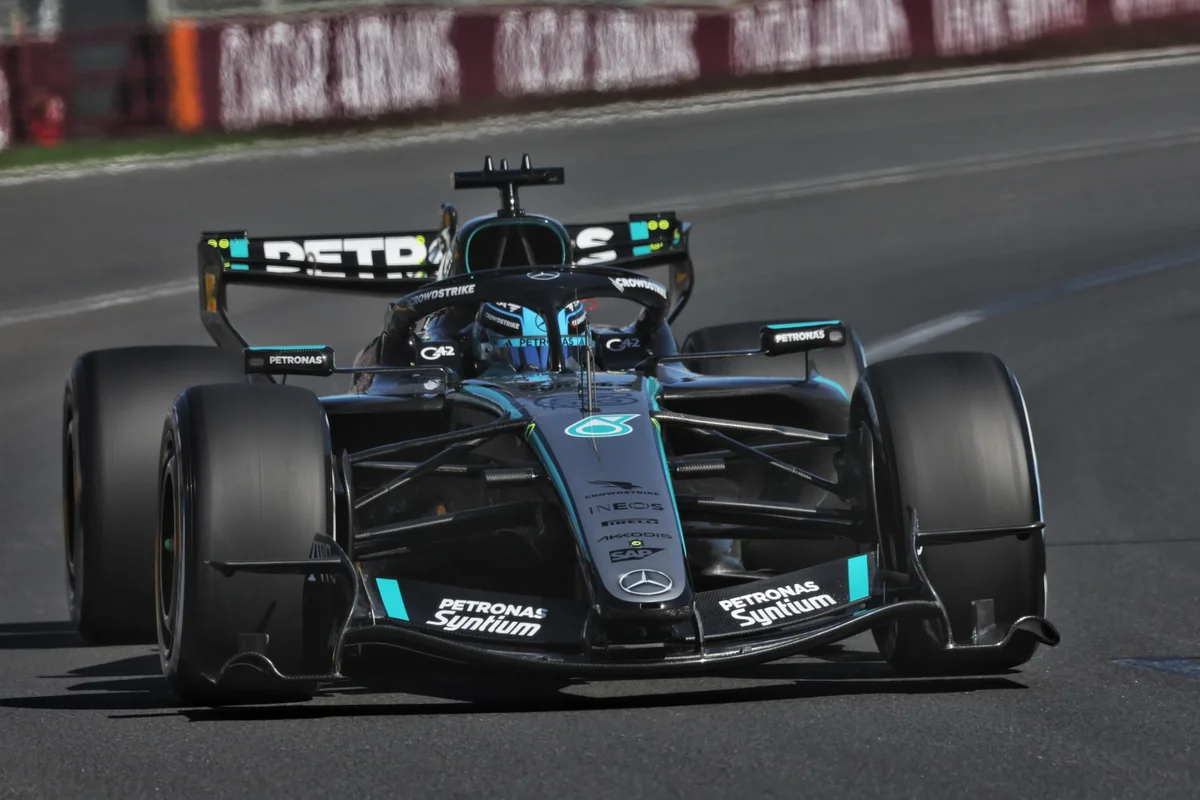
Mercedes achieved a commanding front-row lockout as George Russell secured pole position with teammate rookie Kimi Antonelli impressively qualifying second. Their gap to other teams was significant enough to provoke skepticism within the Formula 1 paddock.
Significant Gaps Evident Among Top Competitors
Red Bull’s Isack Hadjar qualified third but was over half a second slower than Russell’s pole time. Hamilton himself was only able to place seventh, trailing Hadjar by 0.2 seconds, underscoring the considerable performance disparity between Mercedes and Ferrari at this stage in the season.
Hamilton openly questioned Mercedes’ sudden surge that had not been apparent during pre-season testing sessions.
“I don’t understand it exactly,” Hamilton told the media per RacingNews365. “They didn’t show that they could turn it up in testing and now they’ve got this extra power from somewhere. We need to understand what that is. I hope it’s not this compression ratio thing. Hopefully, it’s just pure power and we’ve got to do a better job.” — Lewis Hamilton, Formula 1 Driver
Background on Engine Compression Ratio Allegations
During the winter break, Mercedes’ power units were already under scrutiny by rival teams including Ferrari, Audi, and Honda. These teams suspected that Mercedes had exploited a loophole in the regulations related to the 16:1 compression ratio limit for their engines. Allegations claimed that Mercedes managed to pass official ambient temperature tests by manipulating their engine parameters before driving on track, effectively gaining extra power illegally.
In reaction, Formula 1’s governing body, the FIA, introduced regulatory changes ahead of the Australian event. A compromise was reached after extensive discussions, mandating that from June 1, 2026, engine compression ratio tests must be conducted at both hot and cold temperatures. Starting in 2027, only hot-condition tests will be enforced to prevent exploitation of temperature-related loopholes.
Hamilton’s Frustration with FIA’s Regulatory Response
Despite these new rules, Hamilton expressed dissatisfaction with how the FIA has managed the controversy, particularly if Mercedes is confirmed to have gained an illegal advantage through compression ratio manipulation.
“If it is the compression thing, then I will be disappointed that the FIA allowed that to be the case, that it’s not to the book. I will be pushing my team to do the same thing so we can get more powerful.” — Lewis Hamilton, Formula 1 Driver
Varied Results Among Mercedes-Powered Teams in Qualifying
Performance among other teams using Mercedes engines was inconsistent in qualifying. McLaren fared well, placing fourth and fifth on the grid, while Alpine struggled, qualifying 14th and 16th. Williams experienced similar difficulties with their cars qualifying 15th and 21st. Notably, Carlos Sainz of Ferrari was unable to set a qualifying time due to technical problems that kept him in the garage during the session.
Implications for the Season and Formula 1 Competition
Mercedes’ dominant qualifying performance, combined with the unresolved questions over their engine’s legality, has intensified tensions early in the Formula 1 season. If an undisclosed engine advantage is confirmed, it could prompt further regulatory scrutiny and testing, potentially affecting the competitiveness of teams such as Ferrari, McLaren, and Red Bull.
The FIA’s ongoing regulatory adjustments aim to close loopholes and ensure a level playing field, but the situation also underlines the challenges of policing highly technical elements in modern motorsports. Teams and fans alike will be watching closely as the championship progresses to see whether Mercedes can sustain their advantage and how rivals respond.
