
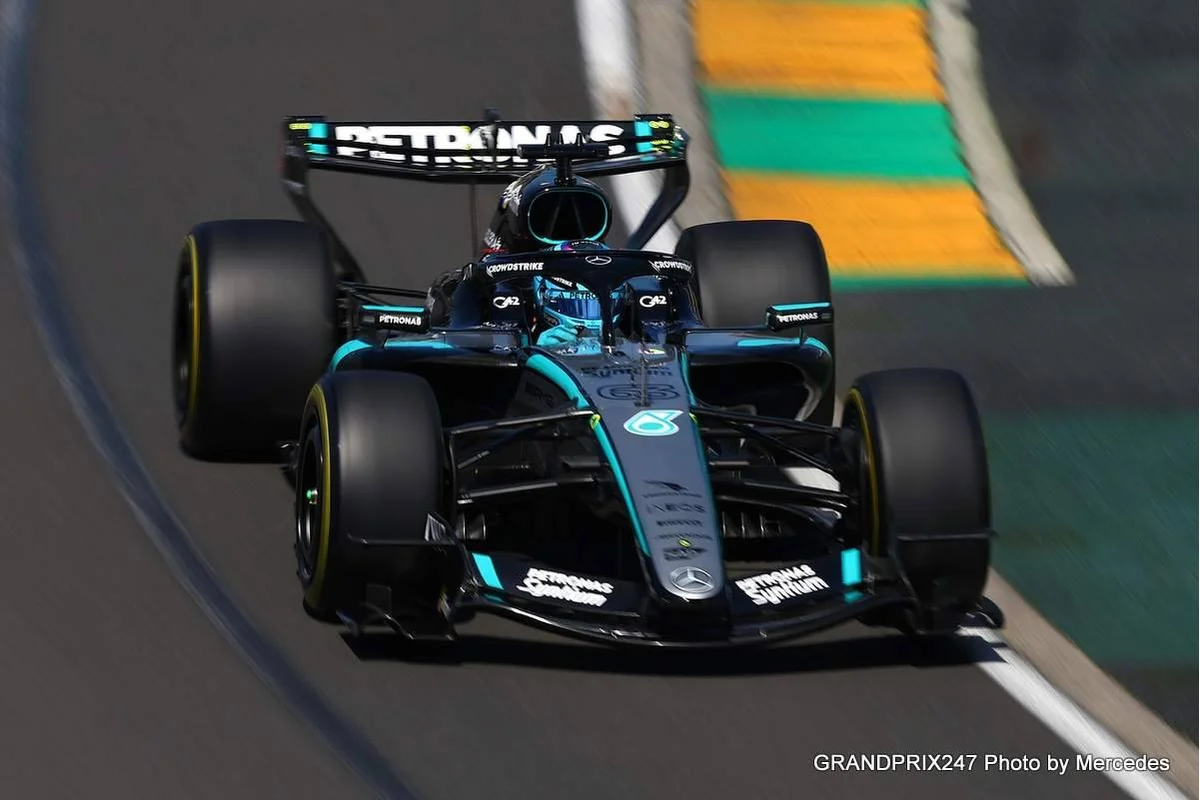
Lewis Hamilton, the seven-time Formula 1 World Champion, has expressed doubts regarding a sudden rise in engine performance displayed by the Mercedes F1 Team during the Australian Grand Prix. Speaking after the race, Hamilton highlighted that if the improvement is legal, he intends to encourage Ferrari to replicate the advantage, underscoring the ongoing technical rivalry in the sport.
The British driver admitted that the extent of Mercedes’ power boost was surprising, particularly since it had not been apparent during preseason testing. This unexpected leap has prompted Hamilton and his team to investigate how Mercedes achieved such a performance gain amid intense competition.
Uncertainty Surrounds Source of Mercedes’ Enhanced Engine Output
Hamilton detailed the challenge in understanding the origin of the additional speed Mercedes showed, emphasizing the opacity of their improvements. He stated that despite close monitoring, Mercedes had not revealed this capability during earlier testing sessions, leaving rivals puzzled.
“I don’t understand it exactly. They didn’t show that they could turn it up in testing and now they’ve got this extra power from somewhere,”
Lewis Hamilton, Driver
This unexpected power increase triggered curiosity within the paddock, as Mercedes has traditionally run a very competitive engine program. Rival teams such as Ferrari are now tasked with dissecting the enhancements to regain competitive balance on the track.
Speculation Around Compression Ratio Advances
Among the technical aspects under scrutiny is the potential use of an altered compression ratio in Mercedes’ power unit. The compression ratio measures how much the fuel-air mixture is compressed before ignition, significantly impacting engine efficiency and power. Adjustments in this area must adhere strictly to FIA regulations.
Hamilton conveyed mixed feelings about this possibility, hoping the advantage stems from pure engine power rather than regulatory gray areas related to the compression ratio.
“I hope it’s not this compression ratio thing. Hopefully it’s just pure power and we’ve got to do a better job.”
Lewis Hamilton, Driver
Should the increased performance prove to be linked to rules interpretations that other teams have not exploited, it could spark broader discussions around regulatory clarity and fairness across the grid.
Hamilton Advocates for Ferrari to Match Valid Performance Gains
Despite questioning Mercedes’ upgrade, Hamilton made clear that if the improvement complies with the regulations, then Ferrari should actively seek to incorporate the same technical solution. This approach reflects the competitive nature of Formula 1, where teams rapidly adopt successful innovations to stay competitive.
“But if it is the compression thing, then I will be disappointed that FIA allowed that to be the case, that’s it not to the book. I will pushing my team to do the same thing so we can get more powerful,”
Lewis Hamilton, Driver
The statement emphasizes the practical mindset in Formula 1, where regulatory loopholes or novel interpretations can quickly become strategies across multiple teams once validated.
Technical Rivalry Remains Central to Formula 1 Competition
The evolving battle for technical superiority continues to define the sport, with engine efficiency, aerodynamics, and power unit systems playing pivotal roles. A sudden advantage like Mercedes’ recent engine boost compels rival manufacturers to deepen their analyses and innovations.
For Ferrari, Hamilton’s remarks highlight the necessity for relentless development to challenge Mercedes’ dominance and secure strong race pace. As the F1 season advances, teams will persist in scrutinizing rivals’ performances both on race weekends and through behind-the-scenes engineering efforts.
This ongoing pursuit of speed and efficiency defines the dynamic landscape of modern Formula 1 racing, where each upgrade can alter the championship trajectory dramatically.
