
Liam Lawson is focusing on effective energy management as he approaches the 2026 Australian Grand Prix, knowing the new Formula 1 regulations will test Racing Bulls’ capabilities. The challenging energy demands of the season opener at Albert Park Circuit require careful planning, especially given the unique attributes of the 2026 cars and track layout.
The New Zealand driver experienced a difficult 2025 season after being reassigned to Red Bull’s sister team shortly after the start, but this year offers a chance for Lawson to rebuild his standing alongside rookie teammate Arvid Lindblad. At 24 years old, Lawson recognizes that the complex hybrid power unit regulations and the circuit’s characteristics could restrict his performance in Melbourne.
Technical Demands of Albert Park and Hybrid Power Units
The 2026 cars feature a 50-50 power split between internal combustion engines and electric motors, intensifying the significance of energy recovery and battery management. On a track like Albert Park, with its long straights and limited heavy braking zones, the Racing Bulls team must fine-tune the power unit’s energy settings precisely to avoid losing substantial horsepower mid-lap.
Lawson faces the risk of running an empty battery, which would translate to losing more than 400 horsepower, particularly through the fast section from Turn 6 to Turn 11 where maximum electric boost is crucial. The Faenza-based team is therefore prioritizing optimizing energy deployment during the race weekend.
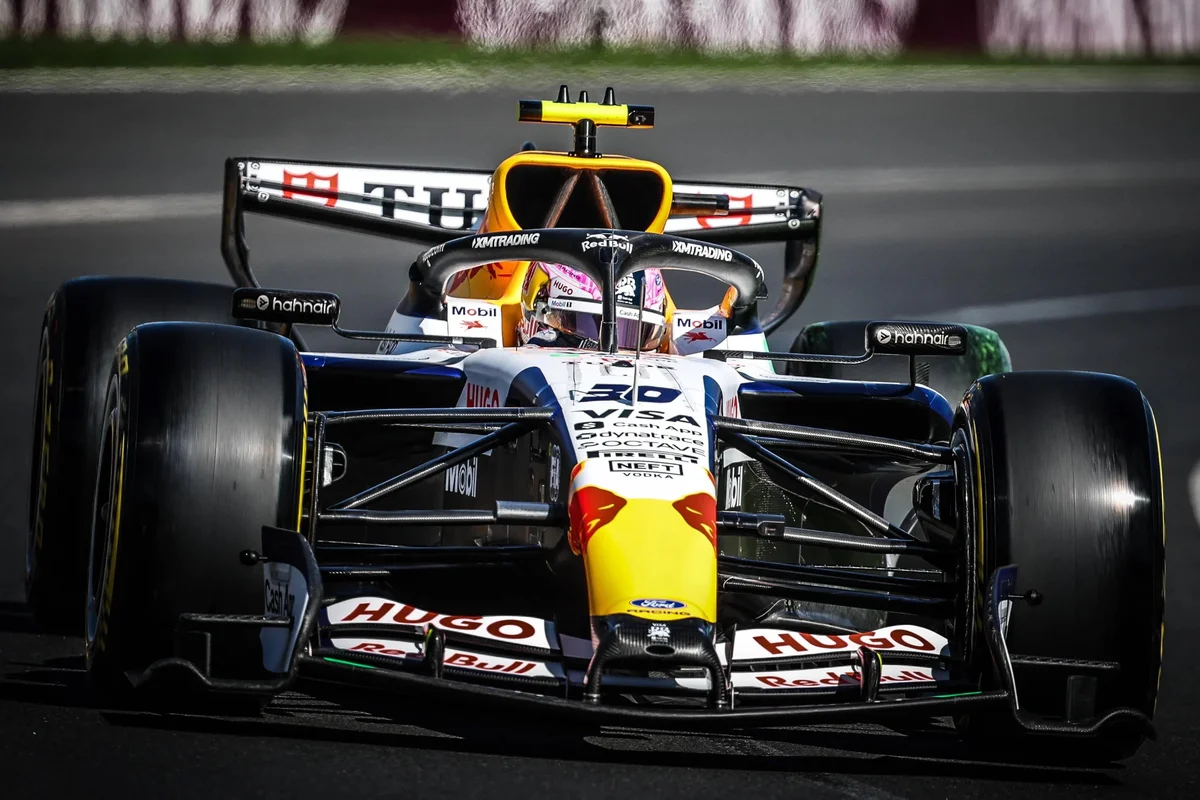
Lawson Shares Insights on Practice Sessions and Car Performance
Following practice sessions leading up to qualifying, Lawson reported positive signs despite the hurdles. He acknowledged that the team nearly completed all their planned work while learning valuable information to improve the car’s performance for qualifying later that day.
“It was a pretty decent day, we completed pretty much everything we wanted to, and learned a lot from it as well,”
he told Motorsport Week.
Lawson added,
“It is promising, but we still have a lot of work to do, and we’ll analyse overnight, but there is definitely more I’m going to have to learn.”
He also noted the complexity of driving the new car with its busy systems:
“There’s a lot more we have to do behind the wheel, like driving the car, which is quite busy, and there are a few new things we have to make sure we are doing correctly.”
“To be honest, it doesn’t feel like we have to do a huge amount. The balance isn’t miles away, which is a really good sign to come out with a decent car, but obviously, everyone is going to be progressing quite quickly, so we need to do the same.”
Lawson’s pace during the first two practice sessions placed him 13th, improving slightly to 12th position in FP3. While not immediately competitive, he believes maintaining consistency under the new regulations will be crucial.
Energy Strategy and Preparation for Race Day
Lawson highlighted the punishing nature of Albert Park for energy use, emphasizing the fine margins required to avoid significant lap time losses by mismanaging the hybrid power unit. He described efforts to optimize strategies through various run types and simulations during the practice sessions.
“On a track like this, it is very challenging, because this is one of the hardest tracks on energy, and on the long runs and even in short runs, if you get it slightly wrong, it is very punishing on lap-time, so it is definitely something we’re trying to optimise,”
Lawson explained.
“We think we’ve done a good job, but there is more to optimise.”
“We were trying a lot of different things throughout the runs, making switch changes, and we had a lot of VSC practice, so restarts, practice starts, pit-stops, exits, entries, it was good to try them all.”
These efforts will be critical as Lawson looks to convert qualifying into a strong race result. He managed to secure eighth on the grid, narrowly ahead of Arvid Lindblad, setting a positive starting point for Racing Bulls in Australia.
Outlook for Lawson’s Australian GP and Season Ahead
With the Albert Park Circuit’s demanding energy requirements, Liam Lawson’s ability to adapt and manage the intricate hybrid systems will significantly influence his success at the Australian GP. His team’s ongoing refinements and his consistent performance in practice sessions suggest potential for progress despite previous setbacks.
Considering the competitive field and rapid development pace across teams, Lawson’s focus remains on learning and harnessing energy efficiently for both qualifying and the race. His results here may shape his momentum going forward in the 2026 Formula 1 season.
