
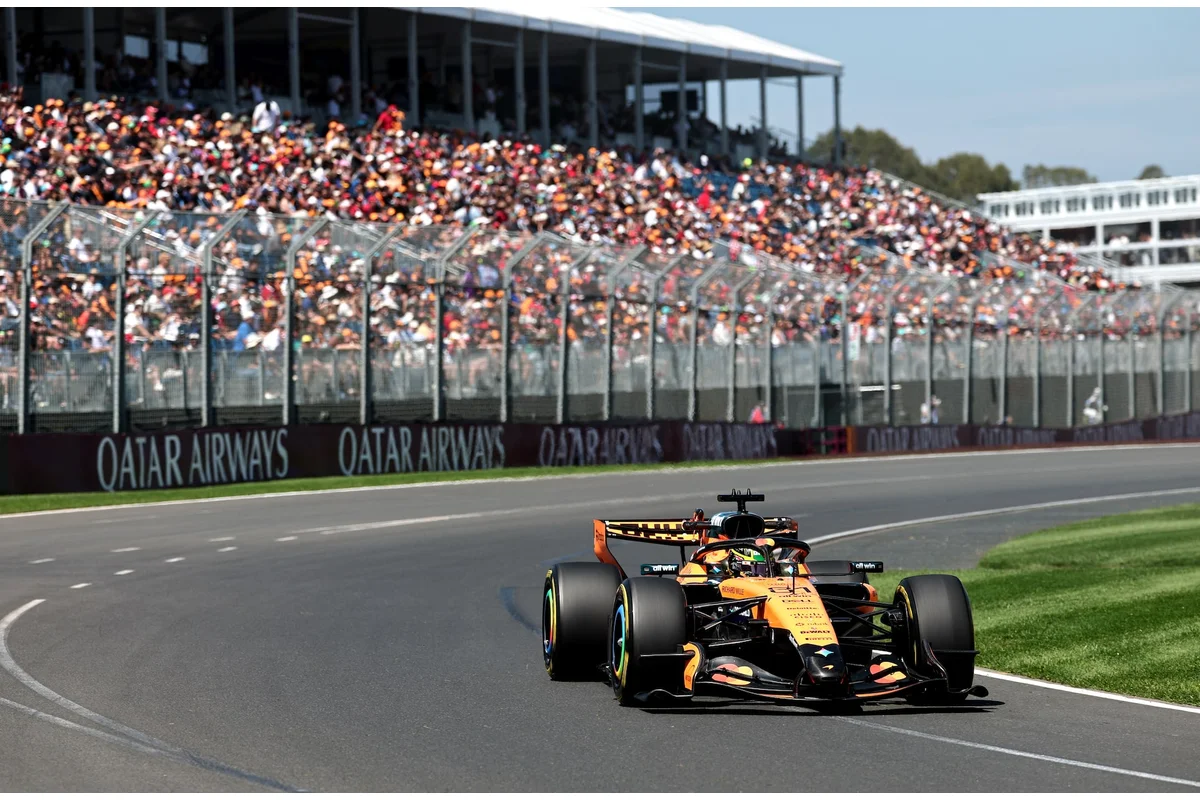
Oscar Piastri has expressed concerns about the challenges posed by the new Formula 1 regulations set for 2026, highlighting that resolving key issues with the car’s performance may be difficult. Speaking after qualifying for the Australian Grand Prix at Albert Park, Piastri discussed the complexity of adapting to the current energy management system under the new rules.
Driving Challenges Under New 2026 Formula 1 Rules
Piastri qualified fifth in his hometown race, sharing the third row with his McLaren teammate Lando Norris, while Mercedes’ George Russell secured pole position with a gap exceeding eight-tenths of a second. Despite this substantial performance difference, McLaren’s team principal Andrea Stella remains optimistic about closing the gap as the team gains a better understanding of Mercedes’ power unit.
While some drivers, including Norris, have been openly critical of how the 2026 cars handle, Piastri took a more measured approach in his remarks, acknowledging that although improvements are likely, fundamental problems remain unsolved and may not be straightforward to fix.
I think everyone can see the state of things,
Piastri said after qualifying.
I think it will probably improve a bit, but there’s clearly some fundamental things that won’t be very easy, and I don’t really know what we do about that.
Piastri elaborated on the current energy recovery and deployment system, describing the difficulty in maximizing its potential during races.
Energy Management Complications and Track Variations
Piastri explained that under present rules, drivers can harvest energy by lifting off the throttle, generating 350 kilowatts, which matches the output during a “super clip” boost at the same power level but with different control nuances. This balance complicates decisions on when to apply power and when to conserve it during a race lap.
At the moment, if you lift, you can harvest 350 kilowatts. So the super clip at 350 is the same as a lift. So the difference is, one of them, you actually off the throttle and in control of it, but the other one, you’re at full throttle. I’m not sure it’s any more helpful.
He noted that different circuits will present different challenges based on their energy demands, distinguishing between energy-starved and energy-rich tracks. The current situation at Albert Park, an energy-starved track, makes these limitations highly visible to viewers.
It’ll be better at different tracks. We’ll have different challenges at other tracks because the tracks are kind of in two categories at the moment of being energy-starved and energy-rich, and there’s a problem with either of those things.
But I think when you’re energy starved like this, it’s a lot more obvious to everyone watching.
Impact of Reduced Horsepower and Battery Restrictions
Piastri indicated the severity of power loss during certain parts of the lap, estimating a deficit of around 450 horsepower compared to competitors like Mercedes. This gap forces drivers to adjust their driving style significantly and manage limited power boosts with precision.
I don’t know what the Mercedes lap looks like, but we were lifting and coasting three times a lap. We had two super clips through the lap, and in some corners, we’ve got effectively 450 horsepower less, so it’s a massive challenge to get your head around. It’s tough for everyone.
The energy management approach has led to unusual tactics such as coasting towards the start of qualifying laps to conserve battery power, which Piastri feels is not an ideal way to drive but is necessary under current constraints.
I’m sure everyone’s seen how we have to start a qualifying lap now, which isn’t great, and there’s just a lot of things you have to do to optimise what we’ve got, basically,
Piastri shared.
So I think for me, the understanding of things is okay, like I know more or less what I can do what I can’t do. It’s just that, in an ideal world, would you be doing the things that we can and can’t do? Probably not.
The Road Ahead for Formula 1’s 2026 Regulations
As the Formula 1 grid continues to adapt to the 2026 power unit and battery rules, Piastri’s perspective points to an ongoing struggle to balance performance and energy management. With significant horsepower disparities and challenging energy deployment strategies, teams will need to innovate and evolve quickly.
Andrea Stella’s confidence in improving McLaren’s competitiveness by understanding rival systems signals a technical battle in the near term, while drivers and fans alike will be watching to see if these fundamental issues in the regulations can be addressed before they impact season outcomes seriously.
Piastri’s comments highlight that while some progress may come with time, the core problems embedded in the current formula pose a complex puzzle that will require collective effort from teams, drivers, and FIA regulators to solve.
