
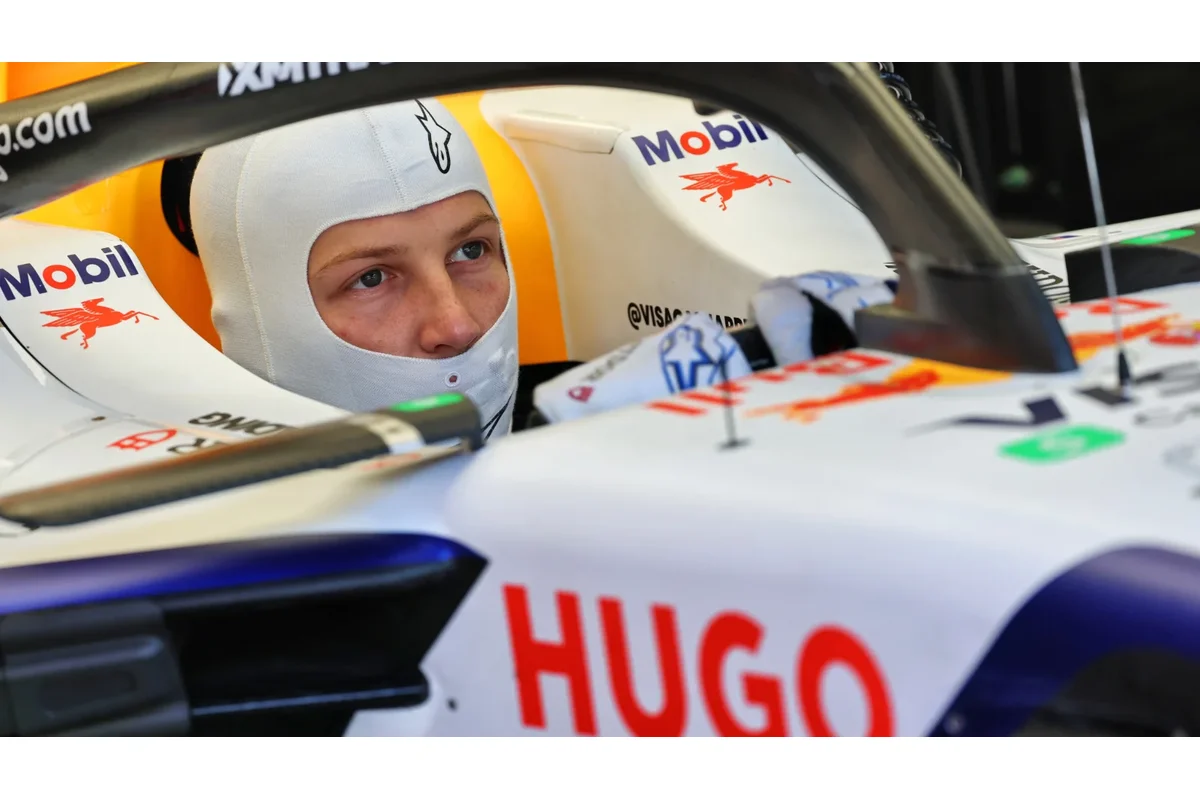
During the recent pre-season testing at Bahrain, Racing Bulls driver Liam Lawson demonstrated an unconventional cornering technique that caught the attention of observers. Lawson, who is embarking on his first full Formula 1 season with Racing Bulls after years of uncertainty in his racing career, is working to adjust to both the team and the new 2026 regulations.
Although Lawson continues with Racing Bulls—the team he concluded last season with—he faces the challenge of mastering the updated car setup and rules as he begins this campaign. His distinct cornering style is part of his adaptation process, highlighting his effort to maximize performance amid evolving technical conditions.
Insights Into Lawson’s Cornering Technique and Challenges Faced During Testing
Journalist Scott Mitchell-Malm shared his observations during The Race F1 Podcast, highlighting what set Lawson apart from his competitors at turn 11, a medium-speed corner approached at high velocity. Unlike other drivers, Lawson was noted to take a considerably shallower line into the corner, a method aimed at managing the car’s balance more cautiously.
Mitchell-Malm explained that Lawson seemed to preload the car’s setup, easing it into the corner rather than making an aggressive steering input that risked destabilizing the rear of the car. This strategy appears to mitigate rear instability on corner entry, even if it contributed to understeer when exiting the corner.
“It was manifesting his understeer on the exit, but I think it was actually a rear instability problem on entry.”
— Scott Mitchell-Malm, Journalist
This method reveals both the potential and difficulties encountered by Lawson and Racing Bulls, as they seek to adapt to the car’s handling quirks and the dynamic effects of the new Red Bull power unit.
Team Efforts to Address Braking and Handling Concerns With New Red Bull Power Unit
Throughout the two-week testing period, Racing Bulls worked to refine their performance, but challenges remained, particularly around braking zones and car dynamics. Edd Straw, another motorsport analyst, pointed out that despite visible improvement, drivers were still cautious in demanding sections like turns nine and ten, a complex curved left-hander leading onto a back straight.
He observed rookie driver Arvid Lindblad grappling with the car’s behavior under braking and cornering. While Lindblad showed moments of pushing harder, he often struggled to maintain the desired trajectory, indicating that the team is still mastering how the power unit integrates with the chassis’s dynamic response.
“I don’t think they’re quite as on top of the way the power unit is influencing the car dynamically.”
— Edd Straw, Motorsport Analyst
Lindblad’s pace during testing even exceeded Lawson’s at times, offering him confidence ahead of the season opener in Australia, although such testing results may not directly predict race outcomes.
The Wider Context: Competition for Seats and Lawson’s Need to Accelerate Progress
Both Liam Lawson and Arvid Lindblad are aware of the intense competition within the Red Bull driver development program, as multiple junior drivers vie for limited seats for the 2027 season. For Lawson, quickly adapting to the demands of the new car and showing consistent performance is crucial not only for securing his current position but also for drawing interest from other teams across the Formula 1 paddock.
With the changes in regulations and a competitive field, Lawson’s ability to refine his unique cornering technique and stabilize his driving will likely influence his career trajectory. The early signs in Bahrain testing suggest potential but also underline the significant work still required to compete at the front in 2026.
