
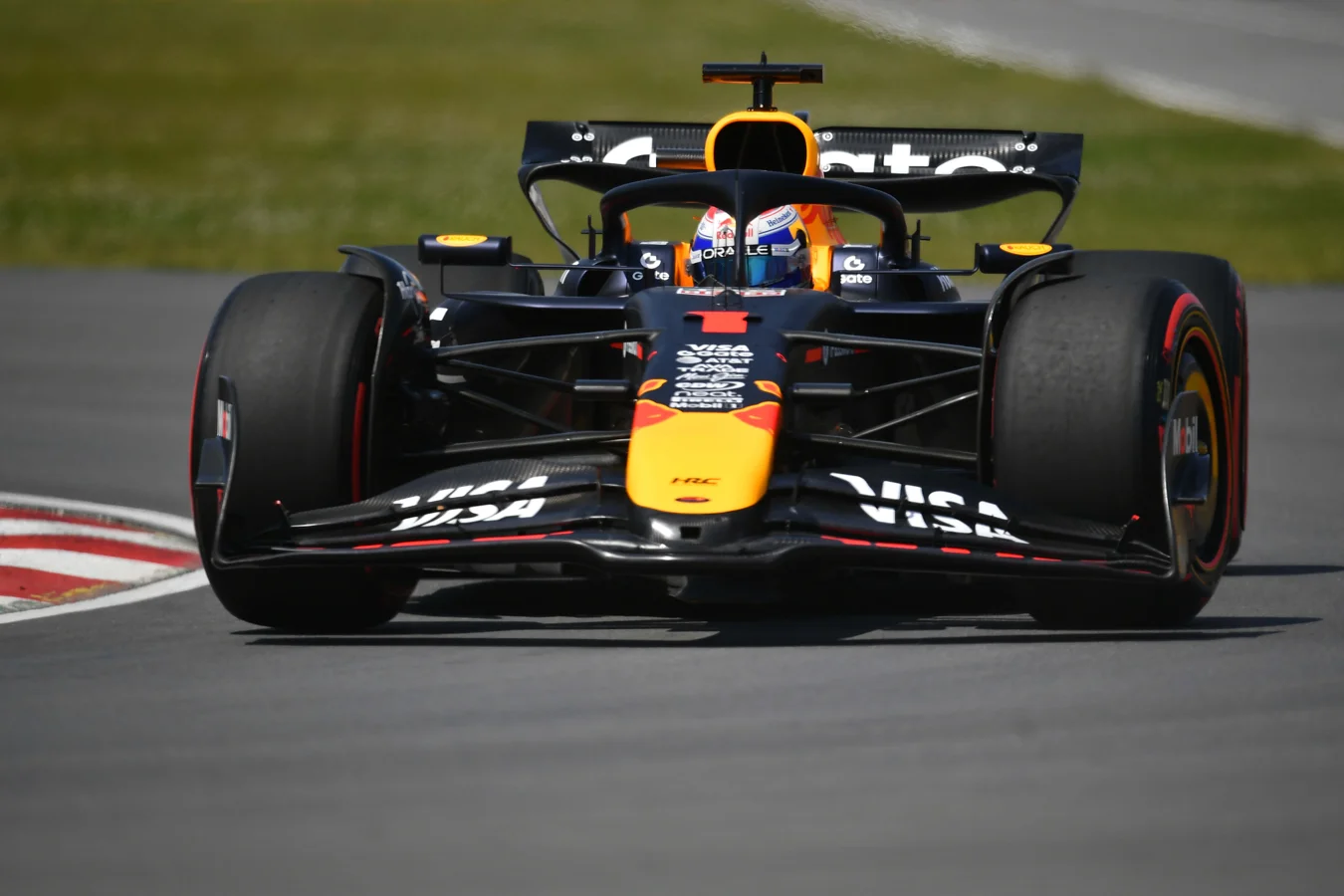
At the 2024 Canadian Grand Prix qualifying session, George Russell and Max Verstappen once again locked out the front row, replicating last year’s pattern with the Mercedes driver securing pole position and Verstappen alongside him. Unlike 2023, however, this time Russell posted a lap that was over a tenth and a half faster than Verstappen, revealing notable differences upon closer examination of their on-track performance and GPS data.
Analyzing the Qualifying Lap Differences
During the qualifying laps, Russell and Verstappen posted nearly identical times up to Turn 8, with Verstappen slightly ahead at certain points. Russell’s later braking into the chicane gained him roughly a tenth of a second advantage approaching the Turn 10 hairpin. At that corner, Verstappen chose an alternative line compared to others, which gave him a marginally better exit and allowed him to reduce the gap to roughly a tenth by the end of the long straight. This difference highlights a subtle aerodynamic efficiency edge in Verstappen’s Red Bull car compared to Russell’s Mercedes W15. Still, Russell again braked later for the final chicane — possibly linked to earlier braking challenges that Verstappen faced — which helped him cross the finish line 0.160 seconds ahead.
Race Weekend Context and Penalty Point Dispute
Friday’s extended run data adds further intrigue for the race at Montreal’s Circuit Gilles Villeneuve, where the drivers’ ability to navigate the first lap incident-free remains a key factor. Verstappen’s accumulating F1 penalty points have attracted attention, though he avoided discussion after qualifying:
“I don’t need to hear it again. It’s really pissing me off. I mean, you were speaking about it on Thursday and it’s such a waste of time. It’s very childish. So, that’s why I also don’t want to say too much because it’s really annoying, this world that we live in.”
— Max Verstappen, Dutchman
Conversely, Russell joked after exiting his car about having
“some more penalty points to play with,”
but in the press conference, he expressed a measured outlook similar to teammate Oscar Piastri, emphasizing a competitive mindset despite the penalties. He made clear, however, that he intends to fight strongly for victory:
“We’re both fighting for the win here, and neither of us are really in a championship battle. I haven’t had a win this year, so I want to get one on the board. Time will tell.”
— George Russell, Brit
Long-Run Pace Reveals Tight Competition Including McLaren
Assuming Russell and Verstappen both avoid incidents in the opening laps, the race is poised to become a close contest based on dry race pace. Friday’s sessions indicated that Lando Norris from McLaren showed the strongest long-run speed, albeit qualifying setbacks mean he will start seventh on the grid. Norris has considerable work ahead, especially when compared to his teammate, Oscar Piastri, who posted slightly quicker long-run times despite only modest margins on Friday.
Verstappen’s race pace degradation was particularly notable, as he lost less than two-tenths per lap compared to the McLaren pair, indicating efficient tyre management. This could be decisive over the race distance, resembling his impressive stint performance at Imola. Behind Verstappen, telemetry from PACETEQ showed that Norris was quicker by 0.18 seconds per lap, while Russell lost 0.24 seconds during his runs. These figures underscore the closeness between the leading teams but also the unusual circumstance where the fastest cars start deeper in the field due to qualifying results.
Weather and Strategy Could Influence Race Outcome
Russell identified weather as a critical variable that could affect race performance at the Circuit Gilles Villeneuve. He explained that the cooler temperatures during Friday’s practice sessions allowed the Mercedes to reach its ideal operating window, while warmer conditions for qualifying might change things significantly during the race at 2 p.m.:
“We had good race pace on Friday, but it depends on the temperature. In practice, it was five degrees cooler than it was today, and the car was easily in its sweet spot. Now, it can easily go the other way tomorrow in the race. If the sun comes out – it’s a 2pm race, it was a 4pm qualifying today – that makes quite a bit of difference.”
— George Russell, Brit
He added a realistic note, emphasizing the presence of quick competitors and the uncertainty surrounding race strategies:
“It’s not going to be an easy race and, of course, I’ve got some really quick guys around me. We don’t know if it’s going to be a one-stop or a two-stop, so it won’t be straightforward.”
— George Russell, Brit
Mario Isola from Pirelli suggested that while a two-stop strategy should be roughly 10 seconds faster, a one-stop approach might still be viable depending primarily on restarts, pit stop timing, and track position throughout the race. This will make strategic decisions a key element in Montreal’s outcome.
Midfield Battles and Team Performances Beyond the Front Runners
Outside the front contenders, Alex Albon and the Sauber team showed promising long-run speed on Friday, building on strong performances from recent races like the Spanish Grand Prix, where Nico Hulkenberg finished fifth. Meanwhile, Yuki Tsunoda‘s long-run pace was less encouraging, partly due to running an older specification car during Friday’s session. Red Bull chose to preserve new parts for Saturday to avoid risks from crashes. Tsunoda described the upgrade as “free lap time,” though his substantial grid penalty gives him a challenging race weekend ahead.
