
Max Verstappen’s impeccable run of 31 consecutive races where he out-qualified his teammates came to a surprising end during the Australian Grand Prix qualifying session in Melbourne on Saturday. Red Bull’s Isack Hadjar outperformed the four-time champion by securing a third-place starting position, marking a rare break in Verstappen’s dominance in qualifying rounds. This disruption highlights a significant moment in the ongoing Formula 1 season, with Verstappen’s qualifying streak finally broken in a much-anticipated race weekend.
The last instance of Verstappen being beaten in qualifying by a teammate dates back to the Azerbaijan Grand Prix in September 2024, when Sergio Perez, now driving for Cadillac F1, achieved a P4 qualifying spot ahead of Verstappen’s P6. Since that unusual weekend, neither Perez nor Verstappen’s other teammates, Liam Lawson and Yuki Tsunoda, managed to outpace him in qualifying—until Isack Hadjar’s surprising performance in Melbourne.
Details of Verstappen’s Qualifying Crash and Performance
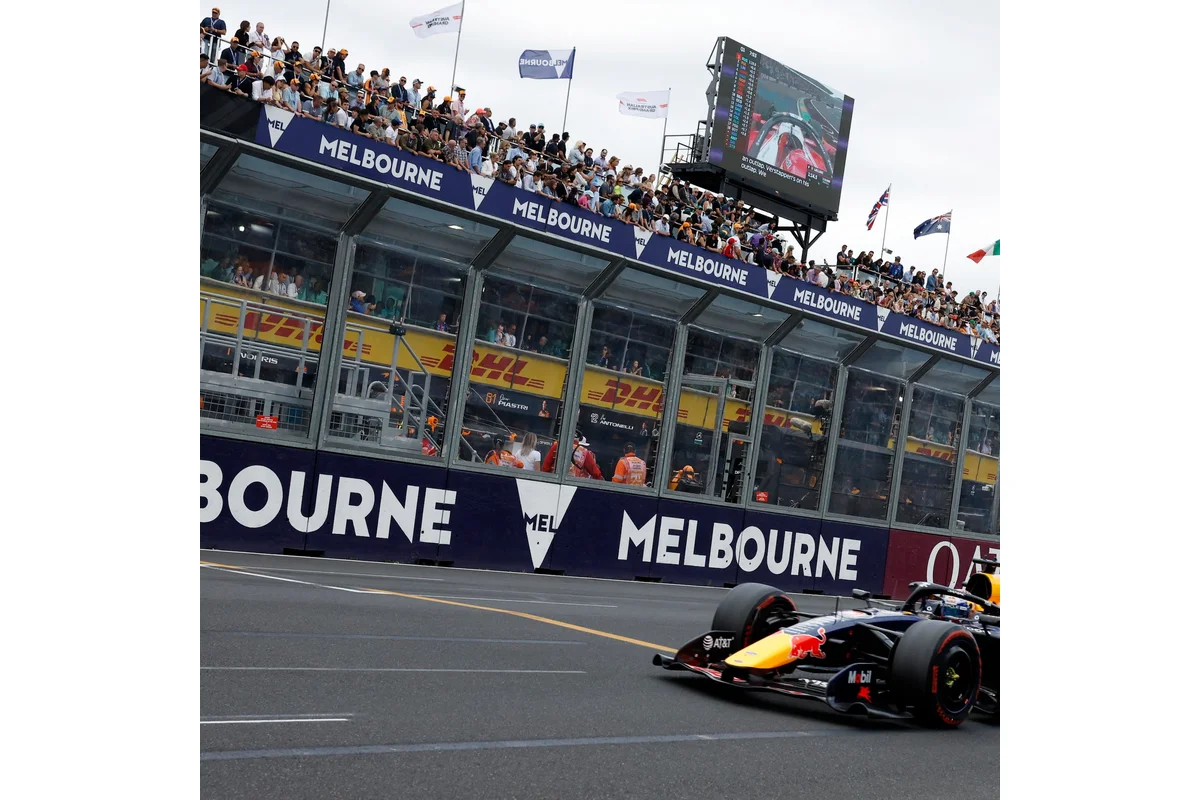
Verstappen’s dramatic exit from Q1 was marked by a rare error; on his first flying lap, entering Turn 1, he experienced an unexpected spin that led him off the track and into the gravel trap before hitting the barriers. The incident appeared to be caused by an unusual locking of the rear axle under braking, something Verstappen described as unprecedented in his career.
“Yep, the car just f***ing locked on the rear axles. Fantastic.”
Speaking after the session, Verstappen gave a clearer explanation of the mishap and the challenges he faced:
“I’ve never experienced something like that before in my career,” said Verstappen. “The rear axle just completely locked on, then of course you can’t save that anymore at that speed. The barrier hit was not that bad – the wheel just snapped out of my hands and that’s why I had to go to the medical centre, but all good.”
“I think it already went wrong before the downshift because I hit the pedal,” he added in an interview with Sky Sports F1. “As soon as you hit the pedal, you quite quickly downshift, but it already immediately locked on the peak of the brake pressure. Something very weird, that’s for sure.”
This mishap relegated Verstappen to the 20th and final qualifying position, making him the last to start the 58-lap race on Sunday. Meanwhile, the Australian GP qualifying session saw George Russell claim pole position and Mercedes secure a front-row lockout with teammate Kimi Antonelli starting second. Other drivers faced difficulties as well, with Lance Stroll unable to participate due to an internal combustion engine issue on his Aston Martin and Carlos Sainz sidelined by an ERS problem on his Williams.
Verstappen’s Weariness and Concerns Over New F1 Regulations
Prior to the Australian GP, Verstappen had openly expressed his frustrations concerning the new generation of F1 cars and the regulatory changes introduced for the 2026 season. These alterations, particularly the increased reliance on energy recovery systems and electrical energy management, have impacted the dynamics of qualifying and racing, with Verstappen candidly admitting his dissatisfaction.
The qualifying session in Melbourne highlighted these challenges when multiple drivers, including Verstappen, experienced a loss of power at the end of straights due to depletion of electrical energy required for deployment. This unusual occurrence was a stark contrast to previous seasons.
Verstappen also shared his emotional state following the crash and the challenging weekend, making clear that his feelings extended beyond the result on the track:
“I’m not enjoying it at all,” Verstappen told Erik van Haren. “Emotionally and feeling-wise, I’m completely drained. This has very little to do with racing.”
Throughout the offseason, Verstappen voiced concerns that the new regulations could prematurely affect the longevity of his F1 career, as managing these complex systems detracts from the racing spirit he values. The issues he faced in qualifying only reinforced his unease with Formula 1’s technical direction.
Broader Implications for Verstappen and the Season Ahead
The end of Max Verstappen’s 31-race qualifying streak marks a rare and significant development in this F1 season and may signal increasing competitiveness among teammates and rivals. His rare crash and the mechanical challenges he encountered underscore the growing pains associated with adapting to the sport’s latest technical framework. The Red Bull driver’s evident frustration and emotional strain reveal the difficulties of maintaining top-level performance amid evolving regulations.
With Verstappen starting from the back of the grid, the Australian GP presents both a challenge and an opportunity for resilience in race conditions. Meanwhile, Isack Hadjar’s emergence as a strong qualifier promises fresh narratives in the contest among Red Bull drivers and the wider grid. How Verstappen responds in the coming races will likely shape the championship battle and demonstrate whether this qualifying setback is a temporary hurdle or a sign of shifting momentum in Formula 1.
