
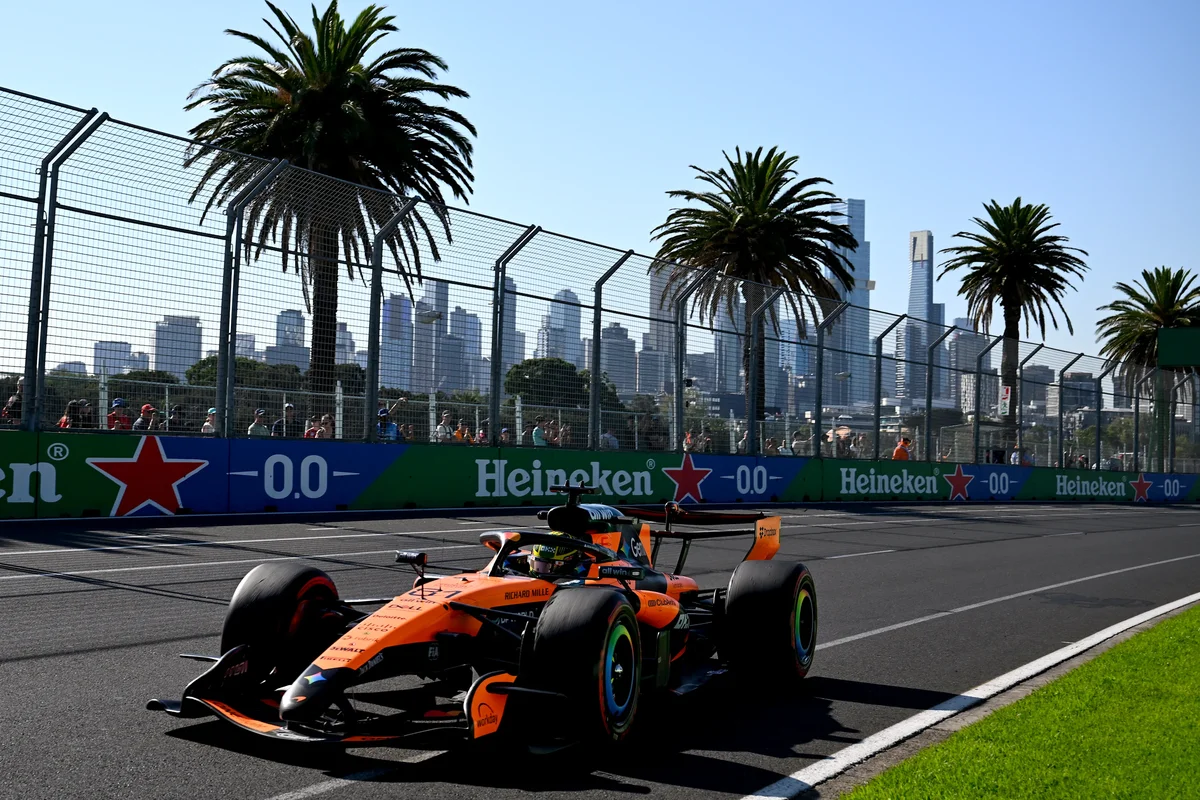
At the Formula 1 season opener in Melbourne, McLaren’s Oscar Piastri took the fastest time during Friday’s two practice sessions for the Australian Grand Prix, showcasing strong pace on his hometown circuit. Piastri’s performance highlighted his potential as top rivals Mercedes and Ferrari also displayed competitive form amid an uncertain start to the 2026 season.
Friday Practice Sessions Reveal Shifts in Team Performances
Oscar Piastri led the second practice session by two tenths of a second over Kimi Antonelli, while Antonelli’s Mercedes teammate George Russell was a further tenth behind in third. Mercedes caught attention with their strong performance on longer runs later in the session, signaling possible improvements after a cautious start. Meanwhile, Ferrari’s Charles Leclerc, who had dominated the opening session by almost half a second, slipped to fifth in the afternoon without improving his time, indicating that the team might have struggled to optimize their setup under changing track conditions.
Lewis Hamilton maintained a consistent form, finishing fourth in the second session and the only driver to place in the top four across both practices, falling three-tenths off Piastri’s leading time. Red Bull’s Max Verstappen faced difficulties in the second session due to a technical issue that sidelined him for nearly 30 minutes. Despite that, Verstappen remained sixth but showed signs of recovery despite damage sustained from running off the high-speed Turn 10 late in the session.
Challenges Impact Several Drivers and Teams on Opening Day
Reigning world champion Lando Norris, also from McLaren, encountered reliability setbacks with a clutch problem that limited his first session to seven laps. Despite a cleaner second session, his single valid flying lap on fresh tires left him about a second behind teammate Piastri in seventh place. Newcomer Arvid Lindblad from Racing Bulls impressed with consistent performance, moving from fifth in first practice to eighth in the second, edging out Verstappen’s new teammate Isack Hadjar.
Aston Martin’s difficulties persisted as both Fernando Alonso and Lance Stroll struggled with the team’s problematic Honda power unit. Alonso missed the first session entirely, and Stroll managed only three laps before limited running in the second session, leaving them near the bottom of the timesheets. Alonso’s best lap was nearly five seconds slower than the leaders.
Sergio Perez failed to set a second session time after stopping on track late in the session, dampening what had been a relatively promising first day for the Cadillac newcomers. His teammate Valtteri Bottas completed 28 laps but was almost four seconds off the pace, placing 19th.
Maintaining Uncertainty Among the ‘Big Four’ Teams
The 2026 season introduces significant regulation changes with new chassis and power units, and pre-season testing indicated that the sport’s traditional frontrunners—McLaren, Mercedes, Ferrari, and Red Bull—remain fastest, though the exact pecking order remains unclear. While Mercedes was widely favoured heading into the season, Mercedes drivers George Russell and Kimi Antonelli ended the first practice session over a second behind Ferrari’s Leclerc, surprising many paddock observers.
Mercedes team principal Toto Wolff acknowledged after first practice that the team was not yet in an ideal position but expressed faith in ongoing improvements. The afternoon session confirmed this progress, as Russell and Antonelli posted times better than Leclerc’s morning benchmark and displayed impressive consistency over longer runs.
McLaren faced early challenges with technical problems limiting both drivers’ track time in the opening session. However, Piastri’s strong showing in the afternoon signaled that McLaren could still contend strongly for pole position on Saturday.
Ferrari started fast in the first session after a promising pre-season, but with Leclerc unable to improve his lap in the afternoon following a setup tweak, their momentum appears to have stalled. Hamilton showed a notable improvement of half a second in the second practice, hinting at growing comfort with his Ferrari after a difficult debut season with the team last year.
Red Bull’s Difficult Afternoon and Verstappen’s Near-Miss
Max Verstappen’s progress stalled early in the second session due to a technical problem that kept him off the track for almost half an hour. Upon his return, Verstappen pushed hard to recover lost time, resulting in a close call at Turn 10 where he ran into the gravel but avoided collision with barriers, albeit sustaining floor damage to his car. The four-time world champion’s setback opened the competition further, emphasizing the unpredictability surrounding the initial sessions.
Looking Ahead to Saturday’s Crucial Qualifying
Despite ongoing uncertainty caused by new regulations and mixed performances in practice, the pre-season belief that Mercedes leads the pack remains largely intact. The first qualifying session for 2026, scheduled for 5 a.m. Saturday and broadcast live on Sky Sports, will be a highly anticipated event, potentially reshuffling the order among the top teams. Fans and analysts alike are watching closely to see whether McLaren’s resurgence, Ferrari’s early promise, or Red Bull’s resilience will define the grid for this new era in Formula 1.
The Australian Grand Prix weekend continues with the third practice session and qualifying on Saturday, followed by race day on Sunday, all streamed live to deliver comprehensive coverage of this pivotal season start.
