
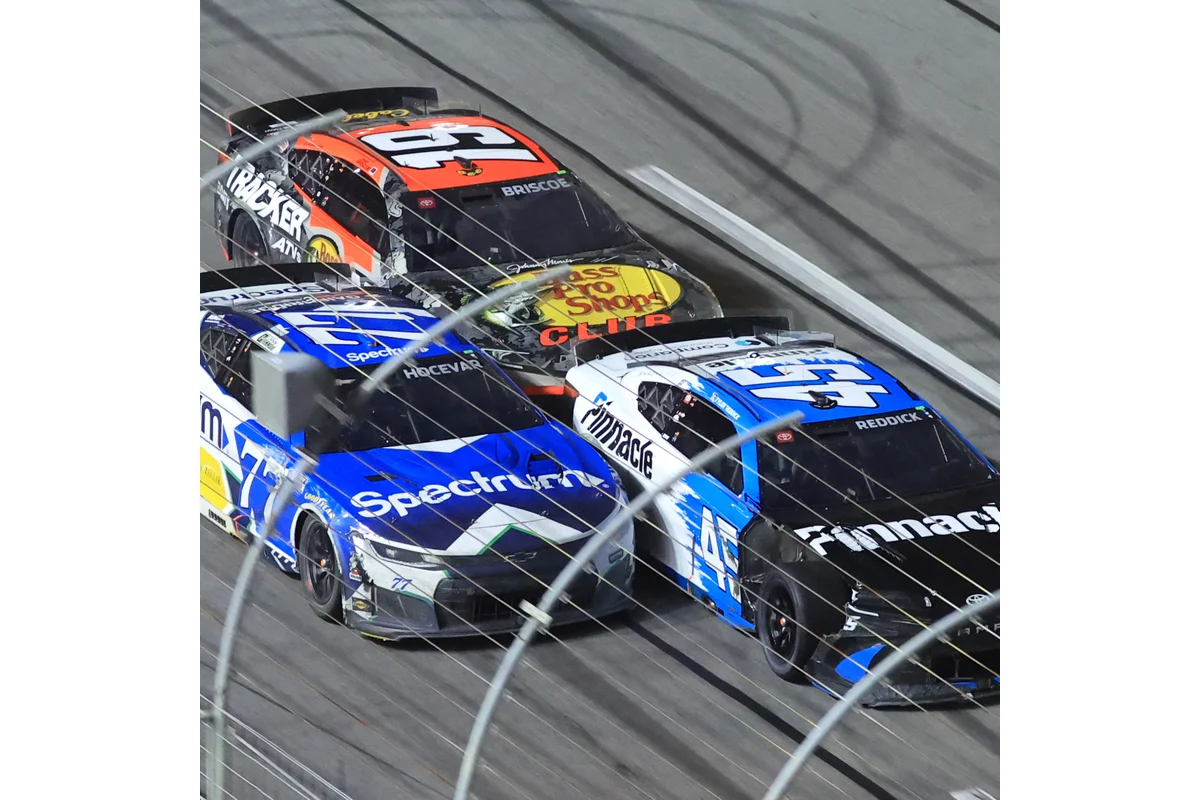
Chase Briscoe recently addressed a crucial decision he made during the final lap at the Atlanta race, which likely cost him the victory. Despite appearing poised to win after an impressive charge through the pack, Briscoe finished second as Tyler Reddick claimed the checkered flag. Briscoe shared insights into why he chose not to attempt a risky pass on the last lap.
Briscoe responded to a fan’s direct question on Twitter about why he didn’t push harder for the lead when the white flag waved. The fan’s curiosity reflected what many viewers were wondering after Briscoe’s aggressive advances earlier in the race had brought him from mid-pack to the front with multiple daring four-wide moves.
Understanding the Strategic Choice Behind the Final Move
Briscoe explained the calculated reasoning behind holding position instead of forcing a difficult pass. In his own words, he said,
“My run I had I knew wasn’t big enough to clear them both so I woulda been stuck 3 wide on the bottom and the 1 woulda pushed the 77 to the win and I probably run 4th or 5th,”
revealing his anticipation of the consequences had he tried to pass.
This decision reflects an advanced level of racecraft, with Briscoe mentally mapping out the possible outcomes before committing to any move. Rather than gambling on an attempt that could have dropped him further back, he settled behind the 45 car, effectively helping Reddick secure the victory.
The fan Briscoe replied to captured the excitement of his earlier efforts, stating,
“drove like a mad man to get from mid pack to the front, multiple 4 wide moves worked to perfection, it was a sight to see,”
while also expressing confusion about the final choice. This mix of admiration and puzzlement highlights the complex nature of racing decisions made in real time.
Briscoe’s Progress and What It Means for His Career
While the last-lap call is the headline, the broader story is Briscoe’s noticeable growth as a competitive driver since mid-last season. His recent performances behind the wheel of the No. 19 car have shown increased speed and composure, changing the perception of his capabilities at the highest Cup level. This renewed form has addressed doubts some had during his time with Stewart-Haas Racing, proving that a different environment can unlock potential.
Though he did not get the Atlanta trophy, Briscoe gained something significant: confirmation that his instincts and decision-making remain sharp under pressure. Choosing to finish second over risking a lower placing by forcing a move reflects mature judgment rather than defeat.
No one knows precisely when Briscoe’s next win will come, but his recent performances suggest it will not be far off. His ability to balance aggressive racing with strategic awareness is a valuable asset as the season continues.
The Impact of Split-Second Choices in NASCAR Races
Briscoe’s experience underscores how seemingly small decisions during a race can dramatically affect the final outcome. Quickly assessing risks and potential gains at speeds near 180 miles per hour demands extraordinary focus and insight. His explanation sheds light on the delicate balance drivers must maintain between ambition and pragmatism to optimize race results.
Overall, Chase Briscoe’s final-lap decision at Atlanta serves as a reminder that in NASCAR, every detail matters profoundly in the quest for Victory Lane.
My run I had I knew wasn’t big enough to clear them both so I woulda been stuck 3 wide on the bottom and the 1 woulda pushed the 77 to the win and I probably run 4th or 5th. https://t.co/SAssvzqRCZ
— Chase Briscoe (@chasebriscoe) February 23, 2026
Briscoe drove like a mad man to get from mid pack to the front, multiple 4 wide moves worked to perfection, it was a sight to see.
Which makes me even more confused why he didn't take the run to go for the lead at the white. Felt like the win was right there…
— Dan (@chasingbriscoe) February 23, 2026
