
George Russell secured a thrilling win at the Australian Grand Prix in Melbourne, kickstarting his world championship campaign as Mercedes overcame a fierce early contest from Ferrari. The race featured several dramatic lead changes, with Russell ultimately finishing ahead of his teammate Kimi Antonelli, who recovered strongly from a difficult start, while Charles Leclerc took third place.
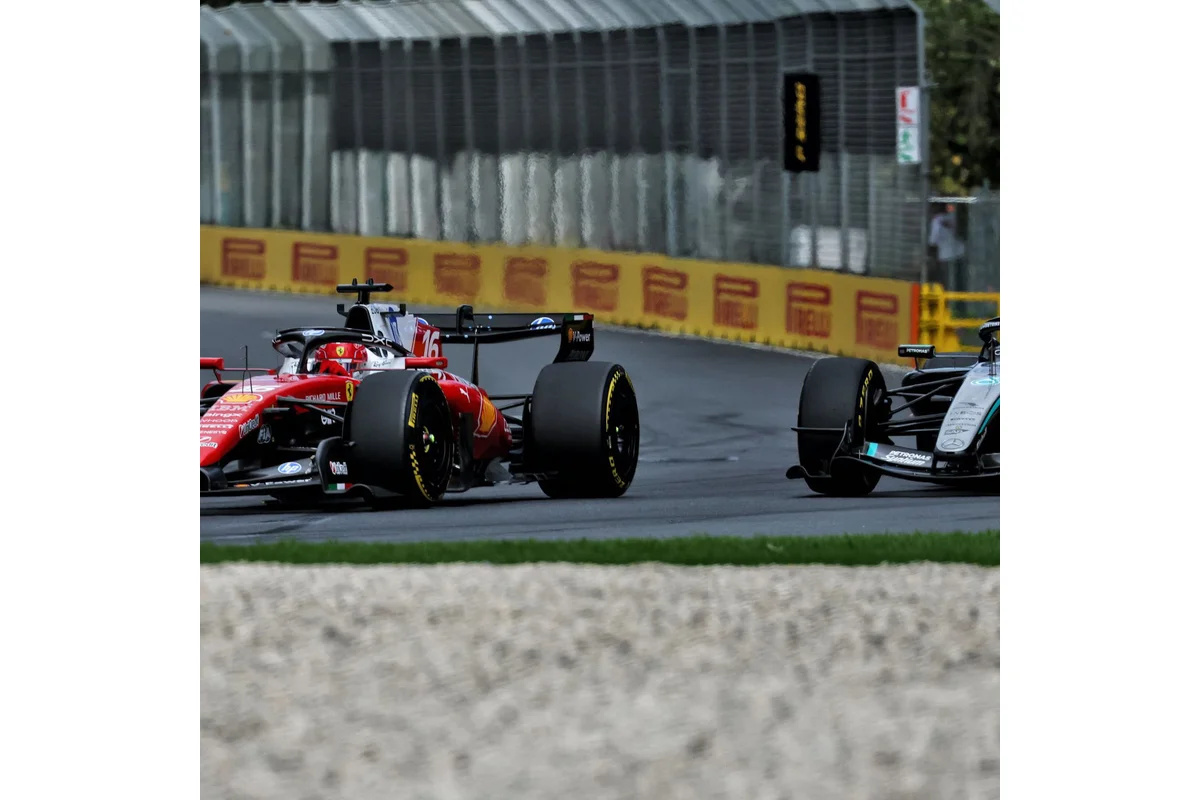
The intensely fought battle between Russell and Leclerc epitomized the complexity of Formula 1’s new regulations, with dynamic energy use and overtaking strategies leading to seven position swaps between the two in the opening nine laps. Lewis Hamilton came in fourth, showing signs of promise alongside his Ferrari teammate.
Race Dynamics and Strategic Decisions Shape Outcome
Russell, starting from pole, lost the initial lead to Leclerc into Turn One, who then led through the excitement-filled first three laps. Hamilton also challenged Russell early on, underscoring the competitive nature of this new era of racing. The early stage of the race was marked by rapid exchanges of the lead as drivers adapted to unfamiliar car performance and energy management systems.
The turning point came on lap 11 when Isack Hadjar’s Red Bull suddenly broke down, triggering a Virtual Safety Car period. Mercedes capitalized on this by pitting Russell and Antonelli immediately, gaining a crucial advantage as Ferrari opted not to pit their drivers during this interruption. Leclerc and Hamilton eventually made their pit stops later, on laps 25 and 28 respectively, under green flag conditions.
Despite Ferrari’s later tire change, Mercedes’ strong pace on older tires enabled their drivers to maintain track position without a second stop. This strategic edge helped Russell and Antonelli secure a commanding one-two finish for Mercedes, with Russell crossing the line almost three seconds ahead of Antonelli, and Leclerc finishing 15 seconds behind the leaders.
Martin Brundle, Sky Sports F1 analyst, remarked,
“What Ferrari gave up was track position and they lost control of the race,”
highlighting the pivotal nature of Ferrari’s strategy.
Intense On-Track Battles Highlight New Racing Era
The Australian Grand Prix showcased the struggle drivers face in mastering energy deployment and tire management under the new 50-50 internal combustion and electric power regulations. The opening laps offered a vivid display of this learning curve, as overtakes and defensive moves occurred with unprecedented intensity and unpredictability.
Leclerc initially jumped ahead at the start, with Hamilton also making significant early progress, while Russell regained the lead before Turn 11 on lap two. The exchanges between Russell and Leclerc continued in a rapid back-and-forth — each driver exploiting the complex energy modes available to them to gain advantage around the circuit.
Russell described the race’s chaotic nature, saying,
“It was kind of a race we were expecting – chaotic start, difficult to match the battery – yoyoing a bit with the overtakes.”
Leclerc echoed this sentiment, stating,
“It was a very tricky race! Honestly, at the start, none of us knew what to expect with the fights, the energy. It’s even more tricky with the overtakes,
and added,
You don’t know when your battery will cut on the straights, so while defending there are massive speed differences.”
Despite the close fight, Leclerc acknowledged,
“It was quite challenging but I was happy to get out of the battle in first. Unfortunately, that didn’t help us for the rest of the race but it was a fun first part of the race. P3 was the best we could do today.”
Ferrari Defends Strategy as Mercedes’ Pace Proves Decisive
After the race, Ferrari stood by their decision not to pit during the Virtual Safety Car, attributing Mercedes’ race pace and tire wear advantage as the decisive factor. Team Principal Frederic Vasseur commented,
“The pace of Mercedes was better than us,”
adding,
I have no regret on the strategy, no regret on the pace of today. We did a decent step compared to yesterday.”
Lewis Hamilton, while initially suggesting over team radio that at least one Ferrari should have changed tires earlier, remained optimistic about Ferrari’s performance. He stated,
“Of course, we are not as fast at Mercedes and we have work to do but we are right in the fight,”
and praised his own race pace:
“It was a really fun race and it felt good for me. A couple more laps and I would have had Charles, so I had great pace. Lots of positives to take from today.”
Midfield and Rookie Performances Round Out the Result
Behind the front four, McLaren and Red Bull contested a fight for fifth place, with Lando Norris edging out Max Verstappen, who made an impressive recovery from 20th after a qualifying crash. Both drivers employed two pit stops as they battled intensely.
Oscar Piastri experienced disappointment at his home race, crashing on the way to the grid and failing to start, while fellow British drivers all finished in points-scoring positions. Haas’ Oliver Bearman put in a strong performance to finish seventh, and 18-year-old debutant Arvid Lindblad impressed with eighth place for Racing Bulls.
Audi’s Gabriel Bortoleto was ninth, with Alpine’s Pierre Gasly rounding out the top ten, and Nico Hulkenberg unable to start due to technical issues.
Complete Australian Grand Prix Finishing Order
1) George Russell, Mercedes
2) Kimi Antonelli, Mercedes
3) Charles Leclerc, Ferrari
4) Lewis Hamilton, Ferrari
5) Lando Norris, McLaren
6) Max Verstappen, Red Bull
7) Oliver Bearman, Haas
8) Arvid Lindblad, Racing Bulls
9) Gabriel Bortoleto, Audi
10) Pierre Gasly, Alpine
Looking Ahead: F1’s Complex New Era and Next Challenges
The Australian GP demonstrated how teams and drivers are still adjusting to F1’s new hybrid power units and energy management rules, which have injected additional strategic layers to racecraft. This season opener’s chaotic start and rapid lead changes underscore how unpredictable races may be in coming weeks.
With Mercedes showing an edge in pace and tire management, the championship battle promises to remain intense, while Ferrari’s resilience suggests the fight will span the entire season. The struggle among midfield teams and promising rookie performances also indicate a deep and competitive field.
Formula 1 now turns its focus to Shanghai for the first Sprint weekend of 2026, where further strategic evolution and driver adaptability will be on full display. Fans can expect more electrifying battles and tactical complexities as the championship unfolds.
