
Lewis Hamilton expressed a keen interest in uncovering the reasons behind Mercedes’ apparent power advantage after the qualifying session of the season-opening Australian Grand Prix in Melbourne. The former Mercedes driver pointed to the Silver Arrows’ dominant front-row lockout and marked superiority across each lap sector, highlighting a significant gap to their rivals.
George Russell secured pole position ahead of teammate Kimi Antonelli, with Mercedes showcasing their early status as championship favourites. The team’s advantage was underscored by a 0.785-second gap to third-placed Isack Hadjar of Red Bull, with McLaren and Ferrari trailing further behind by over eight tenths of a second.
Overview of Mercedes’ Preseason Dominance and Compression Ratio Disputes
The pre-season narrative was largely shaped by controversy around compression ratio regulations. Suspicions emerged that Mercedes had exploited a regulatory loophole, enabling them to operate their engines at a higher compression ratio than the mandated limit during on-track conditions. The new 2026 F1 technical rules capped compression ratios at 16.1, but FIA’s enforcement currently relies on measurements when engines are cold rather than at racing temperature.
Amid weeks of debate involving teams and regulators, the FIA announced a compromise solution last week: from the seventh race in June, a new test will measure compression limits at both ambient and 130-degree engine temperatures. This is intended to ensure compliance and close any regulatory gaps.
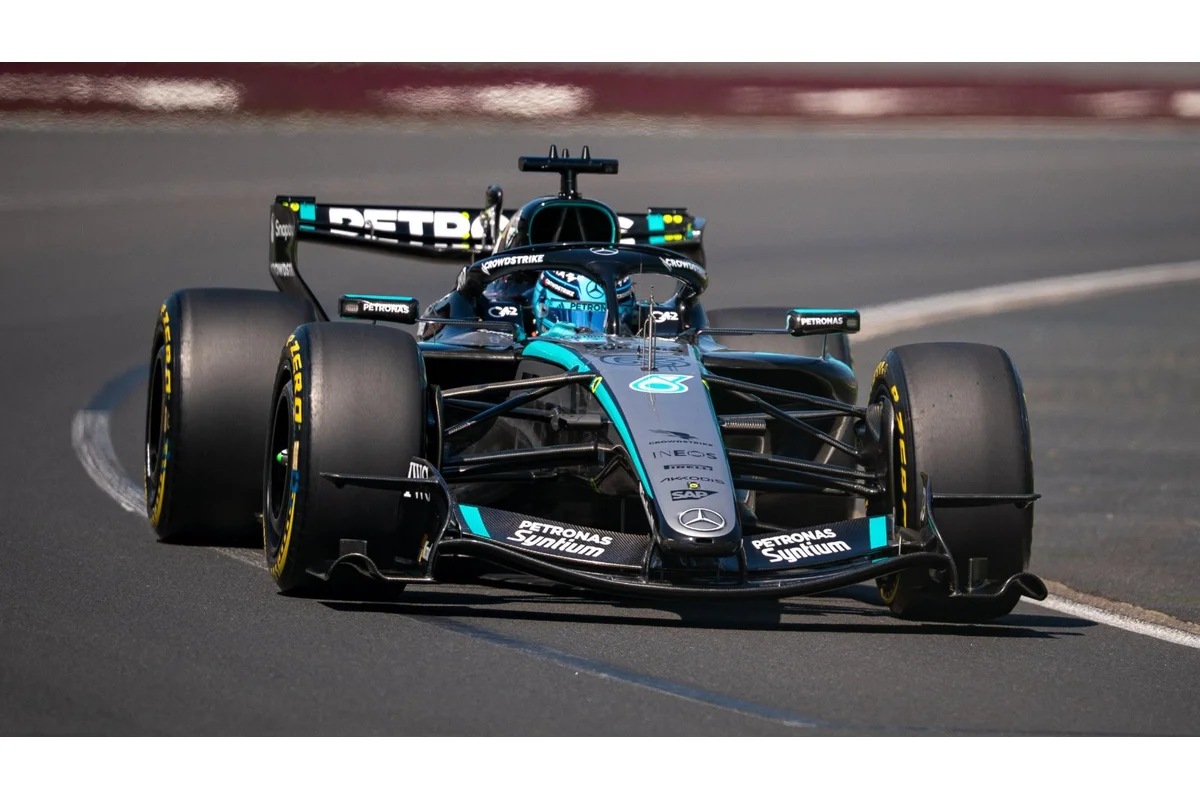
Hamilton Highlights Mercedes’ Superior Power Output on Albert Park Circuit
After Saturday’s qualifying, Hamilton underscored the mystery around Mercedes’ straight-line speed dominance, stating the team had a power advantage amounting to
“two tenths or more just through power”
in every sector of the Albert Park lap. He voiced a desire to understand the exact source of this advantage and considered whether Ferrari, his current team, needed to respond accordingly.
“What’s clear is they didn’t show their engine power through any of the practice [sessions],”
said Hamilton to Sky Sports F1, reflecting on Mercedes’ performance relative to Ferrari’s struggles during qualifying.
He went on to emphasize the ongoing discussions about compression ratios, commending Mercedes’ engine performance but expressing concern over the FIA’s handling of the verification process.
“I want to understand why it’s two tenths or more just through power, per sector.”
Hamilton further questioned regulatory responses, asking,
“If it is a compression thing, I want to understand why the FIA haven’t done anything and what’s been done to rectify it.”
He added a perspective focused on racing competitiveness, saying,
“If it’s not, and it’s just pure power, we have to do a better job.”
Russell Emphasizes the Role of the New W17 Chassis in Mercedes’ Success
While much discussion has centred on the power unit, Mercedes driver George Russell attributed a considerable part of the team’s pace to their car’s chassis. After qualifying on pole, Russell suggested the car’s aerodynamic and mechanical package deserved more recognition for its impact.
“I think we’ve got a really great engine beneath us,
he acknowledged, and continued,
However, I think we’ve also got a really amazing car beneath us, and I think that probably hasn’t been highlighted enough in the press these past few weeks.”
Meanwhile, Mercedes Team Principal Toto Wolff had previously described the compression ratio saga as a storm in a teacup, indicating the team’s confidence in their overall package regardless of regulatory scrutiny. At the final Bahrain test, Wolff said,
It doesn’t change anything for us, whether we stay like this or whether we change to the new regulations.
Expert Analysis Questions Compression Ratio as the Sole Explanation for Mercedes’ Advantage
Sky Sports F1 pundits voiced skepticism that compression ratio discrepancies alone explained Mercedes’ early-season advantage. Analyst Bernie Collins noted that four teams use Mercedes engines, yet only Mercedes leads the timesheet, suggesting other factors contribute.
“Four teams are running this [Mercedes] engine so if it was just down to compression ratio we’d have those four teams at the top of the timesheet and that’s not how it stands at the minute,”
Collins observed.
Martin Brundle added a humorous take, stating,
“I think the whole thing’s a storm in a cylinder.”
Hamilton Reflects on Ferrari’s Qualifying Challenges and Personal Performance
Regarding his own qualifying results, Hamilton admitted that issues with energy deployment on his Ferrari compromised his session. Despite a promising start on the medium tyres in Q1, he was hampered by technical setbacks in Q2, resulting in a seventh-place grid spot.
“Not the best qualifying but I felt solid all weekend,”
Hamilton said. He remained optimistic about his competitiveness within the team, stating,
“I’m feeling super motivated and up until Q1 on the medium tyre, I was feeling great. I was third or fourth just on the medium tyre.”
He elaborated on the difficulties faced after encountering engine deployment problems:
“But when we got into Q2 we had some problems with the engine and deployment. It then threw a bunch of spanners in the mix, so we struggled to get the best out of it after that.”
Hamilton also maintained that without these issues, he believed his qualifying position would have improved to third or fourth, though he doubted catching Mercedes’ pace would have been possible.
“If things hadn’t been an issue, we would have been third or fourth. I don’t think we would have been anywhere near Mercedes.”
Broadcast Schedule for Australian Grand Prix Coverage on Sky Sports
Fans following the 2026 Formula 1 season can expect comprehensive coverage of the Australian Grand Prix on Sky Sports, beginning Sunday morning. The broadcast lineup includes the F3 and F2 Feature Races, build-up shows, the race itself, and post-race analysis. Sky Sports also offers streaming options through NOW without long-term contract commitments.
The scheduled program includes the F3 Feature Race on Saturday at 9:45 pm, followed on Sunday by the F2 Feature Race at 12:20 am, with the Grand Prix build-up starting at 2:30 am. The main race is broadcast live at 4 am, with subsequent reaction shows and highlights throughout the morning and day.
Implications of Mercedes’ Early Pace and Regulatory Scrutiny Moving Forward
The situation surrounding Mercedes’ performance advantage highlights ongoing tensions between teams and regulators under the new 2026 Formula 1 technical framework. Hamilton’s public questions about the engine’s power output and FIA’s testing methods reflect broader unease among rival teams, especially Ferrari, as they seek to close the gap.
With the FIA’s planned introduction of stricter compression measurement procedures in June, the sport may see a more level playing field in the second half of the season. Meanwhile, Mercedes looks poised to capitalize on both their power unit and chassis developments, continuing to challenge their rivals at the front of the grid.
For Ferrari and other competitors, the challenge lies not only in deciphering Mercedes’ technical edge but also in adapting their strategies and car designs to reduce the performance deficit before the regulatory clampdown.
