
Andrea Kimi Antonelli faced a daunting challenge at the 2026 Formula 1 Australian Grand Prix after crashing his Mercedes W17 into the barriers during Free Practice 3 at the Albert Park Circuit. Despite this setback, Mercedes mechanics managed a swift repair, allowing Antonelli to rejoin qualifying in Q1 thanks to an early red flag triggered by Max Verstappen’s crash. Antonelli then delivered a commanding qualifying performance, locking out the front row alongside team-mate George Russell, securing Mercedes’ 83rd front-row lockout.
However, race day proved difficult for the 19-year-old Italian, as Mercedes struggled with new start procedures related to the 2026 power units. Antonelli lost five positions at the start, descending to seventh place by Turn 4 and beginning a tense battle to regain second place.
Struggles and Strategy During the Race
The opening Grand Prix of the season turned into a challenging contest marked by attrition. Local favorite Oscar Piastri crashed on the installation lap, and Audi’s Nico Hulkenberg failed to leave his garage, while Isack Hadjar’s car suffered power unit failure on Lap 12, prompting a Virtual Safety Car. This gave Mercedes an opportunity to adjust their race strategy for both Russell and Antonelli.
Despite switching both drivers to white-walled Hard compound tires in a double-stack pit stop, Antonelli found the new tires difficult to manage compared to the Mediums he had used earlier. He experienced early tire graining but noted that the car’s pace eventually improved.
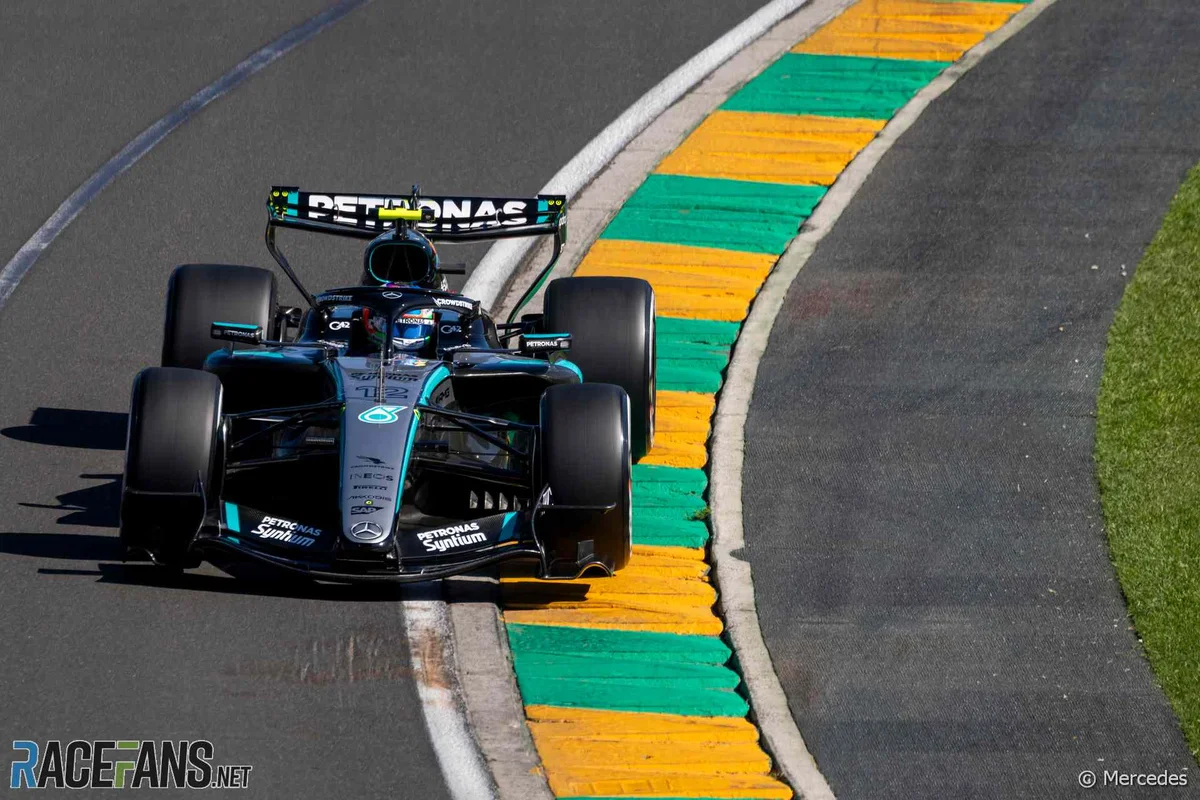
“Well, I didn’t really know, to be fair, but obviously the pace of the car was very strong,”
Antonelli said. “I felt very, very good in the first stint… Then the Hards, I started to grain very early on and had a bit of a difficult time, but then at the end, the pace came back.”
Mercedes opted to employ a one-stop strategy, with Antonelli ultimately trailing his team-mate to finish second, securing the team’s first 1-2 finish of the 2026 season.
“It was good fun at the end. The team did an incredible job because I think the result of today was thanks as well, mainly to the mechanics for the incredible job they did yesterday after FP3,”
Antonelli remarked.
“Definitely, it was a good end of the weekend, and now we will focus on China.”
Antonelli Reflects on the Difficult Start and Car Performance
Antonelli described the poor start as pivotal in the race outcome and the main source of his frustration, emphasizing the lack of power from the car’s last sector and the resulting difficulty in responding to driving inputs.
“Of course, the start was a game changer,”
he told the media including Motorsport Week.
“Then the start was poor, very poor, and I just lost a lot of places and found myself having to chase, but the car was very strong.”
Looking Ahead to the Shanghai Grand Prix
The Formula 1 season will continue next week at the Shanghai International Circuit for the Chinese Grand Prix, and Antonelli is cautiously optimistic about a smoother race. He acknowledged that the Melbourne race exposed many learning opportunities for teams as they contend with energy management challenges unique to the new power units.
Antonelli highlighted the importance of Shanghai as a test for the team’s ability to deploy energy efficiently with only one practice session before qualifying.
“Well, I think for everyone, it was a massive learning. For the first time, we went racing. We did the first proper weekend,”
Antonelli said. “Of course, we did a lot of testing, but testing is one thing, and race weekend is completely different. Shanghai is going to be important to be straight on point with deployment, with everything, because obviously, we go only one practise, and then we go into qualifying.”
The 19-year-old added that the Melbourne race was likely the most demanding energy management challenge to start the season, due to the series of long straights. He stressed how vital it will be to avoid mistakes as the rapid pace of car development could quickly shift competitive standings.
“But it should be a much more straightforward race in terms of how you deploy the energy,”
Antonelli continued.
“This race was probably the hardest race to start the season, because it’s just so difficult on energy with so many straights, one after the other.”
“But I think it was massive learning for us drivers, for the team, also for the team to understand where to push development of the car, because this year, the rate of development is going to be massive, and it’s going to be important to not put any wrong step, because the situation can flip very quickly.”
Implications for Mercedes and Future Prospects
Kimi Antonelli’s strong recovery drive demonstrated his resilience and potential amid the challenges Mercedes currently faces with their new power units and race procedures. The team’s ability to secure a front-row lockout and convert it into a 1-2 finish despite early difficulties shows promise for this young driver and his team. The data collected from this opening race will be crucial as they prepare for Shanghai, where the team aims to refine energy deployment and reduce errors.
Antonelli’s performance not only helped establish him as a key figure in Mercedes’ 2026 campaign but also provided valuable insights into how the Silver Arrows can adapt rapidly to evolving technical demands this season. As the season progresses, his development will likely remain central to Mercedes’ quest for competitive supremacy.
