
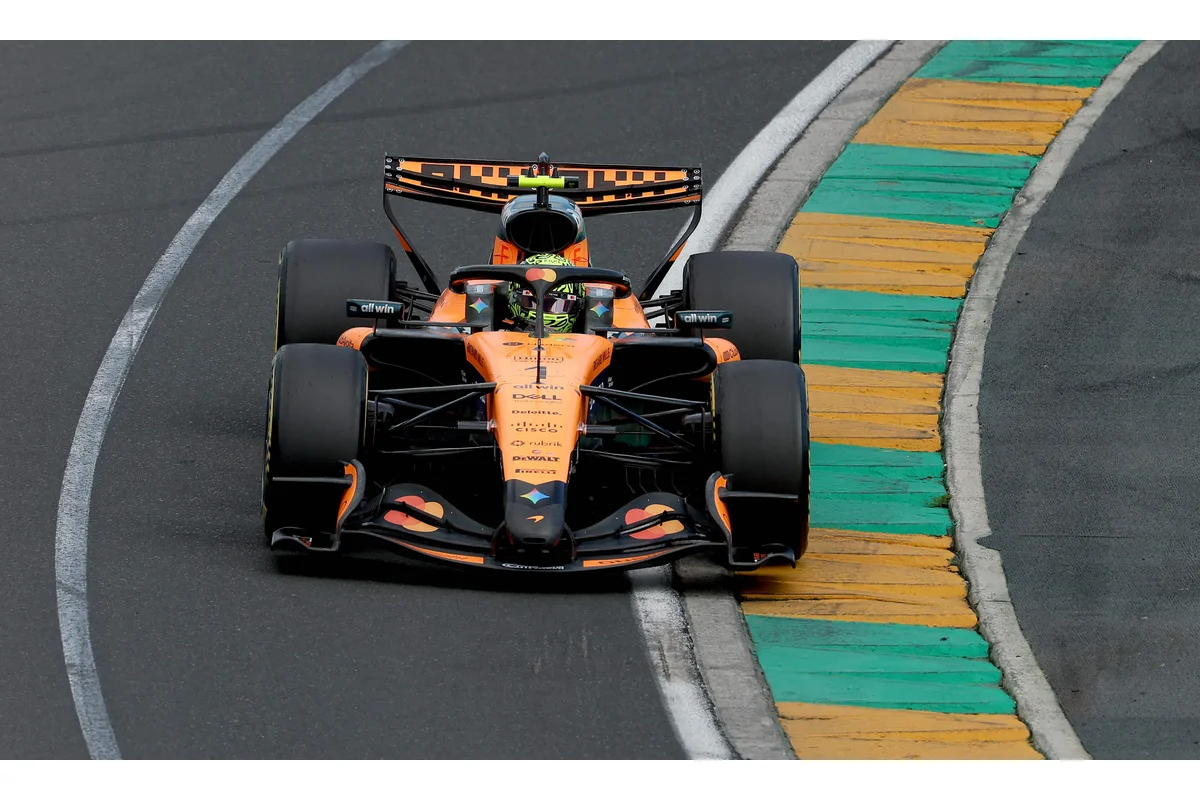
Lando Norris finished fifth at the opening race of the 2026 season in Melbourne, a result that fell short of expectations for McLaren. Despite promising signs during the Free Practice sessions, the Woking-based team struggled to match the pace of the frontrunners, with Norris highlighting Ferrari as the strongest car currently on the grid.
McLaren entered the season not favored to dominate, but with hopes the MCL40 would remain competitive near the front. However, their performance in Australia revealed significant shortcomings, including a notably large gap of 51 seconds behind race winner George Russell, underscoring challenges particularly on the chassis side despite using a Mercedes power unit.
McLaren’s Performance and Development Challenges
As defending World Champion, Norris and McLaren were anticipated to contend strongly again in 2026, especially with Mercedes power supplying the MCL40. Yet, lingering effects from last season’s intense title battle limited their early investment in adapting to new regulations, as considerable wind tunnel time was devoted to the previous car.
Andrea Stella’s engineering team is still working to fully optimize the Mercedes engine within the new chassis rules, meaning there remains significant potential for lap time improvements. That said, to close the current gap of approximately eight-tenths of a second to Mercedes on race day, McLaren will require a series of updates to the car’s design, rather than relying solely on optimization.
Norris’s Perspective on the Season’s Competitive Landscape
Aware of McLaren’s position on the grid, Norris shared his assessment of the competitive hierarchy after the race. Contrary to popular expectations that Mercedes holds the strongest package, the reigning champion pointed to Ferrari as the yardstick for performance this year.
“We finished where we deserved to,”
Norris said, according to The Independent.
“Red Bull is clearly quicker – Max came from last and almost beat us.
“We made some tweaks, [but] we’re nowhere near where we need to be. Clearly, from a car perspective, we’re a long way off – a long, long way off…
“This is nothing that is going to happen overnight, or one, or two weeks time. I was almost a lap off [the Mercedes], not quite.
“Ferrari, from what we see, have the best car, their cornering speeds are unbelievable, to match that? Zero chance.
“We have to learn from this part of the season, the more we learn, the more we understand. The better we’ll be at the end of the season.”
Importance of Mid-Season Development and Team Optimism
The early phase of this generation’s technical regulations demands a steep learning curve, where refining settings and understanding new designs can yield notable gains. Aston Martin’s impressive improvement of about 1.5 seconds from Friday to Saturday, achieved purely through setup adjustments, illustrates what can be accomplished without major redesigns.
McLaren remains cautious but committed, aware that the fundamental concept of the MCL40 started from a basic platform. The team openly acknowledged ahead of the race that substantial upgrades would not be ready for Australia, which likely caused the car to lose ground compared to rivals who introduced significant enhancements between testing and the first round.
Looking forward, McLaren places strong emphasis on mid-season updates as the key to climbing back into championship contention. Norris and teammate Oscar Piastri will hope the team can replicate past campaigns’ progress by continuously improving the package throughout the year.
Ultimately, the pressure now falls on Andrea Stella and Zak Brown’s leadership group to deliver the necessary technical advancements that can restore McLaren’s competitiveness in a field led early by Ferrari.
