
Lando Norris has forecasted that this season’s Formula 1 championship will feature increased chaos on the track, as sweeping regulatory changes take effect. These modifications, affecting engines, chassis, fuel composition, and tyres, represent the most significant adjustments to the sport’s rules in recent history. Norris, the British driver, highlighted how these shifts will require racers to manage new challenges throughout the season.
Drivers Will Face Greater Demands Amid Regulatory Changes
The extensive changes intensify the demands on drivers, according to Norris, who explained that competitors will need to be highly alert to an array of evolving scenarios during each race.
“You’re going to see more chaos in races where a driver has to be a little bit more on top of all of these different situations that can happen. And that will happen through the whole year, I would say. There’s more emphasis on drivers’ ability to control all of these things.”
This heightened pressure on drivers stems from both mechanical innovations and strategic complexities now introduced to the sport.
Introduction of ‘Boost Button’ to Enhance Race Dynamics
To alter the flow of racing, a new feature called the ‘boost button’ will provide drivers with an extra surge of electrical power during competition. Norris sees this as a catalyst for more aggressive and dynamic racing.
“You’ll be able to force people more in different positions and create racing potentially in better ways than you have been able to in the past. And that’s probably a better thing, a good thing.”
Such innovations are expected to open up fresh strategic opportunities for overtaking and position changes on the track.
Testing of McLaren’s New Car Suggests Improved Performance
Norris recently tested McLaren’s updated vehicle alongside other drivers in Barcelona, confirming it delivers enhanced speed and power, particularly on straight sections of the circuit.
“Certainly feels more powerful and quicker.”
Further pre-season tests are scheduled in Bahrain starting February 11, spanning two consecutive three-day sessions to prepare teams for the season’s demands.
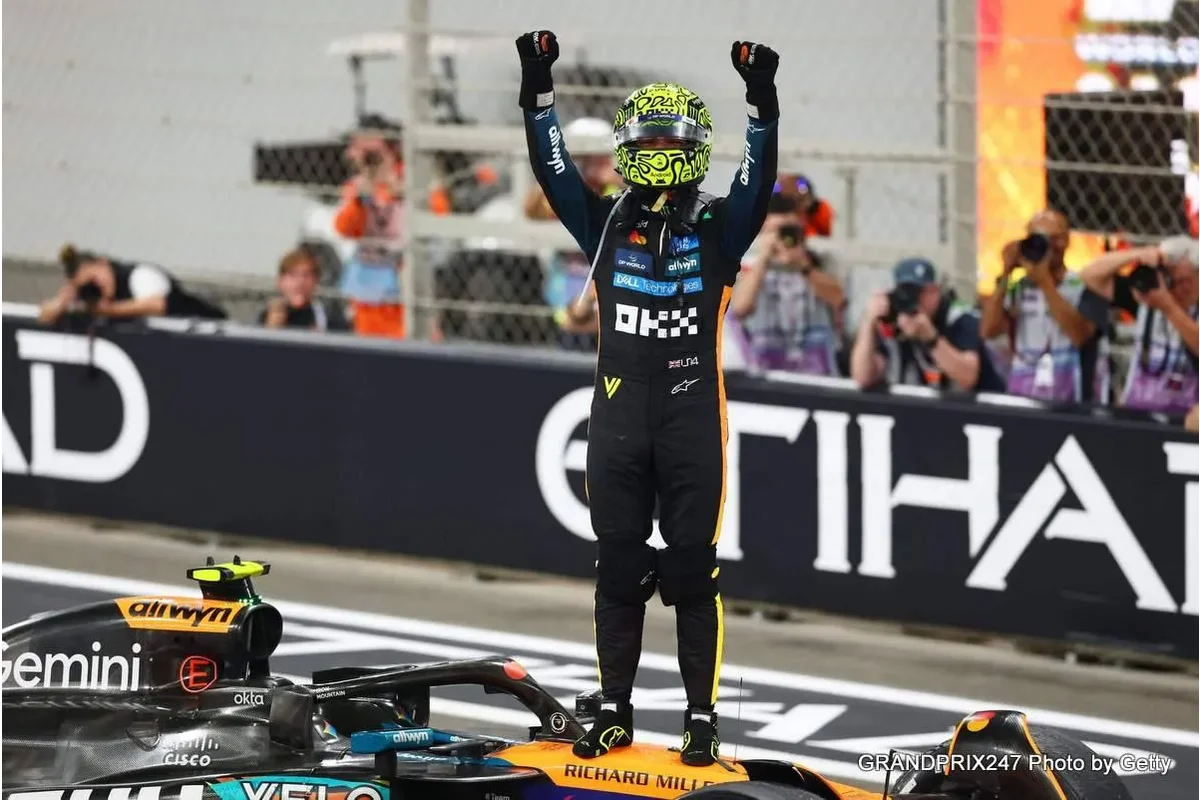
Racing Expected to Feature More Position Changes and Strategic Battles
The combination of new technical regulations and the boost button is likely to result in frequent position changes during races, increasing unpredictability and excitement.
“You’ll see more yo-yoing, more moves with extra speed. But then that person might have to defend more than what you’ve seen in the past and that will create more chaos, which is great for you guys.”
This suggests that spectators can expect a more dynamic and contested style of racing throughout the year.
Battery Management Emerges as a Critical Challenge for Drivers
One of the foremost challenges Norris identified is managing the battery system powering the hybrid cars. The battery is highly potent but has limited duration, demanding careful use and recovery during each lap.
“The biggest challenge at the minute is battery management and knowing how to utilise that in the best way.”
“It’s not simple. You can explain it in quite simple terms. It’s just you have a very powerful battery that doesn’t last very long, so knowing how to use it at the right times, how much energy, how much of that power you use, how you split it up around the lap…”
Moreover, changes such as reintroduced turbo lag add layers of complexity, requiring precise gear shifts and rev control.
“The biggest challenge is how you can recover the batteries as well as possible, and that’s when it comes down to using the gears, hitting the right revs. Obviously, you’ve got some turbo lag now, which we’ve never really had before. All of these little things have crept back in, but I don’t think that changes too much.”
“In a perfect world, I probably wouldn’t have [all] that in a race car, but it’s just F1. Sometimes you have these different challenges.”
Track Changes to Influence Race Strategy and Driver Approach
Norris explained that many corners which had been fairly straightforward in previous seasons will become more challenging and demanding, potentially increasing overtaking opportunities and tactical variation.
“Quite a lot more corners that were easy flat in previous years or the last few years are going to become much bigger corners again. So that’s a good thing in some ways and therefore you can see more racing.”
“But you might have different strategies because what was then flat last year and not really a grip-limited section, now when you put a new set of tyres on you’ll be able to gain in a lot more parts of the track.”
This evolution could lead to greater diversity in tyre and racing strategies, adding further layers of competition throughout the race weekends.
Significance and What to Expect Moving Forward
The combined effect of these technical and regulatory changes is anticipated to make Formula 1 races more unpredictable and thrilling, with drivers required to demonstrate increased adaptability and skill management. Norris’s involvement with McLaren’s enhanced car and his insights into battery management and racecraft highlight the complexity modern drivers face. As the upcoming tests in Bahrain approach, teams will continue fine-tuning strategies and car performance to meet these new challenges.
Formula 1 fans can look forward to a season marked by aggressive race dynamics, frequent position swaps, and innovative technology shaping on-track battles in unprecedented ways.
