
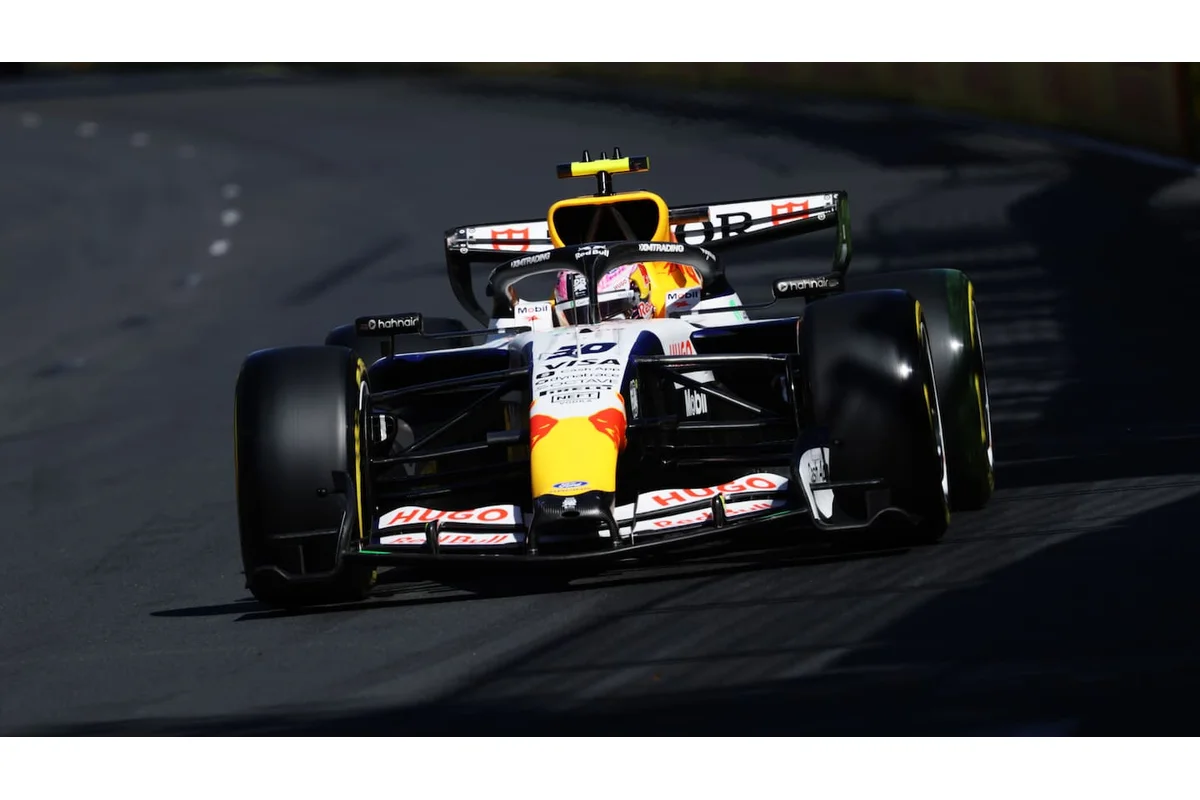
New Zealand driver Liam Lawson has secured an impressive eighth-place on the starting grid for the Australian Formula One Grand Prix in Melbourne, marking a positive start to the 2024 season. The race, set to begin Sunday at Albert Park, saw Mercedes dominate qualifying, while Lawson’s teammate, 18-year-old debutant Arvid Lindblad, qualified just behind him.
Mercedes took control of the front row with George Russell earning pole position, clocking the fastest lap of 1 minute 18.518 seconds, narrowly ahead of Italian driver Kimi Antonelli. This marks Mercedes’ first pole position in Melbourne since Lewis Hamilton’s 2019 victory. However, the session was overshadowed by a high-profile crash involving Red Bull’s Max Verstappen, who will start from the back of the grid following his accident.
Mercedes Takes Pole; Antonelli Faces Post-Qualifying Investigation
Russell’s pole run consolidated Mercedes’ strong qualifying performance, a turnaround highlighted by his remark on unlocking the car’s potential:
“It was a great day, we knew there was a lot of potential in the car,”
Russell said.
“It really came alive this afternoon. Also really happy that Kimi’s here… All in all a pretty good day.”
Antonelli, who rebounded after a heavy crash in Friday’s final practice, faces uncertainty as stewards investigate a cooling-fan part that detached from his car and caused debris on track during Q3, an incident worsened by Lando Norris running over the debris and triggering a red flag.
Unexpected Setbacks for Red Bull and Other Teams
Red Bull endured a turbulent qualifying session, with Verstappen crashing after locking his rear wheels at turn one on his first flying lap, veering off the track and crashing into the barriers. The Dutch driver, unharmed but frustrated, conveyed his disappointment via team radio:
“The car just locked on the rear axles, fantastic,”
he said. Verstappen will either start at the back of the grid or from the pit lane, depending on the extent of repairs.
Team mate Isack Hadjar will start strongly from third position, while Ferrari’s Charles Leclerc claimed fourth on the grid. McLaren drivers Oscar Piastri and defending champion Lando Norris secured fifth and sixth places respectively, giving their team a solid qualifying result.
Aston Martin faced difficulties with both new Cadillac drivers Sergio Perez and Valtteri Bottas eliminated in Q1, alongside twice world champion Fernando Alonso. Additionally, Alonso’s teammate Lance Stroll missed qualifying entirely after Aston Martin failed to complete repairs on time. Williams driver Carlos Sainz was also absent from qualifying.
Liam Lawson’s Progress and Prospects for the Race
Lawson’s performance showed steady improvement over the weekend. After placing 13th in the first two practice sessions on Saturday, he moved up to ninth fastest in the final practice on Sunday morning. Ultimately, his best qualifying lap of 1 minute 19.994 seconds was comfortably ahead of Lindblad, who is off to a promising start in F1.
Lawson will look to build on this momentum after a difficult previous year in Melbourne, when a failure to finish led to his demotion by Red Bull. His strong qualifying effort signals a more hopeful outlook as he prepares to compete in Sunday’s race.
Technical Challenges Shape Early Season Dynamics
The introduction of new chassis and power unit regulations has introduced a steep learning curve for teams and drivers. Managing power deployment and energy regeneration across laps has become critical, emphasizing precision and strategic driving. These factors, combined with heightened competition, contribute to the unpredictable nature of the early season.
Sunday’s race promises to be a critical test for drivers as they adapt to these changes, with the starting grid showing a blend of experience and emerging talent ready to clash on the Melbourne circuit.
