
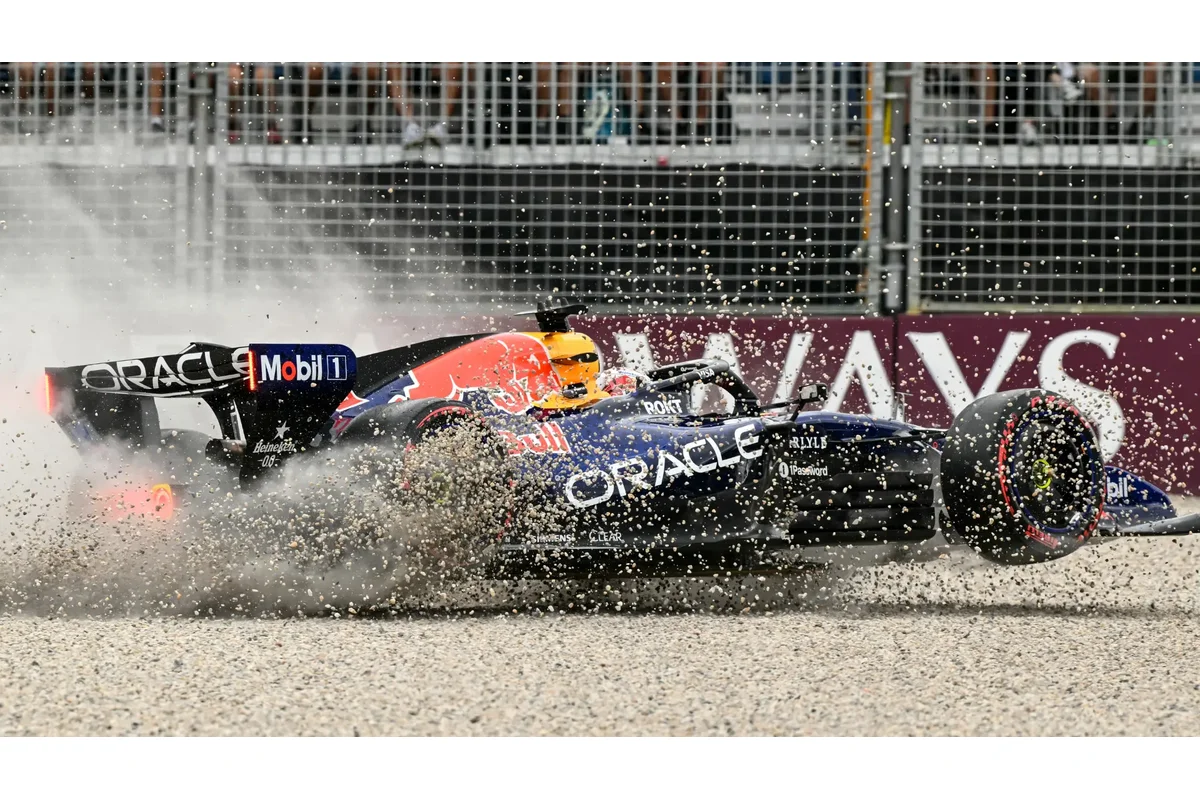
Max Verstappen’s qualifying session at the 2026 Australian Grand Prix was abruptly halted just seconds after it began when his Red Bull RB22 suddenly lost control and slammed into the Turn 1 barrier. The incident was not the result of driver mistake, brake bias issues, or mechanical failure; instead, a faulty software setting triggered an overly aggressive regenerative braking effect that immediately locked the rear wheels as Verstappen applied the brakes.
This unexpected malfunction caused a violent crash that even injured Verstappen’s wrist when he lost grip of the steering wheel. Fortunately, medical officials cleared him afterward, but the damage forced him to start the race in 20th position, a severe penalty caused by a glitch lasting only milliseconds.
Behind the Scenes of the RB22’s Sudden Lockup
The 2026 Formula 1 regulations have removed the MGU-H unit and increased the power of the MGU-K, which recovers much more electrical energy under braking. This shift has made teams heavily reliant on software to regulate the rear axle’s energy regeneration. An overly cautious or aggressive setting can either cause the car to coast or create braking effects through the rear wheels themselves.
According to Red Bull’s technical figure Pierre Wache, a flaw in the team’s software configured the regenerative setting too aggressively, resulting in the rear tires locking immediately once Verstappen lifted off the throttle and touched the brake pedal.
“I just hit the brakes and suddenly the rear axle completely locked… I’ve never experienced something like that before. The formula (for the 2026 F1 cars) is just not correct, and that is something that is a bit harder to change. But I think we need to.”
Verstappen’s own account highlights the unexpected and uncontrollable nature of the failure. At the high speeds involved, there was no chance to recover the car before impact.
Implications of Formula 1’s Energy Management Evolution
This crash exposes the challenging balance Formula 1 faces under its new 2026 hybrid regulations. While the sport promotes a move toward 50% electric power and sustainability, the complexity of these hybrid systems means drivers are now managing sophisticated software-driven energy recovery processes. These systems can dramatically affect performance and safety – either enhancing lap times or causing critical failures leading to crashes.
Moreover, the global F1 calendar demands extensive travel and equipment transport, which contrasts sharply with the sustainability narrative. Verstappen’s incident underscores that:
- The power from hybrid energy recovery can destabilize cars almost instantly.
- Software calibration is as vital as traditional mechanical tuning.
- Efforts to boost green credentials introduce complex technical challenges and potential failure points.
Red Bull’s Lost Chance at Pole Position
Red Bull’s Pierre Wache indicated that without this software malfunction, Verstappen could have been within three-tenths of George Russell’s leading qualifying time. Instead, Verstappen now faces an uphill battle starting at the very back of the grid, while his teammate Isack Hadjar secured a strong P3 start.
For Red Bull, which is already striving to keep pace with Mercedes’s early-season form, this setback delivers a significant blow as they work to maintain competitiveness in the championship fight.
https://twitter.com/SirCular_/status/2030151436328210796
