
As pre-season testing commenced in Bahrain, Mercedes team principal Toto Wolff declared that Red Bull has established itself as the pace setter in Formula 1, highlighting their advantage with the new power unit amid the sport’s major technical overhaul. Wolff’s comments came after the first test day, where McLaren’s Lando Norris recorded the fastest lap, just ahead of Red Bull’s Max Verstappen, underscoring the competitive environment as teams adapt to revamped regulations.
Insights on Red Bull’s Engine Edge from Mercedes Data
Despite Norris’s quickest time on the initial day, Wolff revealed that Mercedes telemetry indicated Red Bull’s engine delivers superior energy deployment along straight sections of the track. He noted,
“They are able to deploy far more energy on the straights than everybody else,”
emphasizing the car’s consistent performance over multiple laps rather than just a single flying lap.
Wolff further explained,
“You are speaking a second, over consecutive laps. On a single lap we have seen it before, but now we have seen it on 10 consecutive laps with the same kind of straight-line deployment.”
He concluded by stating,
“I would say that as per today, on the first official day of testing, which is always with the caveat of that, they have set the benchmark.”
Major F1 Technical Changes Affect Power Unit Performance
This season’s regulations introduce the most extensive changes seen in Formula 1’s history, affecting engines, chassis, tyres, and fuel. The 1.6-litre V6 turbo hybrid engines now balance their power output nearly equally between combustion and electrical components.
Efficiency in energy recovery and deployment has become critical due to limits on electrical energy availability. Batteries are drained and recharged almost every straight, with energy harvested under braking, engine revving through corners, early lift-off before corners, and even while at full throttle.
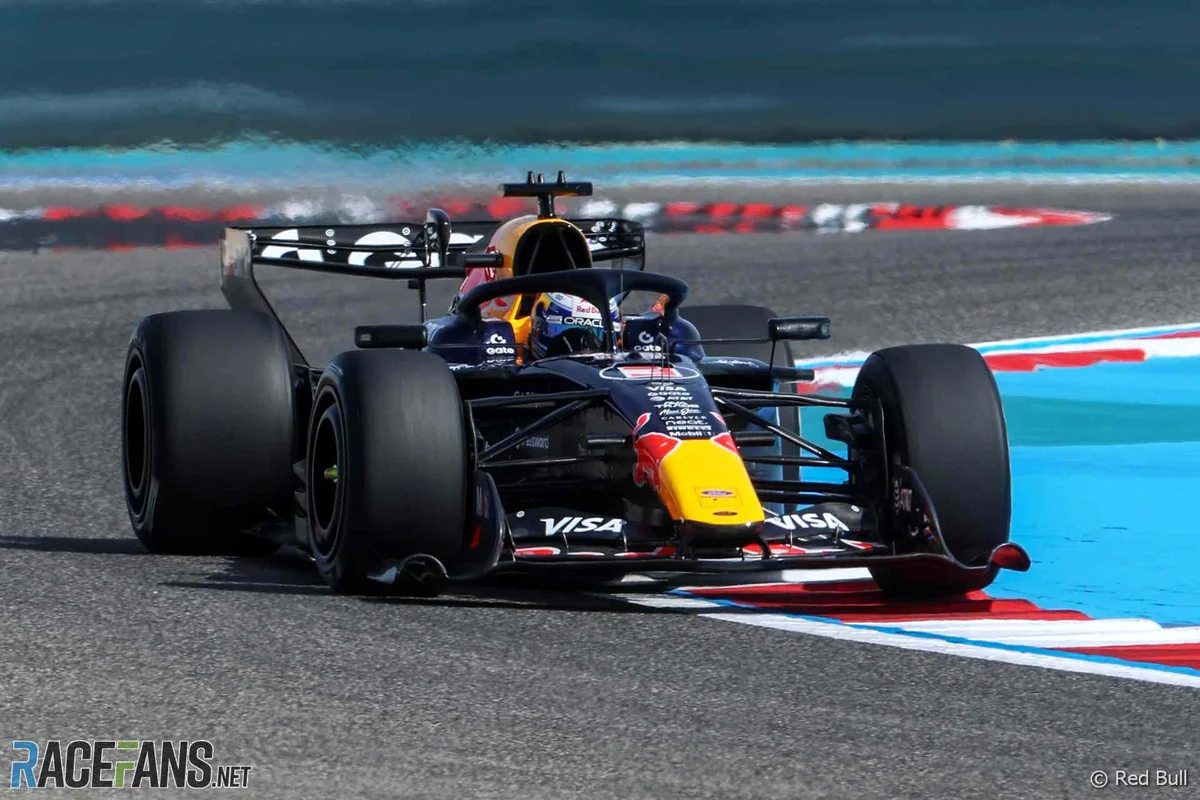
Given the importance of hybrid engine performance, any gains in how energy is utilized on straights could strongly influence overall competitiveness this year.
Day One Times Show Tight Competition Among Top Drivers
Testing lap times can be misleading, as teams’ setups and tire choices vary. Norris clocked the fastest lap on the C2 compound tires, and Verstappen was just 0.129 seconds behind on the softer C3 tires. Ferrari’s Charles Leclerc followed in third place, 0.521 seconds slower than Norris, with Haas’s Esteban Ocon fourth fastest.
While Verstappen drove Red Bull’s car throughout the day, many teams divided their running between two drivers. Aston Martin stood out by running only Lance Stroll in the first session due to an engine data issue, limiting his track time and leaving him over five seconds off the pace. Fernando Alonso was scheduled to take over the Aston Martin car later in the test.
Ongoing Engine Controversy Surrounding Mercedes Power Units
Wolff’s praise of Red Bull’s performance arrives amid a contentious debate about Mercedes’s own engines. Rival teams allege Mercedes has exploited a loophole in the engine rules, allowing them to operate above the maximum allowed compression ratio of 16:1. Although the official regulations require measurements at ambient temperature and with the engine turned off, opponents argue Mercedes’s use of advanced materials and thermal effects effectively raises the ratio during operation.
Mercedes has neither confirmed nor denied these claims but insists their engines comply with all rules. While detractors estimate this advantage could shave up to 0.3 seconds per lap, Wolff described the gain more modestly as
“a few horsepower – in England you would say a couple, which is more like two and three.”
He also acknowledged the intensifying pressure from other manufacturers, remarking,
“Lobbying from the other engine manufacturers has massively ramped up over the last few months. I mean, secret meetings, secret letters to the FIA, which obviously there is no such thing as secret in this sport.”
On accusations that Mercedes’s performance might be “embarrassing” to rivals, Wolff said,
“And I think that our colleagues from the other brands have been carried away a little bit that this could be embarrassing, which I don’t think it is at all.”
Rules Governance and the Prospect of Regulatory Changes
Regarding the possibility of mid-season rule revisions, Wolff commented,
“There is a governance process. And if that governance were to vote for an engine regulation change, you just have to take it on the chin.”
He underscored the core ethos of the sport by stating,
“The very essence of Formula 1 is to find performance, to attract the best engineers and the best people, give them freedom to develop regulations and once it goes for you and another time it goes against you.”
Williams Chief Defends Engine Compliance and Meritocratic Competition
James Vowles, Williams’s team principal and a Mercedes power unit customer, affirmed the legality of the engine in their car, describing the competition as a
“meritocracy where the best engineering outcome effectively gets rewarded as a result, not punished as a result.”
He added,
“Right now, I don’t think there is a person in the pit lane that can tell you what is the best PU. We are focused on one detail.”
Vowles expressed hope for fairness in the sport, saying,
“My hope is that sense prevails and we as a sport recognise that we are here to be a meritocracy. The best engineering solution wins as a result of it and therefore we are where we are right now.”
Comprehensive Results from First Bahrain Test Day
The fastest lap times on day one of testing at Bahrain were as follows:
- Lando Norris (McLaren, Great Britain) – 1:34.669
- Max Verstappen (Red Bull, Netherlands) – +0.129 seconds
- Charles Leclerc (Ferrari, Monaco) – +0.521 seconds
- Esteban Ocon (Haas, France) – +0.909 seconds
- Oscar Piastri (McLaren, Australia) – +0.933 seconds
- George Russell (Mercedes, Great Britain) – +1.439 seconds
- Lewis Hamilton (Ferrari, Great Britain) – +1.764 seconds
- Pierre Gasly (Alpine, France) – +2.096 seconds
- Nico Hulkenberg (Audi, Germany) – +2.192 seconds
- Alex Albon (Williams, Thailand) – +2.768 seconds
- Kimi Antonelli (Mercedes, Italy) – +2.960 seconds
- Arvid Lindblad (Racing Bulls, Great Britain) – +3.276 seconds
- Carlos Sainz (Williams, Spain) – +3.552 seconds
- Sergio Perez (Cadillac, Mexico) – +4.159 seconds
- Gabriel Bortoleto (Audi, Brazil) – +4.481 seconds
- Valtteri Bottas (Cadillac, Finland) – +4.202 seconds
- Lance Stroll (Aston Martin, Canada) – +5.214 seconds
- Franco Colapinto (Alpine, Argentina) – +5.661 seconds
Drivers who did not participate on Wednesday included Isack Hadjar (Red Bull, France), Fernando Alonso (Aston Martin, Spain), Liam Lawson (Racing Bulls, New Zealand), and Oliver Bearman (Haas, Great Britain).
Implications for the 2024 Formula 1 Season
Red Bull’s clear advantage in energy deployment and consistency sets a high bar for competitors as the 2024 Formula 1 season approaches. With power units, chassis, and tyre regulations dramatically changed, teams will face the challenge of optimizing every technical aspect to gain crucial tenths of a second. The ongoing scrutiny over engine legality, particularly concerning Mercedes’s innovations, adds tension to an already intense championship battle. How the FIA and teams navigate these controversies may influence rule enforcement and competitive balance in the months ahead.
